Qnity to buy Meridian’s electronics business for $840 million in cash
The deal adds optical adhesives and thermal management to Qnity’s fastest-growing unit and is expected to lift adjusted margins and earnings per share at once.
4 min read
Qnity Electronics agreed on November 23 to buy the electronics business of Meridian Adhesives Group for $840 million in cash, adding optical adhesives and thermal management to its fastest-growing segment.[1]
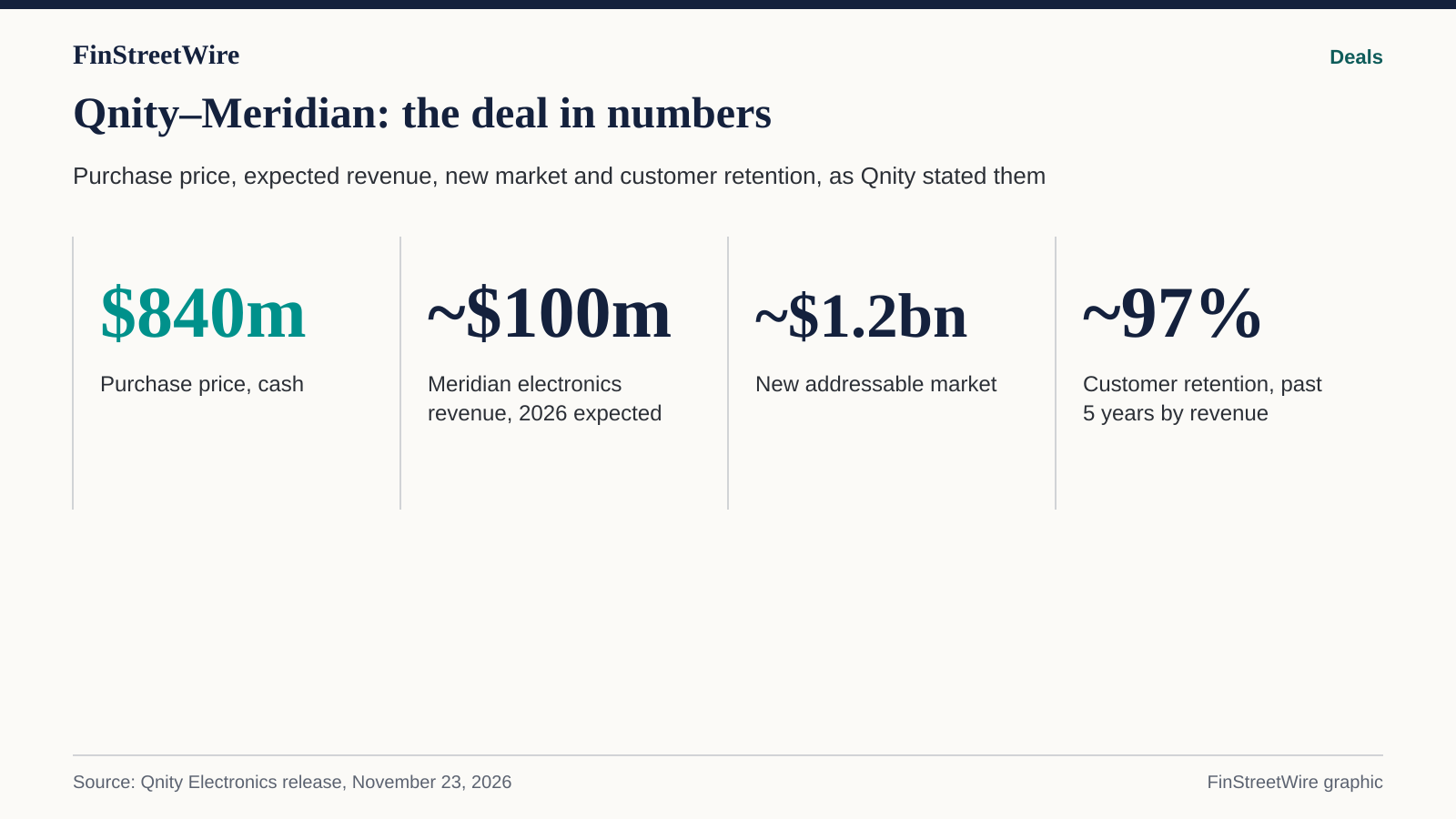
The price is 8.4 times the roughly $100 million of revenue Meridian’s electronics business is expected to record in 2026, by our calculation. That multiple reflects what Qnity is buying beyond the revenue: a position in optical connectivity and cooling for AI systems, where packaging is getting more complex and the materials that move data and shed heat matter more.[1]
Qnity announced the definitive agreement in a release on November 23. The business will sit in its Interconnect Solutions segment, which Qnity describes as its fastest-growing platform, and will strengthen two of that segment’s core growth areas: thermal management and advanced packaging.[1]
What the $840 million buys
Meridian’s electronics business makes epoxy-based adhesives in three kinds: optical-grade, electrically conductive and thermally conductive. Those materials hold together the parts of a system that carry high-speed data and manage heat, and Qnity said they enable faster transmission, more efficient cooling and more reliable performance.[1]
The end markets are the ones Qnity wants more exposure to. Most of Meridian electronics’ revenue comes from AI data centers, semiconductor equipment and aerospace and defense, Qnity said. The business also brings a design-in model: its products are specified into a customer’s design, which produces repeat orders, and Qnity cites customer retention of about 97% over the past five years, measured by revenue.[1]
| Term | Detail |
|---|---|
| Purchase price | $840 million |
| Consideration | Cash: cash on hand plus borrowings under Qnity’s revolving credit facility |
| Target revenue, 2026 expected | About $100 million |
| Target revenue growth, 2027 | Double digits, expected |
| New addressable market | About $1.2 billion, growing double digits a year |
| Expected close | First quarter of 2027 |
| Conditions | Hart-Scott-Rodino waiting period and customary closing conditions |
| Accretion | Accretive from the start to adjusted gross margin, adjusted EBITDA margin and adjusted EPS, Qnity expects |
| Advisors to Qnity | Piper Sandler (financial); Paul, Weiss (legal) |
| Advisors to Meridian | J.P. Morgan and Citi (financial); Weil, Gotshal and Benesch (legal) |
Source: Qnity Electronics release, November 23, 2026. Revenue and market figures are the company’s expectations, not audited results.
Why optical adhesives and cooling matter now
Qnity’s argument is that AI is changing how chips are packaged and connected. As systems move toward optical links between chips and toward denser stacking, the adhesives that bond optical components and the materials that draw heat away become part of the performance of the system, not an afterthought. That is the shift chief executive Jon Kemp pointed to when he described the industry moving to new architectures and designs.[1]
“Our disciplined M&A strategy is focused on high-value technologies critical to enabling next-generation semiconductor applications.”
The deal is a bolt-on, not a transformation. At about $100 million of expected 2026 revenue, Meridian electronics is small next to Qnity, and the $1.2 billion market Qnity cites is the new ground the deal opens rather than the business’s current sales. The test will be whether the optical and thermal capabilities win designs inside Qnity’s existing customer base, which is where the growth Qnity promises has to come from.[1]
Qnity is paying in cash, in contrast to CrowdStrike’s $43.9 billion all-stock deal for Zscaler, where shareholders receive shares rather than cash. Sanofi’s $41 billion acquisition of Insmed, at $175 a share in cash, shows the same preference for cash consideration in large deals this year.[1]
What to expect
- Expiry of the Hart-Scott-Rodino waiting period, the main regulatory step before the deal can close.
- Close in the first quarter of 2027, after which Meridian electronics becomes part of Qnity’s Interconnect Solutions segment.
- Qnity’s first results to include the business, which will show whether the double-digit 2027 growth it expects is materializing.
- Any update on how much of the $840 million was funded by borrowings, which Qnity has not yet split out from cash on hand.
“Joining Qnity represents an exciting next chapter of growth for our business as we combine our capabilities and expertise to meet our customers’ evolving needs and deliver even greater value.”
Questions readers ask
- Why is Qnity paying $840 million for a business with about $100 million of revenue?
- The price is 8.4 times expected 2026 revenue, by our calculation. Qnity is paying for capabilities in optical adhesives and thermal management, access to a roughly $1.2 billion market growing double digits, and a customer base it says it has retained at about 97% over five years.[1]
- When will the deal close?
- Qnity expects the deal to close in the first quarter of 2027, once the Hart-Scott-Rodino waiting period has expired and customary closing conditions are met.[1]
- What does Meridian’s electronics business make?
- Epoxy-based adhesives in optical-grade, electrically conductive and thermally conductive forms. They are used where high-speed data has to move reliably and heat has to be managed, including AI data centers, semiconductor equipment and aerospace and defense.[1]
Sources
- Qnity to Acquire Meridian’s Electronics Business, Expands Advanced Packaging and Thermal Management Capabilities. Qnity Electronics, Deal terms, transaction highlights, advisors, CEO and Meridian quotes; release dated November 23, 2026. Accessed .
Corrections
- : Key Takeaways correction: one bullet restored a dropped attribution, and another was reworded to avoid phrasing copied from the source. No facts, figures or body text changed.