December hike priced at 98% — the Fed question has moved to January
Three prints in two weeks — GDP at 4.3%, PCE at 3.8% and core prices up 0.3% a month — have settled December. January is where the path is decided.
7 min read
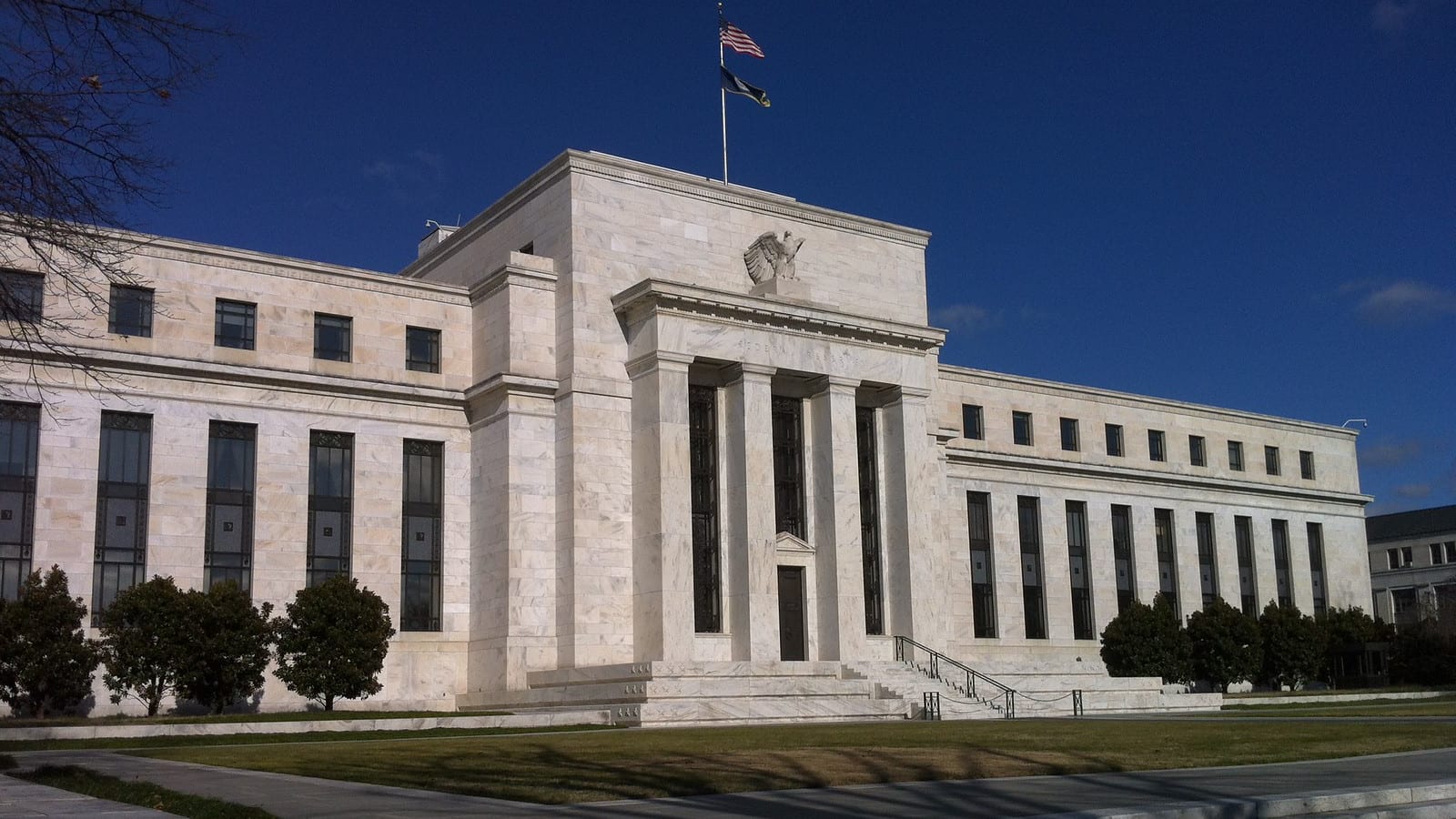
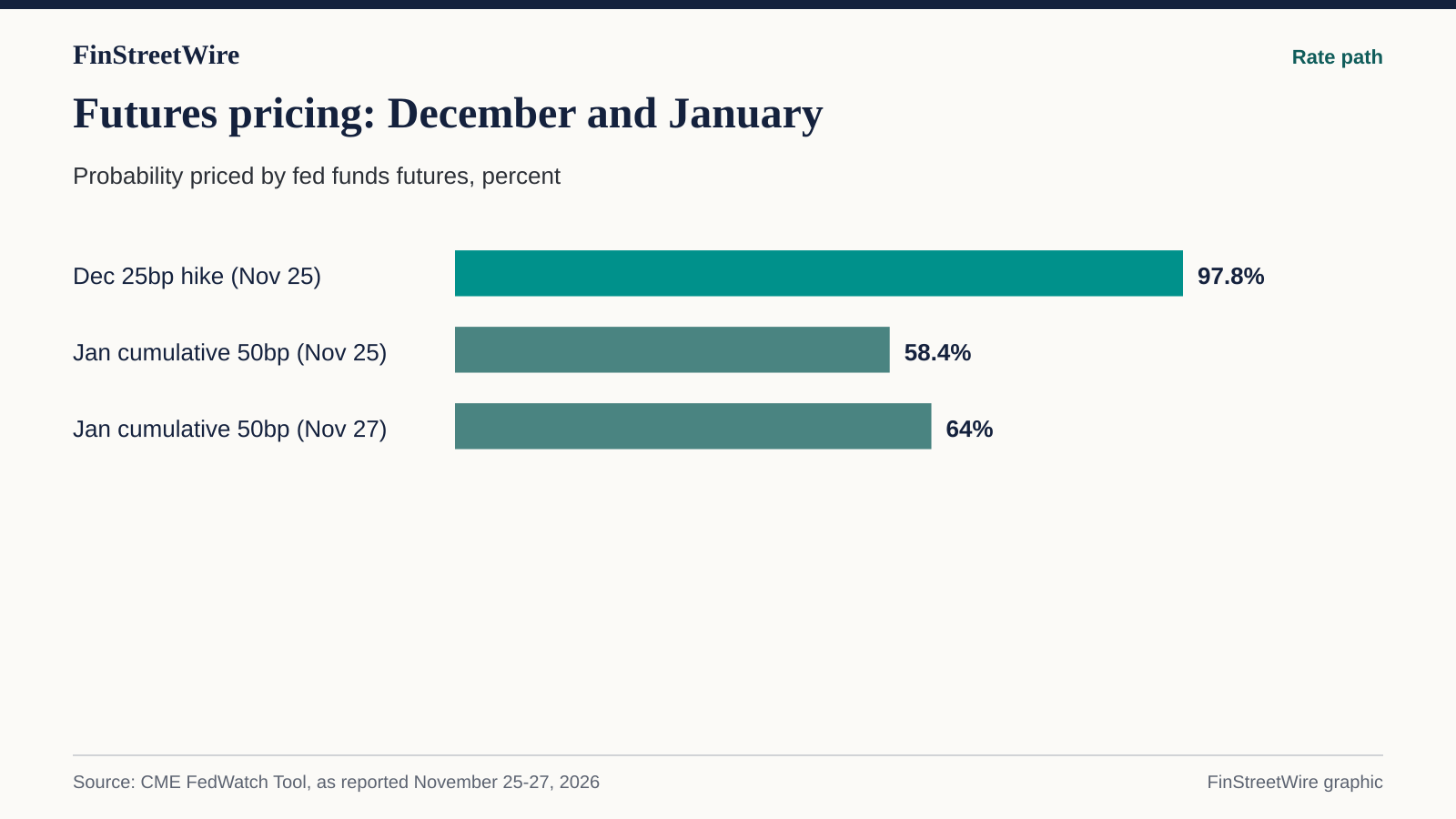
Futures markets have settled the Federal Reserve's December decision before it is made. A quarter-point rate rise on December 9 is priced at about 98%, and the argument has moved to whether the Fed follows it with another in January.[8][9][13]
The shift follows three data releases in two weeks. Growth came in stronger than first thought, inflation on the Fed's preferred gauge moved further from its 2% target, and the monthly pace of underlying prices held at 0.3% for a third month. Together they turned a debate about the size of December's move into a question about how far the tightening goes.[1][2][4]
Our read: December is now about confirmation, not decision. The market's attention — and the risk for borrowers and investors — sits with January, where the odds of a second hike are close to a coin flip.[7]
How three prints settled December
The first print was growth. The Bureau of Economic Analysis raised its estimate of third-quarter GDP to 4.3% a year, up from 3.4% in the advance estimate, with private demand — the spending of households and businesses, excluding trade, inventories and government — up 5.8%. The second was prices. The Fed's preferred gauge, the personal consumption expenditures index, rose 3.8% in the year to October, with the core measure at 3.3%, both higher than September. Both the headline and core gauges rose 0.3% on the month, a pace that compounds to roughly 3.7% a year, by our calculation. The third was the monthly pace of consumer prices: the core index rose 0.3% in October, the third month in a row at that rate, and the headline index rose 0.4%.[1][2][4]
| Release | What it showed | Previous reading |
|---|---|---|
| GDP, third quarter (Nov 25) | 4.3% a year, revised up from 3.4% | 2.2% in the second quarter |
| PCE inflation, October (Nov 25) | Headline 3.8% from a year earlier; core 3.3% | September: 3.6% and 3.1% |
| CPI, October (Nov 10) | Headline up 0.4% on the month; core up 0.3% | September: 0.6% and 0.3% |
Source: Bureau of Economic Analysis and Bureau of Labor Statistics releases. GDP and PCE released November 25; CPI released November 10.
The market's reaction was fast. The half-point December case, which the CME's own feed had put at 14% on November 10 and at about 10% in mid-November, now carries effectively no chance. The quarter-point move hardened to 97.8% on November 25, 97.5% on November 26 and about 99% on November 27, and the chance of any rise at all is effectively 100%.[7][8][9][13][14]
The 50-point argument is gone
The clearest sign of the change is what happened to the half-point case. It was never the market's base case — the quarter-point move held the money throughout — but it was a live argument, pushed hardest by Governor Christopher Waller, who said the Fed should move by 50 basis points in December unless it could credibly signal a quarter-point rise followed by another in January. Futures now assign it essentially no chance.[10][14]
“My view is then you have to go 50 in December to put it in place and get it done.”
Waller's framing is the reason January matters so much. His condition for the smaller December move was a credible signal that another rise follows in January. Our earlier report framed the December decision as a choice between 25 and 50 basis points; the pricing since has settled it. The Fed's chair, Kevin Warsh, has refused to offer explicit guidance on the future path of policy, preferring to let incoming data set it. That leaves January to be decided meeting by meeting — and priced meeting by meeting.[11][15]
“We will deliver price stability. No ifs, ands, or buts.”
Why January is now the live meeting
The pricing tells the story. After the November 25 data, futures gave a 58.4% chance that the target range would be 50 basis points higher by the January 27 meeting — that is, a second quarter-point rise on top of December's. By November 27 the chance had risen to 64%. The same tool also gives just above 58% to the funds rate reaching 4.50%-4.75% or higher by the June 9, 2027 meeting.[7][9]
Banks are reading it the same way. J.P. Morgan forecast on November 19 that the Fed would raise rates by a quarter point at each of the January and March 2027 meetings, on top of December's. LSEG data put the market's total at 71 basis points of rises through the middle of 2027 — roughly three quarter-point moves.[13]
The calendar gives the story its dates. The December meeting runs December 8-9, with the decision at 2 p.m. Eastern on December 9 and fresh economic projections alongside it. The January meeting runs January 26-27, with the decision on January 27. Between the two sits the November inflation report, due December 10 — the morning after the December decision.[4][5]
What a second hike would mean
For borrowers, the mechanics are direct. Credit-card rates and home-equity lines of credit move with the prime rate, which follows the federal funds rate almost step for step, so a second rise would lift the cost of variable-rate debt again within weeks. Mortgage rates are different: they track the 10-year Treasury yield more than the overnight rate, so they respond to what the market expects the Fed to do over years, not to a single meeting.[12]
For savers, the same move cuts the other way. Deposit and money-market rates tend to rise with the funds rate, though banks pass the increase on slowly and unevenly, so cash holdings earn more while borrowing costs more.[12]
For equities, the channel is valuation. Higher rates raise the discount applied to future earnings, which bites hardest on growth companies whose profits sit furthest in the future. It also raises the cost of the debt many artificial-intelligence companies have used to fund data-centre construction. The market has already begun to price it: the Nasdaq posted its worst weekly loss since March 2020 in the week the half-point December bet collapsed.[7][14]
What could go wrong
The pricing is a market judgement, not a promise. Futures record what traders will pay for, and they have been wrong before: the same tool put the December hike at about 71% in early November, and it moved between 97.5% and about 99% in the days around the PCE release. Two data points could move January's odds sharply: the November inflation report on December 10 and the third estimate of third-quarter GDP, with November's income and spending figures, on December 23. A soft reading on either would cut the January odds; a hot one would push them toward certainty.[8][9][11][13]
- December 9, 2 p.m. Eastern: the decision, the statement and new projections, including officials' rate expectations.
- December 10, 8:30 a.m. Eastern: November CPI — did October's monthly pace hold?
- December 23: third estimate of third-quarter GDP, with November income and spending — the last data before January.
- January 26-27: the next meeting, where a second quarter-point rise is now priced at close to two-in-three.
Questions readers ask
- Is a December hike certain?
- No. Futures put a quarter-point rise at about 98%, and the chance of any rise at effectively 100% — but that is market pricing, not a decision. The Fed votes on December 9, and it can still hold.[7][9]
- What would a January hike take rates to?
- A quarter-point rise in December would take the target range to 4.00%-4.25%. A second in January would take it to 4.25%-4.50%. By our calculation, that is 50 basis points above where the range sits today.[12]
- Why did the debate change from 25 or 50 to just 25?
- The half-point case rested on inflation staying hot and on Governor Waller's argument that the Fed should move decisively. After three prints — strong growth, PCE at 3.8% and steady core prices — the market judged a quarter point enough for December and moved the argument to January instead.[1][2][4][10]
Sources
- GDP (Second Estimate) and Corporate Profits, 3rd Quarter 2026. U.S. Bureau of Economic Analysis, Real GDP 4.3% annual rate, revised up 0.9 point from 3.4%; real final sales to private domestic purchasers 5.8%; real GDI 4.4%; corporate profits up $206.0 billion; next release December 23. Accessed .
- Personal Income and Outlays, October 2026. U.S. Bureau of Economic Analysis, PCE price index up 3.8% from a year ago, core up 3.3%; both up 0.3% on the month; personal income up 0.7%; real PCE down $5.8 billion; saving rate 4.1%. Accessed .
- Personal Income and Outlays, September 2026. U.S. Bureau of Economic Analysis, September year-over-year PCE 3.6%, core 3.1%. Accessed .
- Consumer Price Index — October 2026. U.S. Bureau of Labor Statistics, CPI-U up 0.4% in October after 0.6% in September; core up 0.3% for a third straight month; shelter up 0.3%, over 30% of the monthly rise; November release due December 10. Accessed .
- Meeting calendars and information. Board of Governors of the Federal Reserve System, 2026 FOMC meetings: December 8-9 with projections; 2027 meetings: January 26-27, March 16-17, April 27-28, June 8-9. Accessed .
- CME FedWatch Tool. CME Group, Probabilities derived from 30-day federal funds futures prices; readings for the December and January meetings as reported November 25-27. Accessed .
- The Latest Interest Rate Forecast Is In, and It Spells Trouble for a Historically Expensive AI-Driven Bull Market. The Motley Fool, 100% chance of a December hike; 64% chance of at least 50bp by Jan 27, 2027; just above 58% for at least 4.50%-4.75% by June 9, 2027; CME's November 10 post put the 50bp December hike at 14%. Accessed .
- Gold struggles for traction as Fed rate hike bets dominate sentiment. FXStreet, 97.5% chance of a 25bp December hike; around a 60% probability of another increase in January. Accessed .
- CME Fed Watch: Probability of a 25 basis point rate hike in December is 97.8%. Odaily, After the PCE release: December 25bp hike 97.8%, hold 2.2%; January 25bp 40.7%, cumulative 50bp 58.4%. Accessed .
- Fed's Waller: Have to Be a Little More Aggressive With Rate Hikes. Morningstar (Dow Jones Newswires), Waller: Fed should raise 50bp in December unless it can credibly signal a quarter-point hike followed by another in January; Waller quotes from CNBC Squawk Box. Accessed .
- Kevin Warsh Offered a Warning on Inflation. Here's What History Says Is Coming Next.. The Motley Fool, Warsh at the October 29 press conference: 'We will deliver price stability. No ifs, ands, or buts.'; FedWatch put the December hike at 70.9% in early November. Accessed .
- Federal Reserve issues FOMC statement. Board of Governors of the Federal Reserve System, Held the target range at 3.75%-4.00% in a 10-2 vote; Lisa D. Cook and Beth M. Hammack preferred a quarter-point hike; September 16 hike set the range. Accessed .
- Market prices in 71 basis points of Fed hikes through mid-2027, J.P. Morgan sees rates at 4.50-4.75%. DeepsFinance, CME FedWatch as of November 27: 99% December hike, 64% January hike; LSEG: 71bp priced through mid-2027; J.P. Morgan November 19 forecast: 25bp hikes in January and March 2027. Accessed .
- Wall Street's Slide Erases Bets on Half-Point Fed Hike in December. Biggo Finance, 50bp December hike now effectively zero, down from about 10% ten days earlier; Nasdaq worst weekly loss since March 2020; futures imply nearly 60% chance of a January hike. Accessed .
- Fed holds fire as Warsh telegraphs more hikes without saying it. The Japan Times (Bloomberg), Warsh left the Fed on track to raise rates again this year while sticking to his refusal to offer explicit guidance on the future path of policy. Accessed .