The Fed goes silent: blackout opens ahead of the December meeting with a hike all but priced in
Officials cannot speak publicly until December 10, leaving markets to trade on the October minutes and futures pricing before the December 8-9 meeting.
5 min read
The Federal Reserve's communications blackout began at 12:00 a.m. ET on Saturday, November 28, silencing Federal Open Market Committee (FOMC) participants until 11:59 p.m. ET on Thursday, December 10, ahead of the December 8-9 meeting.[2][3]
With officials silent until December 10, the market must price the December decision from the October minutes and futures alone. A 25-basis-point hike is already the base case in futures pricing, so Treasury yields and the dollar are more likely to move on the new Summary of Economic Projections than on the rate decision itself, unless the projections undercut the case for further tightening.[4]
Our read: the blackout does not change the December outcome, but it raises the stakes of the projections, because they are the only new signal the meeting will produce.[4]
What the blackout covers
The rule is mechanical. Under the FOMC's policy on external communications, the blackout begins at 12:00 a.m. Eastern Time on the second Saturday before a meeting and ends at 11:59 p.m. Eastern Time on the day after it. The December meeting starts on Tuesday, December 8, so the blackout began on Saturday, November 28, ten days earlier, and ends on Thursday, December 10, the day after the meeting closes.[2][3]
It binds Committee participants, the Board members and the Reserve Bank presidents. During the blackout they refrain from communications on monetary policy with the public, so no official can preview, explain or walk back the December decision before it is made.[2]
| Meeting | Blackout window | Outcome or what is due |
|---|---|---|
| October 27-28, 2026 | October 17-29 | Rate held at 3.75% to 4.00%, 10-2 vote |
| December 8-9, 2026 | November 28 - December 10 | Decision and new projections due December 9 |
Blackout windows are from the Federal Reserve Bank of St. Louis; meeting dates and the October outcome are from the Federal Reserve. Source: Federal Reserve Bank of St. Louis blackout calendar; FOMC minutes of October 27-28, 2026.
What the October minutes said
The minutes of the October 27-28 meeting, released on November 18, show a Committee that left the policy rate unchanged on a 10-2 vote, holding the target range at 3.75% to 4.00%. Voting against were Lisa D. Cook and Beth M. Hammack, who wanted a quarter-point increase at that meeting instead. The dissent is the clearest signal in the minutes that the December meeting is live.[4]
“Some participants favored an increase of 25 basis points in the target range at this meeting, emphasizing that inflation had remained too high and that they saw few signs of it abating.”
The minutes also record that almost all participants judged further action to raise the target range would likely be appropriate under their baseline outlooks for inflation and the labor market, broadly consistent with the September Summary of Economic Projections. That language is the reason the December meeting is framed as a question of how much tightening comes next, not whether the direction has changed.[4]
The staff estimates behind that judgment put PCE inflation, the Fed's preferred gauge, at 3.6% in September, boosted by a rapid increase in consumer energy prices, with core PCE price inflation at 3.1%. Both were higher than a year earlier, which the staff attributed largely to earlier tariff increases, higher energy prices and upward pressure on consumer goods prices linked to the AI buildout. The unemployment rate edged up to 4.2% in September, and hiring averaged roughly 50,000 jobs a month over the three months to September.[4]
What markets expect
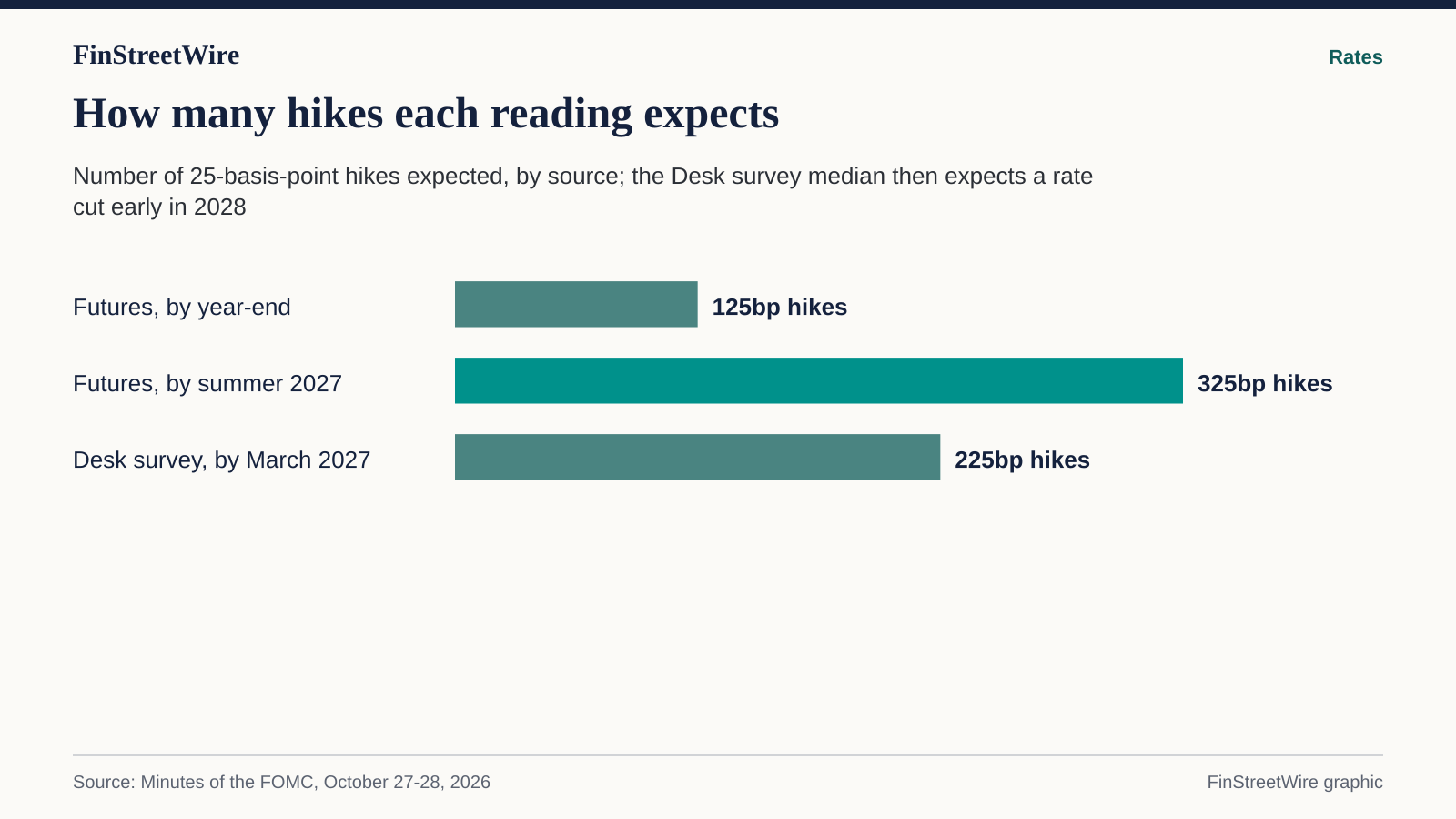
The base case is a 25-basis-point hike in December. Futures pricing points to a rise by year-end, with two further increases by the summer of 2027, according to the minutes' account of the rates path. A hike of that size would lift the target range to 4.00% to 4.25%, by our calculation, from 3.75% to 4.00% today.[4]
The Open Market Desk Survey of Market Expectations (Desk survey) tells a cooler story. Its median participant expects one rise in December and a second in March 2027, with a cut to follow early in 2028. The minutes note that term premiums in market prices may explain the gap between the two paths, and the Desk survey's median longer-run nominal rate rose to about 3.4%. The alternative to the base case, then, is not no hike in December but a shorter tightening cycle: two hikes, then a cut, rather than the three hikes futures imply by the summer of 2027.[4]
What could be wrong
Two readings of the same outlook already disagree on how many hikes follow December, so neither should be treated as a forecast. If inflation proves stickier than the staff estimates, and some participants saw few signs of it abating, the Committee could move more than futures imply. If the labor market softens instead, with unemployment already at 4.2% and payroll growth near 50,000 a month, the case for further hikes fades. The minutes also flag a wilder card: rapid growth in debt tied to the AI buildout, including off-balance-sheet leasing and circular financing among AI firms, which participants said could amplify losses if returns on AI investment disappoint.[4]
What to watch
- The December 8-9 meeting: the decision and the new Summary of Economic Projections are due December 9, with the Chair's press conference the same day.
- The blackout ends at 11:59 p.m. ET on Thursday, December 10, when FOMC participants can speak publicly again.
- The minutes of the December meeting, due about three weeks later, for the debate behind the decision.
- Inflation and jobs data released before December 8, which are now the only inputs that can move the December call.
Questions readers ask
- What is the Fed's blackout period?
- It is the period before each FOMC meeting when Committee participants refrain from public communications on monetary policy. It begins at 12:00 a.m. ET on the second Saturday before a meeting and ends at 11:59 p.m. ET on the day after it.[2][3]
- When does the current blackout end?
- At 11:59 p.m. ET on Thursday, December 10, 2026, the day after the December 8-9 meeting ends.[3]
- Will the Fed raise rates in December?
- The decision has not been made. Futures pricing points to a 25-basis-point rise by year-end, and the Desk survey median expects one rise in December and a second in March 2027, with a cut to follow early in 2028.[4]
Sources
- FOMC Calendars. Federal Reserve, December 8-9 meeting, marked as associated with a Summary of Economic Projections; October 27-28 minutes released November 18, 2026. Accessed .
- FOMC Policy on External Communications of Committee Participants. Federal Reserve, Blackout begins 12:00 a.m. Eastern Time the second Saturday before a meeting and ends 11:59 p.m. Eastern Time the day after a meeting; applies to Committee participants. Accessed .
- Fed Blackout Periods: Meaning & Key Dates. Federal Reserve Bank of St. Louis, 2026 blackout periods, including Saturday, November 28 – Thursday, December 10; blackouts begin the second Saturday preceding a meeting and end the Thursday following it. Accessed .
- Minutes of the Federal Open Market Committee, October 27-28, 2026. Federal Reserve, Target range held at 3-3/4 to 4 percent, 10-2; dissenters Cook and Hammack preferred +25bp; 'some participants favored an increase of 25 basis points'; 'almost all participants judged' further action to raise likely appropriate; futures imply high probabilities of 25bp hike by year-end and two more by summer 2027; Desk survey median one hike December, another March 2027, then a cut early 2028; longer-run nominal rate about 3.4%; staff estimates PCE 3.6% September, core PCE 3.1%, unemployment 4.2%, payrolls about 50,000 per month over three months to September. Accessed .