Goldman sees more dollar gains, then a 2027 dip; the call rests on Fed rate pricing, not the balance sheet
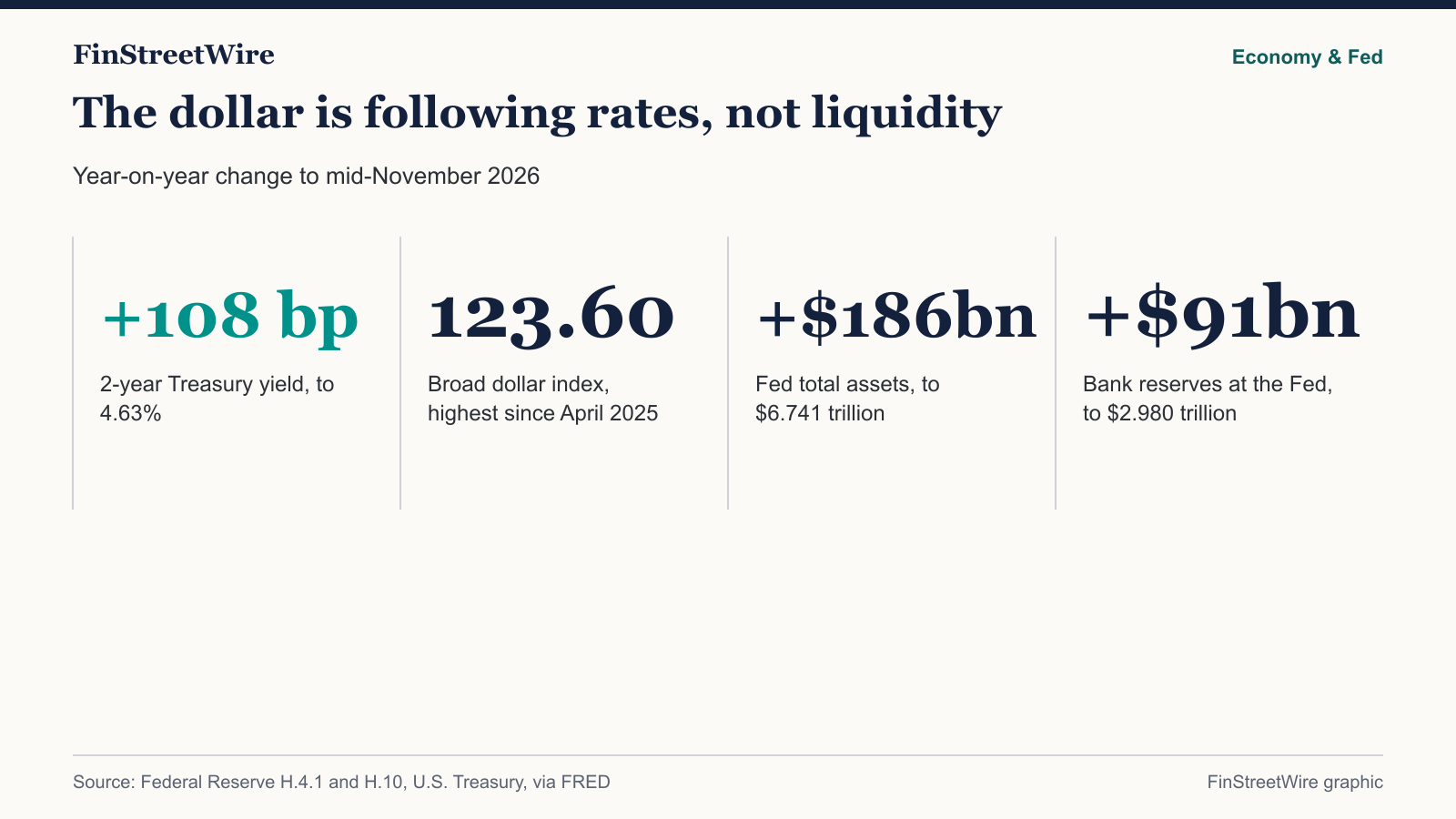
The broad dollar is at a 19-month high while the Fed's balance sheet is larger than a year ago. The 2-year Treasury yield, not liquidity, is doing the work.
4 min read
Goldman Sachs expects the dollar to keep strengthening for a few more months before easing modestly next year. Kamakshya Trivedi, the bank's global head of foreign-exchange and interest-rate forecasts, made the case on Bloomberg Television on Monday, Nov. 23, as reported by Investing.com.[1]
For US investors the call is mainly about the Fed. If markets keep pricing more rate increases, a stronger dollar would continue to weigh on unhedged foreign holdings and on multinational earnings translated back into dollars. If that pricing fades, the 2027 dip Goldman describes becomes the base case. The trigger is the rate path, not a shortage of dollars.[1][3]
Our read: the dollar is trading on the price of money, and the Fed's own data show the quantity of money is not the constraint.[2][3][4]
What Goldman said
“When you are seeing interest-rate driven tightening in financial conditions, the dollar tends to do well against that.”
Trivedi said the dollar "still has some fight in it" and would "weaken modestly" next year, arguing that market pricing already assumes more Fed tightening than will happen, according to the Investing.com report. He also expects the euro to fall to $1.08 over the next three months. Investing.com reported that traders price about 70 basis points of Fed increases through September 2027.[1]
The call is a turn from January. A Bloomberg video on Jan. 19, 2026, carried the headline that Goldman saw further dollar weakening on a tariff threat. The broad index then sat near 120 and fell to its 2026 low of 117.44 ten days later. It has since climbed 5.2%.[6][2]
The rate side: a 2-year yield above the Fed's ceiling
The Fed raised its target range to 3.75% to 4% in September, its first increase since 2023, and held on Oct. 28 by a 10-2 vote, with both dissenters favoring a hike. Governor Christopher Waller said on Nov. 10 that a half-point move should be considered in December if October inflation matched the previous two months.[5][7]
The 2-year Treasury yield, the market's best read of the next two years of policy, was 4.63% on Nov. 20. That is 108 basis points higher than a year earlier, and 63 basis points above the top of the target range. It peaked at 4.92% on Sept. 28.[3]
Show the data as a table
| Item | % |
|---|---|
| Jan | 3.5 |
| Feb | 3.4 |
| Mar | 3.8 |
| Apr | 3.9 |
| May | 4.0 |
| Jun | 4.1 |
| Jul | 4.3 |
| Aug | 4.3 |
| Sep | 4.9 |
| Oct | 4.6 |
| Nov 20 | 4.6 |
Last trading day of each month; November is Nov. 20. Source: U.S. Treasury via FRED (DGS2).
The quantity side: the balance sheet is growing
A dollar squeeze driven by a shrinking Fed would show up in the H.4.1 release. It does not. Total assets were $6.741 trillion in the week to Nov. 18, up from $6.555 trillion a year earlier. Treasury bill holdings rose by $385 billion while mortgage-backed securities ran off by $186 billion.[4]
Reserve balances, the cash banks hold at the Fed, were $2.980 trillion, up $91 billion over the year. More reserves and a stronger dollar have arrived together, so the dollar's gains are not explained by scarce liquidity.[4]
| Measure | Nov. 2025 | Nov. 2026 | Change |
|---|---|---|---|
| Fed total assets ($bn) | 6,555.3 | 6,741.5 | +186.2 |
| Treasury bills held ($bn) | 195.5 | 580.7 | +385.2 |
| Mortgage-backed securities ($bn) | 2,069.9 | 1,883.5 | -186.4 |
| Reserve balances ($bn) | 2,888.6 | 2,979.7 | +91.0 |
| 2-year Treasury yield (%) | 3.55 | 4.63 | +108 bp |
| Nominal broad dollar index | 121.69 | 123.60 | +1.6% |
Balance sheet: weeks ending Nov. 19, 2025 and Nov. 18, 2026 (H.4.1). Market data: Nov. 20, 2025 and Nov. 20, 2026. Changes are our calculation. Sources: Federal Reserve H.4.1 and H.10 releases, U.S. Treasury, via FRED.
What could go wrong with the call
Goldman's 2027 view needs three things to happen. Inflation must fall back toward 2% as energy prices ease, as Trivedi argues. The roughly 70 basis points of increases priced into futures must not be fully delivered. And capital must then flow out of dollar assets.[1]
Still, each step has a counter-signal in the data. Cook said on Nov. 20 that financial conditions were "too accommodative" and warned that standing pat risks falling behind. The euro was already at $1.0981 on Nov. 20, close to the $1.08 Goldman sees. If the dollar weakens because the Fed is responding to market stress, that would likely arrive alongside wider credit spreads, not easier conditions.[7][8][2]
The next test is the Dec. 8-9 FOMC meeting, which brings new projections for the policy rate through 2027. The H.4.1 balance-sheet release is published each Thursday.[5][4]
Sources
- Goldman Sachs sees US dollar rally continuing before a pullback in 2027. Investing.com (Vlad Schepkov), Report of Trivedi's Bloomberg TV interview. Accessed .
- Nominal Broad U.S. Dollar Index (DTWEXBGS); U.S. dollars to euro (DEXUSEU). Federal Reserve Board H.10 via FRED, Daily, Dec. 2024-Nov. 20, 2026. Accessed .
- Market Yield on U.S. Treasury Securities at 2-Year Constant Maturity (DGS2). U.S. Treasury / Federal Reserve H.15 via FRED, Daily, 2025-Nov. 20, 2026. Accessed .
- Factors Affecting Reserve Balances (H.4.1): WALCL, WSHOBL, WSHOMCB, WRESBAL. Federal Reserve Board via FRED, Weeks ending Nov. 19, 2025 and Nov. 18, 2026; FRED series WALCL, WSHOBL, WSHOMCB, WRESBAL. Accessed .
- FOMC statement, Oct. 28, 2026, and meeting calendars. Federal Reserve Board, Statement, vote; /monetarypolicy/fomccalendars.htm. Accessed .
- Goldman Sees Further Dollar Weakening on Tariffs Threat (video). Bloomberg, Headline. Accessed .
- The Economic Outlook and Some Thoughts on Labor Market Dynamism (Waller); The U.S. Economy in Global Context (Cook). Federal Reserve Board, Waller, Nov. 10, London; Cook, Nov. 20, Santiago (/newsevents/speech/cook20261120a.htm). Accessed .
- The U.S. Economy in Global Context (speech by Governor Lisa D. Cook). Federal Reserve Board, XXIX Annual Conference of the Central Bank of Chile. Accessed .