US jobless claims fall to 189,000, but the holiday-week seasonal adjustment did much of the work
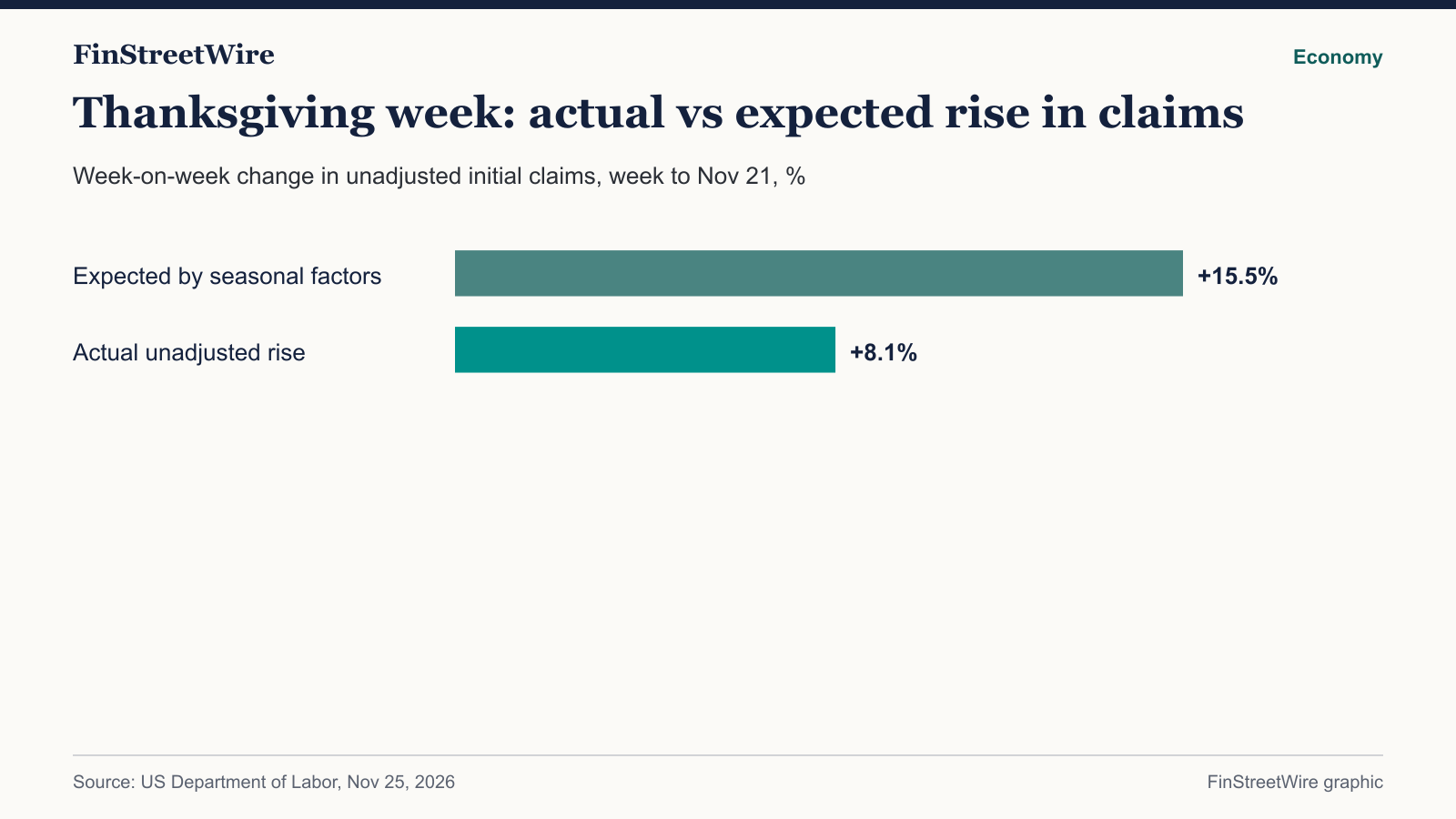
Unadjusted claims rose 8.1% in the week to November 21, about half the rise the seasonal factors expected. Insured unemployment also fell.
3 min read

Fewer Americans filed new claims for unemployment benefits in the week before Thanksgiving. Seasonally adjusted initial claims fell by 13,000 to 189,000 in the week ending November 21, the Labor Department reported on Wednesday, November 25, a day earlier than usual because of the holiday. The prior week was revised down by 1,000 to 202,000.[1]
Initial claims are the most timely official measure of layoffs: they count people filing for the first time after losing a job. A reading below 200,000 is low by historical standards and points to employers holding on to staff.[1]
Read the holiday adjustment with care
The drop is partly a statistical effect. Before seasonal adjustment, claims actually rose by 15,894, or 8.1%, to 212,945. Claims normally jump in the week before Thanksgiving as some seasonal work ends, and the seasonal factors had expected a 30,549 increase, or 15.5%. Because the real rise was only about half that, the adjusted figure fell. Holiday weeks are among the hardest for seasonal adjustment, so a single week's move carries less information than usual.[1]
The four-week moving average, which smooths those swings, gives a steadier picture: it slipped 1,500 to 196,000. Comparing unadjusted numbers with a year earlier avoids the adjustment altogether, and that comparison is also favourable. There were 244,713 unadjusted initial claims in the comparable week of 2025, so this year's 212,945 is about 13% lower, by our calculation.[1]
| Measure | Latest | Previous | Year earlier |
|---|---|---|---|
| Initial claims, SA (week to Nov 21) | 189,000 | 202,000 | 218,000 |
| Initial claims, NSA (week to Nov 21) | 212,945 | 197,051 | 244,713 |
| 4-week average, SA | 196,000 | 197,500 | 224,000 |
| Insured unemployment, SA (week to Nov 14) | 1,697,000 | 1,792,000 | 1,943,000 |
| Insured unemployment rate, SA | 1.1% | 1.2% | 1.3% |
SA = seasonally adjusted; NSA = not seasonally adjusted. Source: US Department of Labor, Unemployment Insurance Weekly Claims, November 25, 2026.
Continuing claims fell too
The number of people still receiving benefits, known as insured unemployment, fell by 95,000 to 1,697,000 in the week ending November 14, and the insured unemployment rate eased to 1.1% from 1.2%. The previous week's figure was revised up by 29,000 to 1,792,000, so part of this week's drop reverses a jump that had looked larger at first. A year earlier, insured unemployment was 1,943,000.[1]
State detail, which runs a week behind, showed the largest increase in initial claims in the week to November 14 in Michigan, up 6,036, and the largest decreases in Missouri, New Jersey and Texas.[1]
Why it matters for the Fed
Low layoffs strengthen the case of Federal Reserve officials who want to raise interest rates to bring down inflation, which on the core PCE measure ran at 3.3% in October. A labour market that is not shedding workers gives the Fed less reason to worry that tighter policy will push unemployment sharply higher. The November employment report, due next week, is the next major test before the Fed's December meeting.
Questions readers ask
- How many Americans filed for unemployment last week?
- 189,000 on a seasonally adjusted basis in the week ending November 21, down 13,000. Before adjustment, 212,945 people filed initial claims.[1]
- Why did jobless claims fall in Thanksgiving week?
- Unadjusted claims rose 8.1%, but seasonal factors expected a 15.5% rise, so the adjusted figure fell. Holiday weeks are hard to adjust, so the four-week average is a better guide.[1]
Sources
- Unemployment Insurance Weekly Claims (news release). US Department of Labor, Employment and Training Administration, pp. 1-4 and summary table. Accessed .