FTC finalizes order barring Beretta from placing its own people on Ruger's board
Beretta keeps its path to a 25% stake in Sturm, Ruger, but every director it sources must be independent of Beretta — and the FTC gets 15 days' notice first.
5 min read

The Federal Trade Commission has closed the antitrust review of Beretta Holding's move on Sturm, Ruger — and the Italian gunmaker can keep buying, but not governing. The FTC finalized a consent order on November 25, 2026, that lets Beretta build its stake in Ruger toward 25% while barring it from putting anyone who is not independent of Beretta on Ruger's board. The order answers the agency's allegation that the deal, as first structured, would have created an illegal interlocking directorate between two of the largest firearms manufacturers.[1][2]
What the order requires
The order's first condition is independence. The FTC says no one Beretta puts forward for Ruger's board may be a Beretta insider: the nominee must be unaffiliated with Beretta, its parent Upifra and their controlled entities, must not recently have worked for or been paid by them, and must have no material relationship that would reasonably be expected to impair the director's objectivity.[1][2]
The second condition is notice. The FTC says Beretta must warn the Commission in writing at least 15 days before any new Ruger director takes a seat — whether by appointment, designation, nomination or election. The order also restricts what Beretta may do with a director it nominates: it may not hire that director, or enter into any financial or other relationship with them, if the arrangement would breach the director's duty to Ruger or hand Ruger's nonpublic information to Beretta. Those limits apply while the director serves and for one year after the service ends.[1]
Two further terms close the information channel. The FTC says Beretta may not seek or receive Ruger's nonpublic information from any director it nominates — a term the order defines broadly, covering customer and price lists, strategic plans, contracts, expansion projects, cost information and marketing methods. Beretta must also circulate the order to its own board members, officers and directors, and run an antitrust compliance program.[1][2]
“The FTC alleged that Beretta and Ruger's proposed stock purchase deal would create an illegal interlocking directorate arrangement in violation of Section 8 of the Clayton Act.”
The deal behind the order
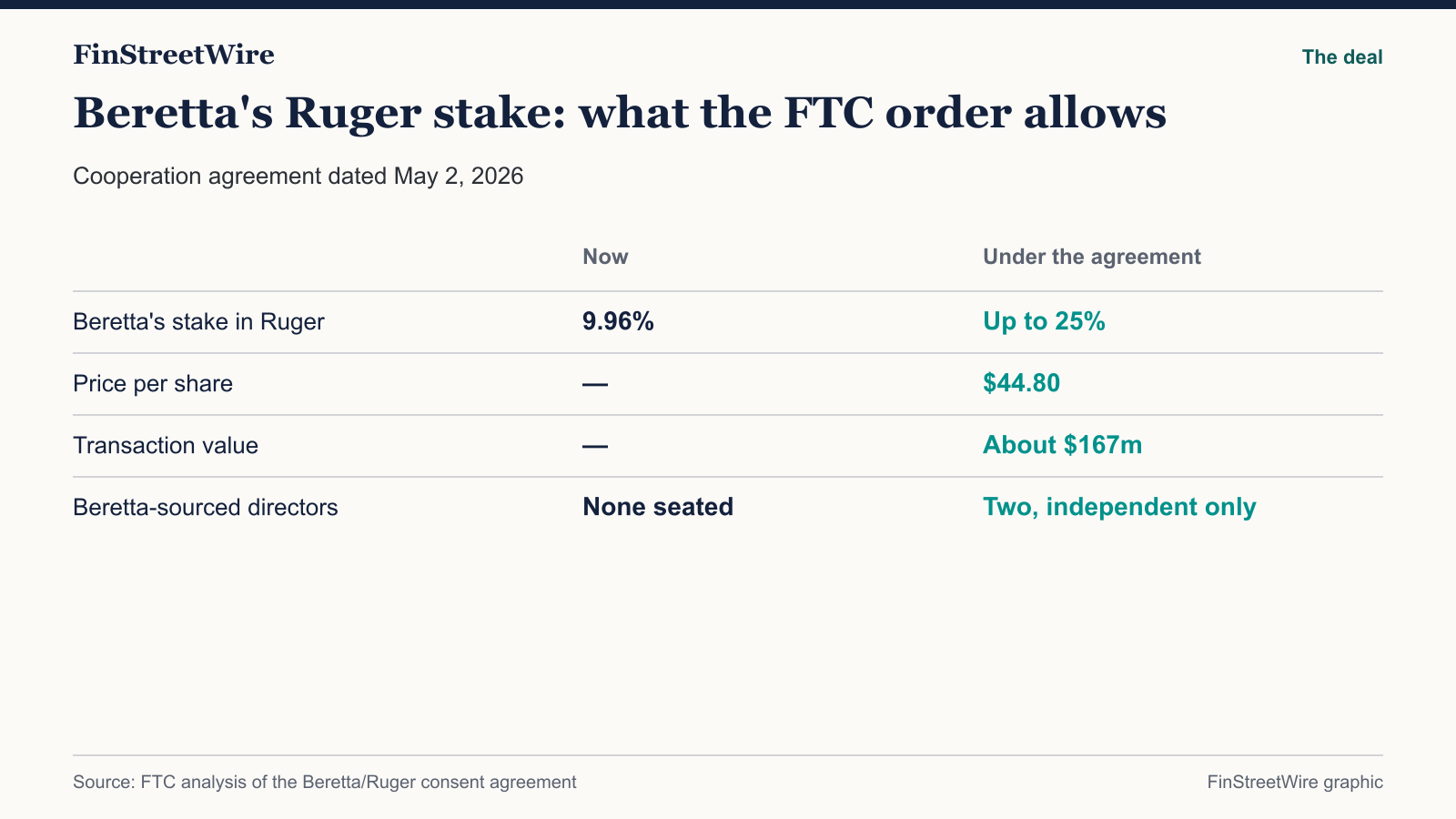
The order grows out of a cooperation agreement dated May 2, 2026, under which Beretta may buy up to 25% of Ruger's outstanding shares at $44.80 a share — a position the FTC values at about $167 million. Beretta already owns 9.96% of Ruger, which the FTC says would make it one of Ruger's largest shareholders. The agreement also gave Beretta the right to source two directors for Ruger's board, with Ruger obliged to seat them and put them up for re-election at the 2027 and 2028 annual meetings.[2]
At $44.80 a share, the roughly $167 million price tag implies about 3.7 million shares, by our calculation. Beretta is the world's largest firearms manufacturer, the FTC says, headquartered in Luxembourg with its main United States offices in Accokeek, Maryland. The relevant market, in the agency's framing, is the production and sale of firearms — pistols, shotguns and rifles — where Ruger is known as a purely American maker with significant share in rifles and handguns, competing against Smith & Wesson, SIG Sauer, Glock, Springfield Armory and Browning.[2]
| Term | Now | Under the agreement |
|---|---|---|
| Beretta's stake in Ruger | 9.96% | Up to 25% |
| Price per share | — | $44.80 |
| Transaction value | — | About $167 million |
| Shares for a full 25% stake | — | About 3.7 million |
| Beretta-sourced Ruger directors | None seated | Two, independent only |
Share count is our calculation from the FTC's $167 million and $44.80 figures. Source: FTC analysis of the consent agreement.
Why the FTC objected
The FTC's theory is about governance, not market share. Section 8 of the Clayton Act generally bars directors and officers from serving on the boards of competing companies, and the agency says Ruger's duty to seat two Beretta-sourced directors would have given Beretta a voice inside its rival's boardroom — access to competitively sensitive, nonpublic information and influence over Ruger's competitive decisions. The cooperation agreement even allowed the parties to waive restrictions on Beretta officers, employees, agents, representatives or directors serving as Ruger directors, the FTC says.[1][2]
The order is prophylactic rather than punitive: it does not unwind the stake, block the purchase or force Beretta to sell. It fences off the board channel instead. The FTC's complaint also alleged an unfair method of competition under Section 5 of the FTC Act, on the ground that the arrangement risked the exchange of confidential, competitively sensitive information.[1][2]
What to watch
- Whether Beretta moves from 9.96% toward the full 25% — and at what pace.
- The first two independent-director nominations, and whether the FTC's 15-day notice draws any response.
- Whether the information barriers hold in practice — the order binds Beretta for the directors' service and one year beyond it.
Questions readers ask
- Does the order force Beretta to sell its Ruger shares?
- No. The order leaves the shareholding alone: Beretta keeps its 9.96% and may buy up to 25% at $44.80 a share. The restrictions fall on board seats and information, not on ownership.[1][2]
- Can Beretta put anyone on Ruger's board at all?
- Only directors independent of Beretta. The cooperation agreement gave Beretta the right to source two directors, but the order says each must qualify as independent — unaffiliated with Beretta or Upifra, not recently employed or paid by them, and with no material relationship impairing their objectivity — and Beretta must notify the FTC at least 15 days in advance.[1][2]
- What happens if a Beretta-nominated director shares Ruger's secrets?
- The order bars Beretta from seeking or receiving Ruger's nonpublic information from any director it nominates, and bars relationships that would breach the director's duty to Ruger. The limits apply during board service and for one year after it ends.[1][2]
Sources
- FTC Finalizes Order Resolving Antitrust Concerns Stemming from Beretta, Ruger Stock Purchase Deal. Federal Trade Commission, FTC finalized the order resolving antitrust concerns over the Beretta-Ruger stock purchase agreement; alleged illegal interlocking directorate under Section 8 of the Clayton Act; final consent order bars Beretta (Upifra S.A. subsidiary) from appointing or nominating anyone to Ruger's board unless independent of Beretta; 15 days' written notice required before any board appointment; Beretta may not hire a director or enter into any financial or other relationship that would breach the director's fiduciary duty to Ruger or pass Ruger's nonpublic information to Beretta; limits run through board service and one year after; Commission voted 2-0 after public comment.. Accessed .
- Analysis of Agreement Containing Consent Order to Aid Public Comment — In the Matter of Beretta Holding S.A.. Federal Trade Commission, Cooperation Agreement dated May 2, 2026: Beretta may acquire up to 25% of Ruger's outstanding shares at $44.80 per share, total about $167 million; right to source two directors, renominated at 2027 and 2028 annual meetings; Beretta already owns 9.96%; Beretta largest firearms manufacturer in the world, HQ Luxembourg, primary US offices Accokeek, Maryland; lines of commerce pistols, shotguns, rifles; competitors Smith & Wesson, SIG Sauer, Glock, Springfield Armory, Browning; Independent Director definition (not affiliated with Beretta/Upifra/controlled entities, not recently employed or paid, no material relationship impairing objectivity); 15-day notice; relationship limits until one year after service; ban on seeking or receiving Ruger's nonpublic information (customer lists, price lists, strategic plans, contracts, expansion projects, cost information, marketing methods); Beretta must distribute the order and run an antitrust compliance program; complaint alleges Section 8 Clayton Act and Section 5 FTC Act violations.. Accessed .