Meta puts its non-voting Class C share dividend on hold until a Delaware challenge is resolved
Meta told the SEC it will not issue Class C stock while shareholder suits head to an April 2027 trial, delaying its planned at-the-market share sales.
3 min read

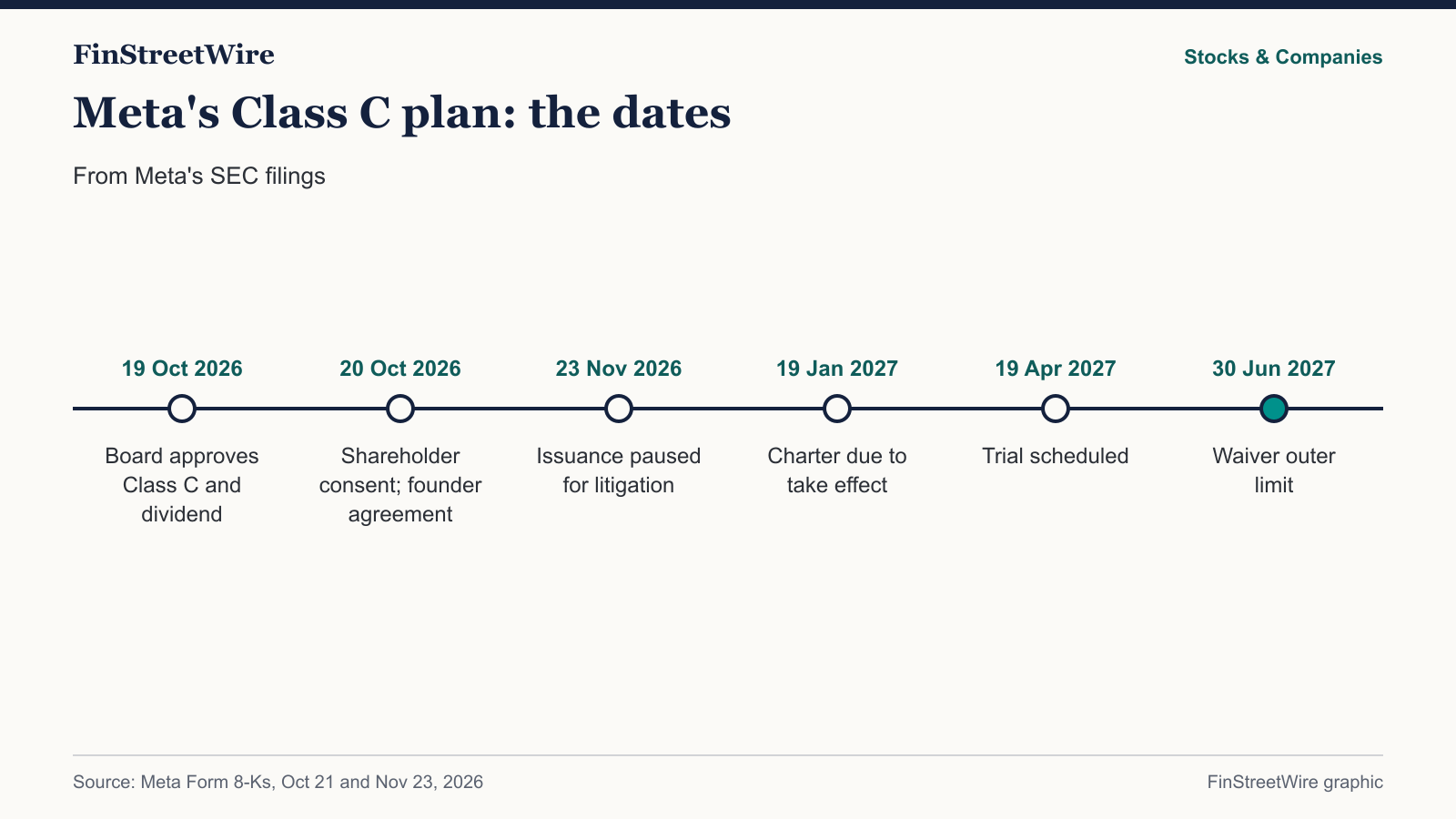
Meta Platforms (Nasdaq: META) has agreed not to issue its planned non-voting Class C shares while shareholder lawsuits challenging the new share class are heard in Delaware. The company disclosed the commitment in a Form 8-K filed with the SEC on November 23, 2026.[1]
The pause holds up two things: the one-time dividend of a Class C share for every Class A and Class B share, and a program to sell new shares into the market, which Meta says depends on the Class C stock trading first.[1]
What Meta planned in October
On October 19, Meta's board approved a restated charter creating a new class of non-voting Class C common stock, on the unanimous recommendation of a special committee of independent directors. Shareholders approved it by written consent the next day. The charter is due to take effect on January 19, 2027.[2]
The board also declared a one-time dividend of one Class C share for each outstanding Class A and Class B share, contingent on the charter taking effect. The filing ties the arrangements to the voting power of Zuckerberg, Meta's founder, chairman and chief executive, which comes through his Class B shares.[2]
The Founder Alignment Agreement
Because Class C shares have no votes, Zuckerberg could in principle sell them for cash without reducing his voting control. The Founder Alignment Agreement, signed October 20, limits that.[2]
- Only 20% of the Class C shares Zuckerberg's group receives will be freely saleable.
- The other 80% are 'stapled': for each one sold, the group must also sell a Class A or Class B share, or convert a Class B share into Class A, within two business days, or use stapling credits earned from earlier sales.
- If stapled shares are sold in breach of the condition, an equivalent number of Class B shares is deemed converted to Class A, cutting voting power.
- Once the group holds no Class B shares, the remaining stapled Class C shares are released.
In plain terms, Zuckerberg can turn most of his new shares into cash only by giving up votes at roughly the same pace. The 20% unstapled portion is the exception.[2]
What changes now
The agreement required the dividend to be paid within five business days of the charter taking effect. Zuckerberg has waived that requirement. The waiver ends at the earliest of three points: Meta failing to pay within a reasonable period after the litigation is resolved in a way that allows payment; a final ruling that blocks the dividend; or June 30, 2027, if it has not been paid by then.[1]
The filing does not say what the plaintiffs allege beyond challenging the recapitalization, and FinStreetWire has not reviewed the court filings. Meta's agreement to hold off on issuance is a procedural commitment, not an admission.[1]
The delay to the at-the-market program comes as Meta is raising money in debt markets. On November 12 it completed an offering of six euro-denominated note series totalling €9.0 billion, by our addition, with maturities from 2031 to 2065.[3]
What to watch
- January 19, 2027: the date the restated charter is due to take effect.
- April 19, 2027: the scheduled start of trial in the Court of Chancery.
- June 30, 2027: the outer limit of Zuckerberg's waiver if the dividend has not been paid.
Questions readers ask
Sources
- Meta Platforms, Inc. Form 8-K (Item 8.01): Class C reclassification litigation. Meta Platforms, Inc. via SEC EDGAR, Item 8.01. Accessed .
- Meta Platforms, Inc. Form 8-K (Items 1.01, 2.02, 8.01): recapitalization and Founder Alignment Agreement. Meta Platforms, Inc. via SEC EDGAR, Items 1.01 and 8.01. Accessed .
- Meta Platforms, Inc. Form 8-K (Item 8.01): EUR notes offering. Meta Platforms, Inc. via SEC EDGAR, Item 8.01. Accessed .