Disney's new segment reporting moves $2.3 billion of licensing profit from parks to Entertainment
A November 17 filing recasts three years of results before fiscal 2027. Entertainment's margin rises and Experiences' falls; net income does not change.
3 min read

The Walt Disney Company (NYSE: DIS) will move its merchandise licensing and publishing businesses out of the parks-led Experiences segment and into Entertainment, the home of its studios, Disney+ and Hulu. It furnished three years of recast segment results in a Form 8-K on November 17, 2026, ahead of reporting its first quarter of fiscal 2027 on the new basis.[1]
Disney says the aim is to link consumer products more directly with the creative teams behind the content. For investors, the practical effect is that a highly profitable licensing business no longer flatters the parks segment's margins.[1]
What changes in the segments
- Merchandise Licensing (royalties from Disney characters and brands on products and games) and Publishing move from Experiences to Entertainment.
- Branded Retail, Disney's own shops and online store, stays in Experiences, reported within Domestic Parks and Experiences.
- Entertainment revenue will be shown in three lines: subscription video on demand (SVOD), content and IP, and linear networks and virtual pay-TV (vMVPD) services such as Hulu Live TV and Fubo.
- Equity income is excluded from Entertainment's operating results. Disney sold its 50% stake in A+E Global Media, the largest such investment, on September 30, 2026.
The fiscal 2026 numbers, before and after
| Segment | Revenue reported | Revenue recast | Operating income reported | Operating income recast |
|---|---|---|---|---|
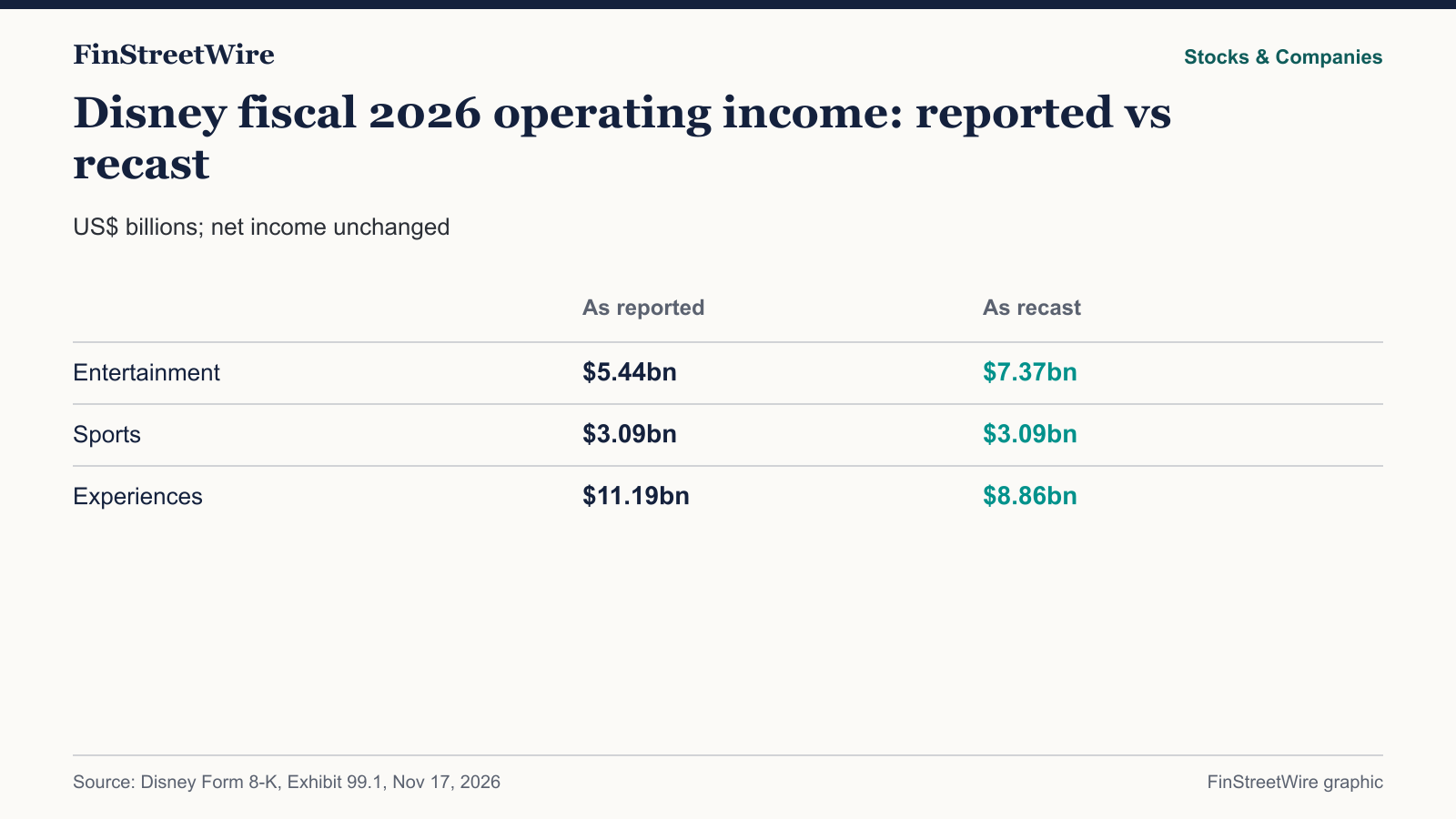
| Entertainment | 46,562 | 50,273 | 5,443 | 7,367 |
| Sports | 18,632 | 18,632 | 3,094 | 3,094 |
| Experiences | 39,566 | 35,855 | 11,191 | 8,859 |
Entertainment's recast operating income adds $2,332m from the licensing shift and removes $408m of equity income. Fiscal 2026 included a 53rd week. Source: Disney Form 8-K, Exhibit 99.1, November 17, 2026, p. 5.
The business being moved is small by revenue and large by profit. On fiscal 2026 figures it earned $2.33 billion of operating income on $3.71 billion of revenue, a margin of about 63%. Licensing earns royalties without the cost of making the products, which explains the high return.[1]
That changes how each segment looks. By our calculation, Experiences' operating margin falls from about 28% to about 25% on the recast basis, while Entertainment's rises from about 12% to about 15%. The fiscal 2025 and 2024 recasts show the same pattern, with $2.17 billion and $2.14 billion of operating income moving in those years.[1]
Total segment operating income is lower by the $408 million of equity income now left out of Entertainment. That income has not disappeared; it is reported outside the segments, which is why net income is unchanged.[1]
What the new Entertainment lines show
| Line | FY2024 | FY2025 | FY2026 |
|---|---|---|---|
| SVOD (Disney+, Hulu) | 18,049 | 19,731 | 22,414 |
| Content and IP | 11,235 | 12,042 | 12,913 |
| Linear networks and vMVPD | 15,419 | 14,247 | 14,946 |
| Total Entertainment | 44,703 | 46,020 | 50,273 |
Fiscal 2026 had 53 weeks; Disney estimates the extra week added about $840m to Entertainment revenue and $260m to its operating income. Source: Disney Form 8-K, Exhibit 99.1, November 17, 2026, pp. 6-7.
Streaming is now Entertainment's largest revenue line, up about 14% in fiscal 2026 on our calculation, helped by the extra week. Linear networks rose in fiscal 2026 after falling in 2025, but their advertising revenue was $3.09 billion against $4.16 billion two years earlier.[1]
A change in the accounting chair
In a separate 8-K on November 23, Disney said Brent Woodford, Executive Vice President for controllership, financial planning and tax and its principal accounting officer, will retire. David Haskett, Senior Controller for corporate controllership since May 2022, takes over as principal accounting officer on February 15, 2027. Woodford stays as an employee until June 1, 2027.[2]
Questions readers ask
- Does the recast change Disney's profits?
- No. Disney says the changes have no impact on historically reported net income or earnings per share. They change how profit is allocated between segments.[1]
- When will Disney start reporting this way?
- With its first quarter of fiscal 2027, the quarter ending in late December 2026.[1]
Sources
- The Walt Disney Company Form 8-K (Item 7.01), Exhibit 99.1: fiscal 2027 segment reporting changes. The Walt Disney Company via SEC EDGAR, Segment reporting changes p. 1; reconciliations p. 5; supplemental results pp. 6-8. Accessed .
- The Walt Disney Company Form 8-K (Item 5.02). The Walt Disney Company via SEC EDGAR, Item 5.02. Accessed .