Abbott starts a 300-patient trial of Encantor, a balloon-expandable heart valve to sit beside Navitor
VOYAGER CE in Europe and Australia is meant to support approval there, with a US pivotal trial planned. The primary endpoint is death or stroke at 12 months.
3 min read
Abbott Laboratories (NYSE: ABT) has started a clinical trial of Encantor, an investigational heart valve system that it hopes will give it a second type of device in the market for transcatheter aortic valve implantation (TAVI). The company announced the VOYAGER CE trial on November 19, 2026.[1]
TAVI replaces a narrowed aortic valve through a catheter, usually threaded from the groin, instead of open-heart surgery. Abbott already sells Navitor, a self-expanding valve. Encantor is balloon-expandable: the new valve is crimped onto a balloon, and inflating the balloon presses it into place.[1]
What the trial will test
| Item | Detail |
|---|---|
| Registry ID | NCT07696182 (sponsor protocol ABT-CIP-10647) |
| Design | Prospective, single-arm, pre-market |
| Enrollment | Up to 300 patients (estimated) |
| Patients | Symptomatic severe aortic stenosis caused by severe calcium buildup |
| Countries | Europe and Australia; registered sites include seven Australian hospitals and several in France |
| Primary endpoint | All-cause mortality or all strokes at 12 months |
| Estimated primary completion | September 30, 2028 |
| Purpose | Basis for seeking CE Mark approval in Europe and approval in Australia |
Sources: Abbott press release, November 19, 2026; ClinicalTrials.gov record NCT07696182, last updated November 12, 2026.
A single-arm trial has no comparison group, so Encantor will not be tested against another valve in the same study. Its results will show how patients fared on Encantor, but give less direct evidence of how it compares with competing valves.[2]
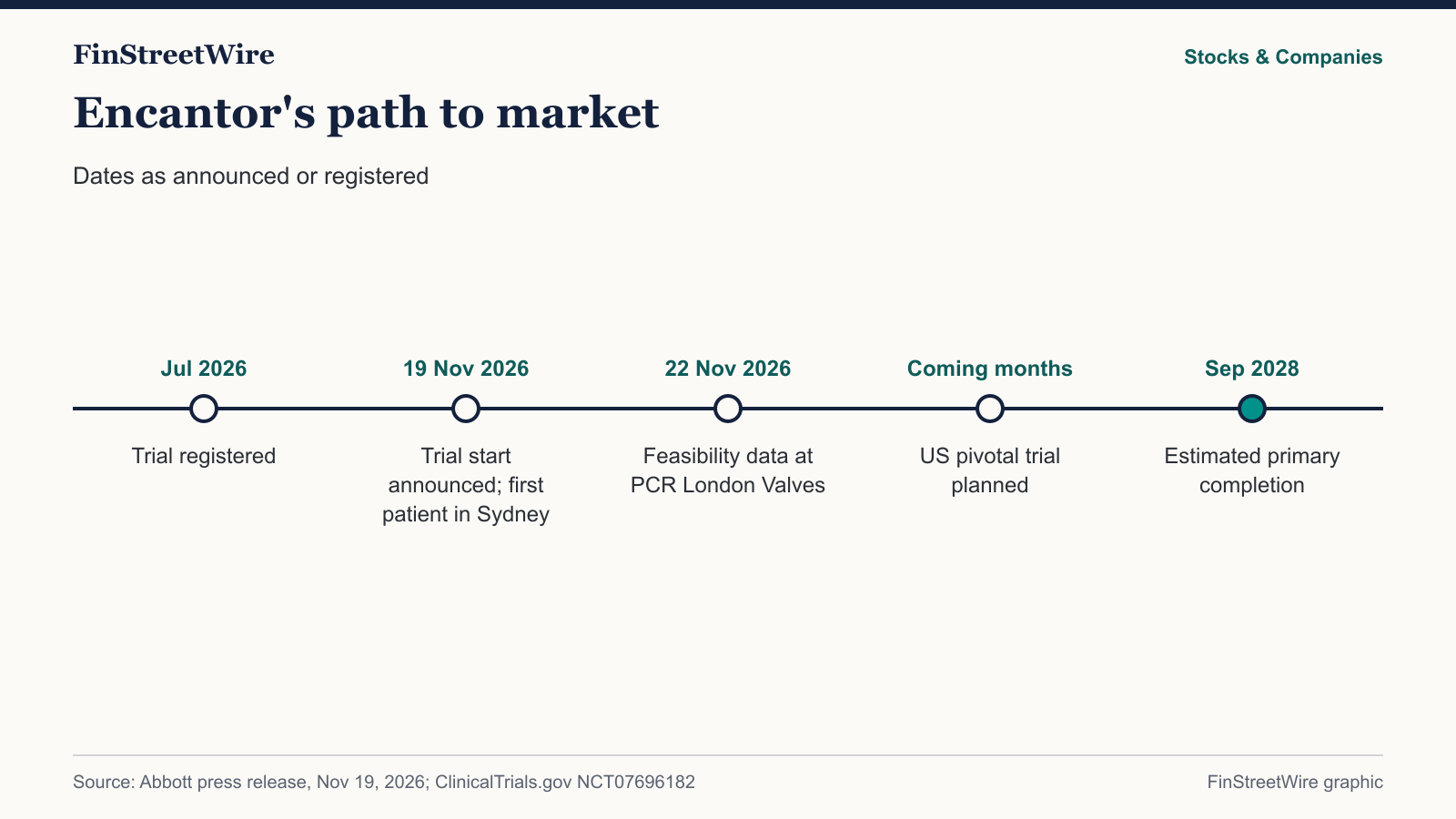
The public registry had not caught up with the announcement when we checked: it listed the trial as not yet recruiting, with an estimated start of November 30, 2026. Abbott says the first patient was enrolled at Macquarie University in Sydney, led by Stephen Worthley. Registries are often updated after the fact.[1][2]
Why the balloon-expandable design matters to Abbott
Self-expanding and balloon-expandable valves are the two main families of TAVI device, and physicians choose between them partly on the patient's anatomy. Abbott says Encantor is meant to complement Navitor, so it could offer both.[1]
Abbott's pitch is software-guided deployment, which it says lets physicians tailor the valve's expansion to each patient's anatomy. That is a company claim about an investigational device; the trial is designed to test safety and effectiveness, not to compare it with rival systems.[1]
“Our investigational Encantor system complements our Navitor self-expanding platform with a balloon-expandable option designed around physician insights, precise deployment and procedural ease of use.”
What to watch
- Six-month early feasibility data, which Abbott said would be presented at PCR London Valves on November 22.
- The start of the US pivotal trial, which Abbott says is planned in the coming months and would be needed for FDA approval.
- Enrollment progress toward the estimated September 2028 primary completion date.
Questions readers ask
- Can doctors use Encantor now?
- No. Abbott says the system is investigational only and not for use anywhere in the world, including the US, Australia, Canada and Europe.[1]
- Does this trial support US approval?
- No. VOYAGER CE is meant to support approval in Europe and Australia. Abbott plans a separate pivotal trial in the US.[1]
Sources
- Abbott initiates VOYAGER clinical trial for investigational Encantor software-guided balloon-expandable TAVI system to treat aortic stenosis. Abbott, Press release and FAQ. Accessed .
- VOYAGER CE Clinical Trial (NCT07696182). ClinicalTrials.gov, US National Library of Medicine, Status, design, outcome measures and locations modules. Accessed .