FTC finalizes order limiting Beretta's influence on Sturm, Ruger's board after share purchase deal
Beretta may nominate only independent directors to Ruger's board and must give the FTC 15 days' notice. The order targets a Clayton Act board interlock.
3 min read

The Federal Trade Commission has made final an order that limits how Beretta Holding can use its investment in Sturm, Ruger & Co., the US firearms manufacturer listed on the New York Stock Exchange. The FTC announced on November 25 that, after a public comment period, commissioners voted 2-0 to approve the order, which resolves concerns about a stock purchase agreement between the two companies.[1]
The FTC describes Beretta and Ruger as two of the largest firearm manufacturers. Its concern was not the share purchase itself but the board seats that could come with it.[1]
The interlock problem
The agency alleged that the deal as proposed would create an illegal interlocking directorate under Section 8 of the Clayton Act. That provision generally bars the same people from serving as directors or officers of competing companies at the same time, because shared directors can become a channel for coordinating prices, products or strategy. When a competitor buys a significant minority stake and seeks board representation, that risk arises even without a merger.[1]
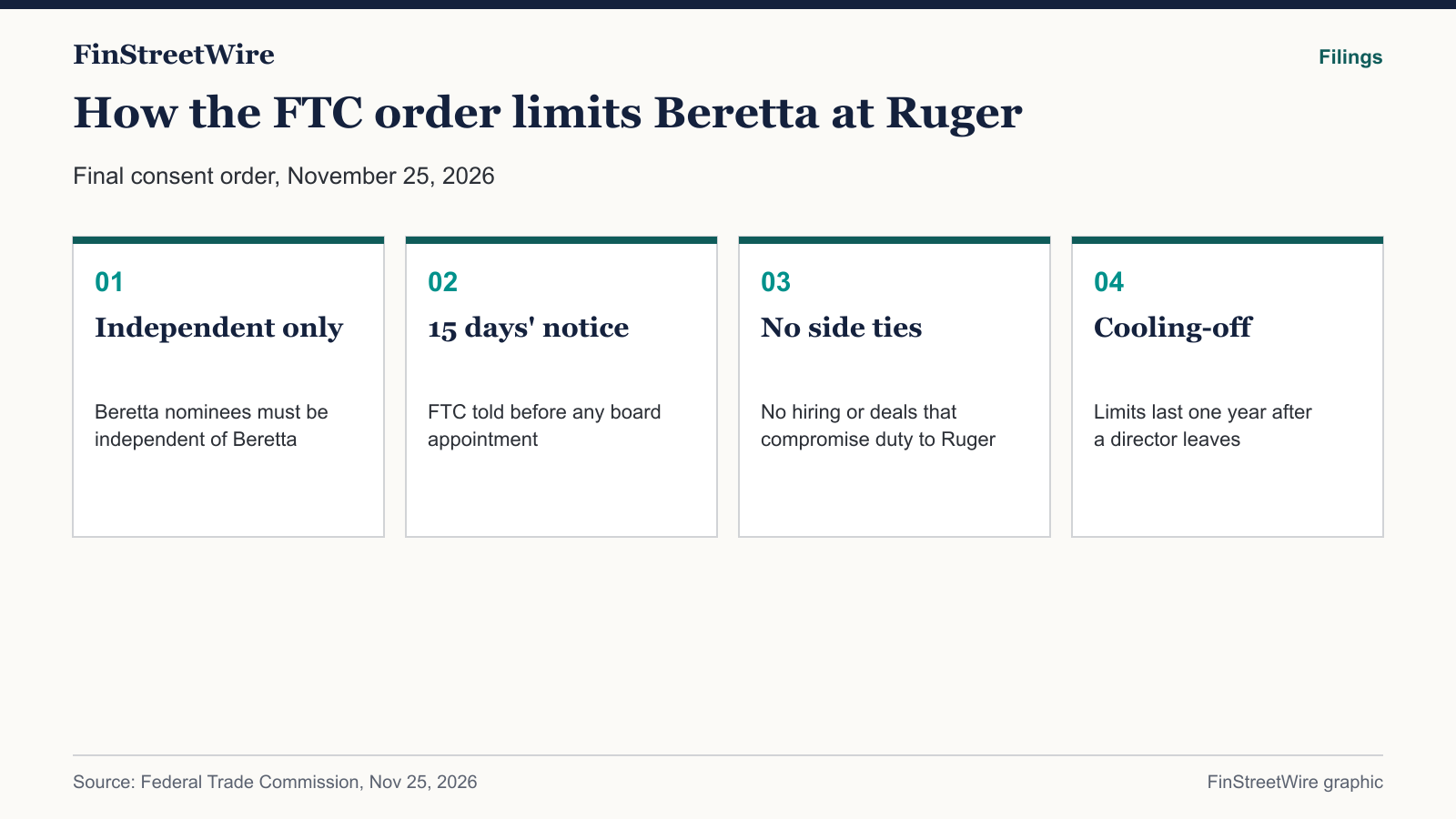
| Requirement | Detail |
|---|---|
| Board nominees | Only people independent of Beretta |
| Notice to FTC | At least 15 days before any Ruger board appointment |
| Relationships with nominees | No hiring or financial ties that breach duty to Ruger or pass on its non-public information |
| Duration of relationship limits | While serving and for one year after |
| Commission vote | 2-0 |
Beretta Holding is a subsidiary of Upifra S.A. Source: Federal Trade Commission press release, November 25, 2026.
What it means for Ruger shareholders
For Ruger's other investors, the order works as a safeguard. Directors that Beretta proposes must be independent of it, and the restrictions on side relationships are designed to keep those directors loyal to Ruger rather than to a competitor that owns Ruger shares. The 15-day notice requirement means the FTC will see every Beretta-linked nomination before it takes effect.[1]
The order does not block Beretta from holding Ruger shares. By our reading, it leaves Beretta with the economic exposure of a large shareholder but without a direct line into Ruger's boardroom, which limits the strategic influence a competitor could otherwise gain from such a stake.[1]
Questions readers ask
- Can Beretta put directors on Sturm, Ruger's board?
- Only people who are independent of Beretta, and only after giving the FTC at least 15 days' written notice, under the final FTC order.[1]
- Why did the FTC act on Beretta and Ruger?
- It alleged the stock purchase deal would create an illegal interlocking directorate under Section 8 of the Clayton Act, which generally bars shared directors between competitors.[1]
Sources
- FTC Finalizes Order Resolving Antitrust Concerns Stemming from Beretta, Ruger Stock Purchase Deal. Federal Trade Commission, Press release. Accessed .