Germany's flash PMI hits 55.0, its highest since March 2022, as factories hire again
November's survey shows manufacturing output at a 63-month high and services demand reviving. Service firms still cut jobs, and cost inflation stays steep.
3 min read

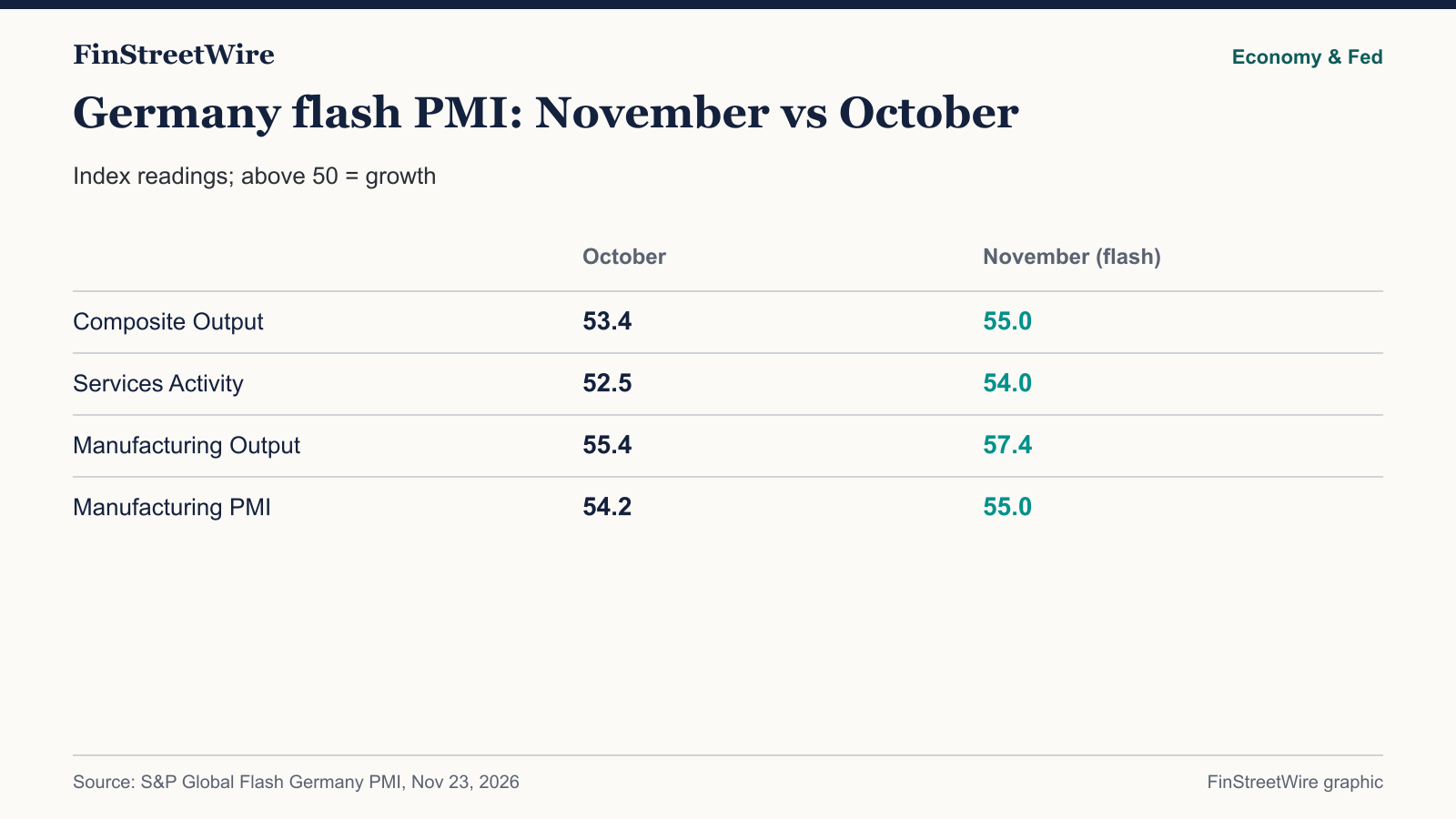
Germany's private sector expanded at its fastest pace in more than four and a half years in November, according to S&P Global's flash purchasing managers' survey published on November 23. The Composite PMI Output Index rose to 55.0 from 53.4, the fifth straight month above the 50 line that separates growth from contraction.[1]
For readers who follow US markets, Germany is Europe's largest economy and a major buyer of American goods and capital equipment. A sustained German upturn would matter for US exporters and multinationals with large European sales, and for the euro against the dollar.
The November readings
| Index | November (flash) | October | Note |
|---|---|---|---|
| Composite PMI Output | 55.0 | 53.4 | 56-month high |
| Services Business Activity | 54.0 | 52.5 | 13-month high |
| Manufacturing Output | 57.4 | 55.4 | 63-month high |
| Manufacturing PMI | 55.0 | 54.2 | 56-month high |
Data collected November 12-19, 2026. October values as given in the November release. Source: S&P Global Flash Germany PMI, November 23, 2026.
What is driving the upturn
New business rose at the steepest rate in more than four and a half years. Manufacturing new orders accelerated, helped by a continued rise in export sales, and the service sector reported renewed growth in new work after a weaker October.[1]
That second point is what S&P Global treats as the news. Services are the more domestically driven part of the economy, so a pickup there hints that the recovery is spreading beyond export-led factories.[1]
“Encouragingly, alongside the sustained upturn in manufacturing, which continues to see support from rising export orders, demand also revived in the more domestic-oriented service sector”
Where the survey is weaker
- Jobs: overall employment fell for a second month because service firms kept cutting staff, even as manufacturers added staff, their first increase since mid-2023.
- Services confidence: growth expectations in services softened, while manufacturers' optimism was at its joint-highest since February.
- Prices: input cost inflation eased to a three-month low but stayed steep by historical standards, driven by energy, wages, components and transport. Prices charged rose faster, mainly in services.
The price detail matters for the European Central Bank. Faster increases in service-sector selling prices are the kind of signal that can keep a central bank cautious about cutting rates, though one month of survey data is a weak basis for any policy conclusion. That reading is ours.[1]
How to read a PMI
A PMI is a diffusion index: the share of firms reporting an increase plus half of those reporting no change. A reading of 55.0 says many more firms saw activity rise than fall in November compared with October. It measures breadth, not the size of the change, so it is not a direct measure of GDP growth.[1]
S&P Global surveys panels of around 400 manufacturers and 400 service providers. The flash release is an early estimate, and final November figures follow on December 1 and December 3.[1]
Questions readers ask
- Is Germany's economy growing?
- The survey says private-sector activity rose for a fifth straight month, the quickest expansion since March 2022. Official GDP data from Destatis are a separate, later measure.[1]
- When are the final November figures?
- December 1 for manufacturing and December 3 for services and the composite index.[1]
Sources
- S&P Global Flash Germany PMI: German Composite PMI climbs to highest since March 2022. S&P Global Market Intelligence, Headline indices p. 1; comment p. 1; prices and employment p. 2; methodology p. 3. Accessed .