Tokyo core inflation jumps to 2.9% on power and gas bills, while the underlying rate eases to 2.5%
Energy added 0.34 point to the core rate in November, but strip out energy and fresh food as well and Tokyo inflation slowed for a second month.
4 min read
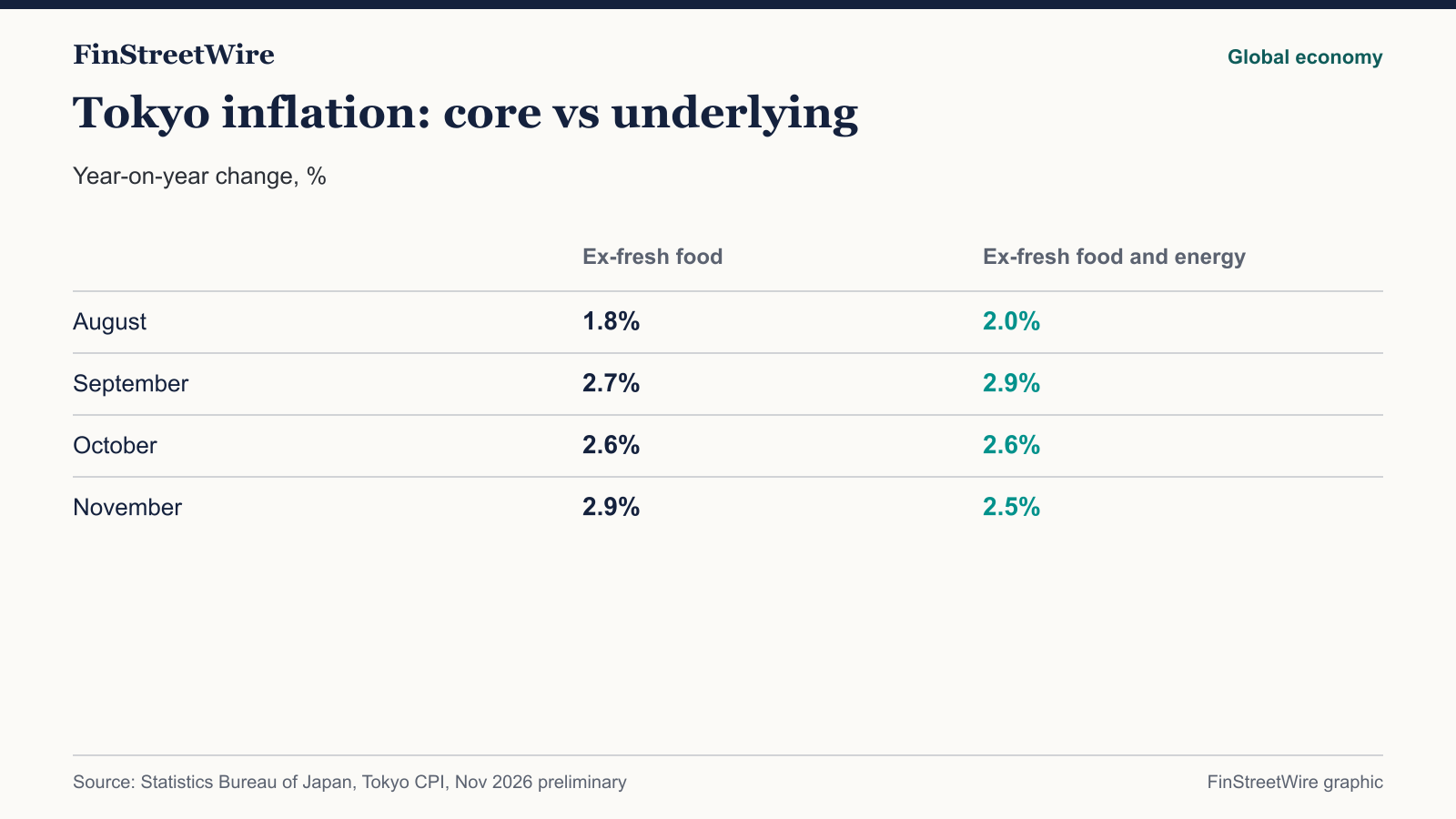
Inflation in Tokyo picked up in November on the core measure, which leaves out fresh food, but almost all of the acceleration came from household energy bills.[1]
Consumer prices in the capital's 23 central wards, excluding fresh food, were 2.9% higher than a year earlier in the middle of the month, compared with 2.6% in October, the Statistics Bureau of Japan said in preliminary figures released on November 27.[1]
The Tokyo index comes out ahead of the national figures, and the bureau publishes it explicitly as a leading indicator for the whole country. Investors use it as an early read on whether inflation is strong enough, and broad enough, for the Bank of Japan to keep raising interest rates.[1]
Three measures, two directions
| Month | All items | Excluding fresh food | Excluding fresh food and energy |
|---|---|---|---|
| August | 1.9 | 1.8 | 2.0 |
| September | 2.7 | 2.7 | 2.9 |
| October | 2.7 | 2.6 | 2.6 |
| November | 2.8 | 2.9 | 2.5 |
2025 = 100. November figures are a mid-month preliminary estimate. Source: Statistics Bureau of Japan, Ministry of Internal Affairs and Communications, Consumer Price Index for the Ku-area of Tokyo, November 2026 (Japanese-language release).
The three series moved apart in November. The headline and core rates rose, while the measure that also leaves out energy slowed for the second month running. On a seasonally adjusted basis, the bureau's figures show the core index rising 0.5% from October, against just 0.1% for the index excluding fresh food and energy.[1]
Electricity and gas did the work
Electricity charges rose 14.2% from October and were 9.5% higher than a year earlier, after an annual rise of only 1.7% the month before. City gas charges were up 13.7% on the year, from 4.9%. Gasoline was 1.1% cheaper than a year ago. Taken together, energy contributed 0.43 point to the all-items rate in November, compared with 0.09 point in October.[1]
The bureau's summary does not say what caused the monthly jump in power and gas bills. What it does show is that food excluding fresh items, the other large driver of Tokyo inflation this year, barely changed: it rose 3.1% on the year after 3.0%, adding only 0.02 point to the change in the core rate.[1]
What held the headline down
Fresh food prices rose 1.8% on the year, after 7.0% in October, which narrowed the all-items rate by 0.19 point. Fresh fish was still up 12.8%, but non-Koshihikari rice was 33.8% cheaper than a year earlier. Childcare fees at nursery schools recorded a 100% annual fall and subtracted 0.21 point from the headline rate, while hotel charges rose 3.6% after 6.7% in October.[1]
What it means for the BOJ
By our reading of the bureau's tables, November's rise in core inflation is an energy story rather than a sign of broadening price pressure. Underlying inflation, measured without fresh food and energy, has eased from 2.9% in September to 2.5%, and its seasonally adjusted monthly rise slowed to 0.1%. That interpretation is ours; the bureau draws no policy conclusions.[1]
Both core measures remain above the Bank of Japan's 2% inflation target. For a central bank that wants to see domestically generated, service-led inflation before tightening further, though, a jump driven by utility bills is a weaker signal than a 2.9% headline figure suggests.[1]
What to watch
- The national November CPI, due in December, will show whether the energy jump is repeated outside Tokyo.
- Whether electricity and gas charges stay at November's higher level, or whether the rise was a one-off step.
- Revisions: the Tokyo figures are a mid-month preliminary estimate, and the bureau revises its seasonally adjusted series back in time when it publishes December results.
Questions readers ask
- What was Tokyo's core CPI in November 2026?
- Consumer prices in Tokyo's 23 wards excluding fresh food rose 2.9% from a year earlier, up from 2.6% in October, according to the Statistics Bureau's preliminary data.[1]
- Why did Tokyo inflation rise?
- Mainly energy. Electricity charges rose 9.5% on the year and city gas 13.7%, and the bureau says energy widened the core rate's rise by 0.34 point. Excluding energy and fresh food, inflation eased to 2.5%.[1]
Sources
- 2025-base Consumer Price Index, Ku-area of Tokyo, November 2026 (mid-month preliminary) [Japanese]. Statistics Bureau of Japan, Ministry of Internal Affairs and Communications, Overview and tables 1-2 p. 1; ten major groups and main contributors p. 2; contributions to the change in the annual rate and energy items (table 5) p. 3. Accessed .