October CPI came in hot at 0.4% — and left the Fed to choose between 25 and 50 basis points
Prices rose 0.4% in October and core prices 0.3% for a third straight month — but the report carries no yearly rate. The Fed's December 9 call is about size.
5 min read
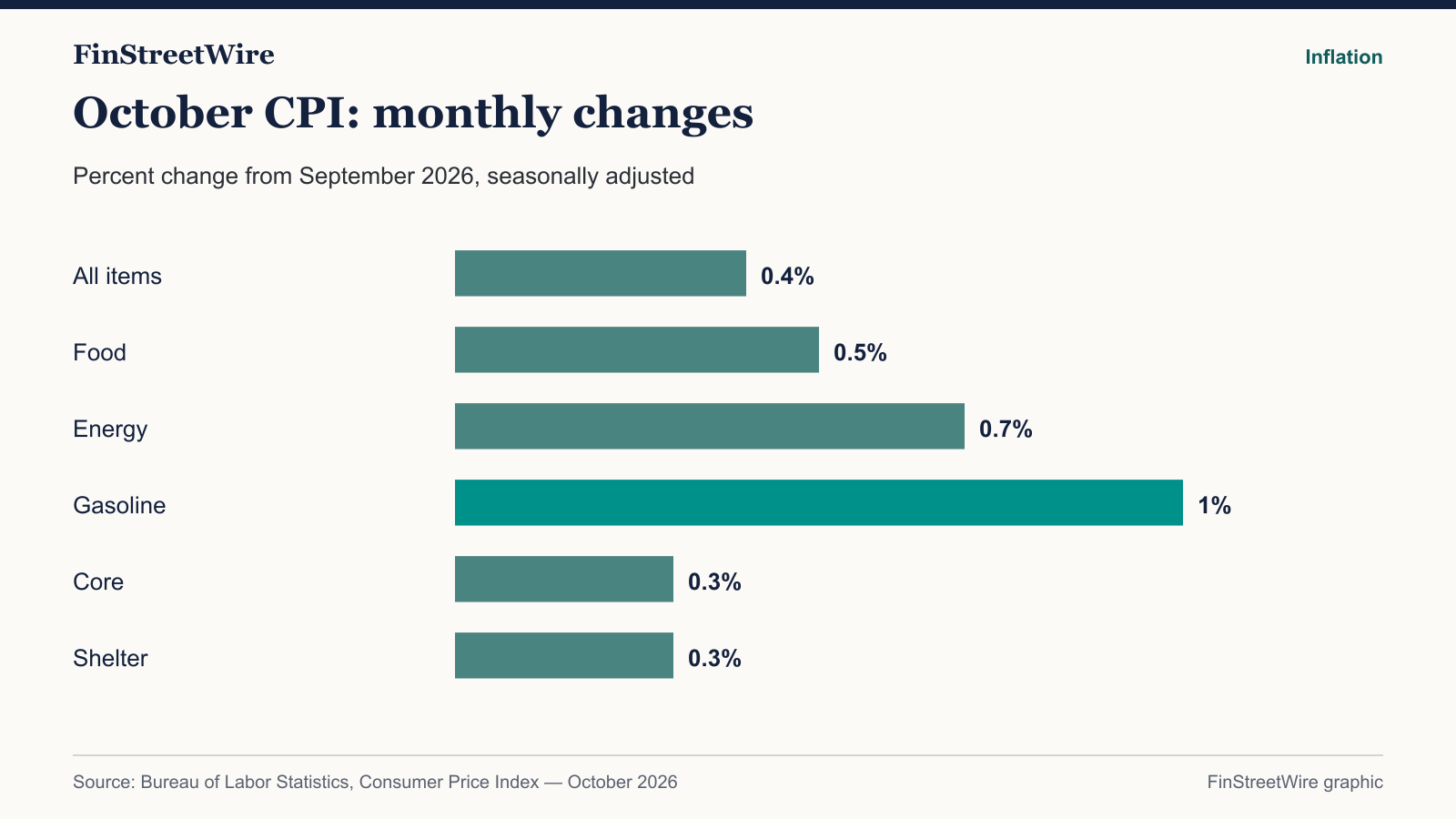
October's inflation report gave the Federal Reserve exactly the kind of reading that sharpens a debate without settling it. Prices climbed faster than expected, the underlying pace held steady for a third month, and the number everyone usually quotes — the change from a year earlier — is not in the report at all. The Fed meets December 8-9 to set rates, and the open question now is not whether it moves, but by how much.[1][3]
The report's missing number
The gap is a hangover from the 2025 funding lapse. Because the bureau gathered no survey prices in October 2025, it has nothing to compare this October against for most of its series. The last official yearly readings date from September: overall prices up 3.7% from a year earlier, core prices up 2.6%. One series escaped the gap — gasoline, whose yearly change the bureau could still publish, stands at 37.4%, up from 34.2% in September. It is the only yearly figure in the release, and it points the wrong way for anyone hoping energy would cool the numbers.[1][2]
The timing matters. The next inflation report, covering November, is due December 10 — the day after the Fed announces its decision. Officials vote with October's numbers as their freshest reading.[1][3]
What drove the month
Shelter did the heaviest work, rising 0.3% in October — a touch slower than September's 0.4% — yet supplying more than 30% of the month's overall increase. Rents rose 0.2% and owners' equivalent rent — the bureau's estimate of what a homeowner would pay to rent their own home — rose 0.3%. Food added pressure too, rising 0.5% after standing still in September, with groceries up 0.4%, meals away from home up 0.5% and beef up 0.9%. Energy cooled sharply without turning down: up 0.7% after September's 5.2% jump, as gasoline slowed from 9.1% to 1.0%, electricity rose 0.9% and natural gas fell 0.8%.[1]
The rest of the core basket was broad. Recreation rose 0.8%, motor vehicle insurance 0.7%, medical care 0.3% with hospital services up 0.8%, and education 0.3%. The offsets were small: used cars and trucks fell 1.2% after rising 0.7% in September, and communication slipped 0.1%. The breadth is the point: steady pressure across services, not one wild category.[1]
| Measure | September 2026 | October 2026 |
|---|---|---|
| All items | 0.6 | 0.4 |
| Food | 0.0 | 0.5 |
| Energy | 5.2 | 0.7 |
| Gasoline | 9.1 | 1.0 |
| Core (less food and energy) | 0.3 | 0.3 |
| Shelter | 0.4 | 0.3 |
Source: Bureau of Labor Statistics, Consumer Price Index news releases for September and October 2026.
The case for 50
The loudest voice for a half-point move belongs to Ed Yardeni, president of Yardeni Research. He argues the Fed skipped a quarter-point rise in October and now must catch up — and that last year's 75 basis points of cuts, which he calls an insurance policy the economy never needed, should be reversed. Some early headlines garbled his call as a cut; the outlet corrected it to 'hike' the same day.[4][5]
“I was thinking that when the Fed passed on doing 25 basis points in October, that we probably would get 50 basis points in the December meeting, and I think that's increasingly likely. I think it's going to happen.”
Yardeni is not alone, and the more consequential voice is inside the Fed. Governor Christopher Waller, speaking in London hours before the report, said he leaned toward a quarter-point rise in December — but set a clear test: should October's core reading come in around 0.3% or higher, a stronger step might be needed. It did, at 0.3% on the month. By November 20, Yardeni himself had second thoughts, telling CNBC's Power Lunch that the Fed might instead move 25 points and signal it would watch the data.[4][6][12]
“In that case, I believe a 50 basis point hike in the policy rate should be considered at the December meeting.”
The October meeting's own record leans the same way. The committee held the range at 3.75% to 4.00% on October 28, but Lisa Cook and Beth Hammack dissented in favor of a quarter-point rise, and the range itself was set by a quarter-point hike in September.[10][11]
Why 25 is still the base case
For all that, the market's money remains on the smaller move. Futures put a quarter-point hike at about 96% as of November 26, with a half-point hike near 4% and a hold at about zero — and every one of the 101 economists in a Reuters survey taken November 6-10 expected the quarter-point step, to a 4.00%-4.25% range. The Fed also has a habit to defend: it almost always moves in quarter-point steps, and a half-point rise would read as an emergency signal, or an admission the October hold was a mistake. The data give it cover to stay measured. Core prices have risen 0.3% in each of the last three months — steady, not accelerating. By our calculation, three months at that pace compounds to about 0.9% over the quarter, roughly a 3.7% yearly pace: above the Fed's 2% goal, but not running away. The headline pace is hotter — 0.4% a month works out near 4.9% a year if it held — though April to October cumulates to about 2.2%, near a 3.8% yearly pace.[1][7][9]
The December meeting also carries fresh economic projections, and officials may prefer to let those carry the message rather than doubling the size of the move.[3]
What to watch
- December 9, 2 p.m. Eastern: the decision, the statement and new projections, including the dot plot of officials' rate expectations.
- December 10: November CPI — did October's monthly pace hold?
- Whether any official echoes Waller before the meeting, and whether the 50-point odds — near 12% after the report — keep climbing.
- Gasoline and shelter: the first runs 37.4% above a year earlier, the second supplies over 30% of each month's rise. If either quickens, the 50-point argument strengthens.
Questions readers ask
- Why is there no year-over-year inflation rate for October?
- Because the Bureau of Labor Statistics collected no survey prices in October 2025, during the 2025 lapse in appropriations. With nothing to compare against, it cannot publish 12-month changes for most indexes. The last yearly readings are September's: overall up 3.7%, core up 2.6%.[1][2]
- What will the Fed decide on December 9?
- Whether to raise its target range from 3.75% to 4.00%, and by how much. Markets and all 101 economists in a Reuters survey expect a quarter-point rise, to 4.00%-4.25%. A half-point rise would take it to 4.25%-4.50%.[7][9]
- Did Yardeni call for a rate cut?
- No — he called for a 50-basis-point hike, arguing the Fed should reverse last year's cuts. Early headlines saying 'cut' were corrected the same day.[4][5]
Sources
- Consumer Price Index — October 2026. U.S. Bureau of Labor Statistics, Headline, core, shelter, food and energy monthly changes; missing 12-month changes; index levels; November release date. Accessed .
- Consumer Price Index — September 2026. U.S. Bureau of Labor Statistics, 12-month changes to September: all items 3.7%, core 2.6%, energy 20.4%, gasoline 34.2%; monthly changes. Accessed .
- Meeting calendars and information. Board of Governors of the Federal Reserve System, 2026 FOMC meetings: December 8-9 with projections; October 27-28, minutes released November 18. Accessed .
- Yardeni Research's Ed Yardeni: A 50-basis-point rate cut in December is increasingly likely. CEOInterviews.AI (CNBC Television transcript), Yardeni's 50-basis-point December call on CNBC's Squawk on the Street; reversing last year's 75bp of cuts. Accessed .
- A 50-basis-point rate hike in December is increasingly likely, says Ed Yardeni. Seeking Alpha, Correction note: Yardeni implied the Fed will have to hike interest rates, as opposed to cutting rates. Accessed .
- Fed's Waller and Logan signal readiness to hike higher and faster, with 50 bps on the table for December. Kitco News, Waller's London speech: 25bp lean, 50bp to be considered if core CPI came in around 0.3% or higher. Accessed .
- Euro slips below 1.1200 as hot US CPI supports Fed hike odds. FXStreet, Reuters poll expectations (headline 0.3%, core 0.2%); CME FedWatch 25bp hike odds 99% after CPI vs 84% before; all 101 economists expect a 25bp hike. Accessed .
- Fed's Christopher Waller opens door to 50-basis-point December rate hike after hot CPI. The Economic Times, Odds of a 50-basis-point December hike rose to 11.8% after the CPI release. Accessed .
- Fed December rate hike odds: CME FedWatch puts 25 bps hike at 96.4%. Stocktwits (CME FedWatch data), CME FedWatch: 25bp December hike 96.4%, 50bp hike 3.6%; decision December 9. Accessed .
- Federal Reserve issues FOMC statement. Board of Governors of the Federal Reserve System, October 28 FOMC held at 3-3/4 to 4% in a 10-2 vote; Lisa D. Cook and Beth M. Hammack preferred a quarter-point hike; statements released at 2:00 p.m. EDT. Accessed .
- Federal Reserve issues FOMC statement. Board of Governors of the Federal Reserve System, September 16 FOMC raised the target range by 1/4 percentage point to 3-3/4 to 4%, 12-0 vote. Accessed .
- What investors say about US rates & the Fed. Chorus, Yardeni's November 20 second thoughts on CNBC Power Lunch: maybe 25 basis points and signal data dependence. Accessed .