SEC charges two firms over $130m crypto fraud built on fake filings
The SEC says two firms raised over $130m from retail investors by promising risk-free crypto returns — and filed false SEC forms to look legitimate.
4 min read
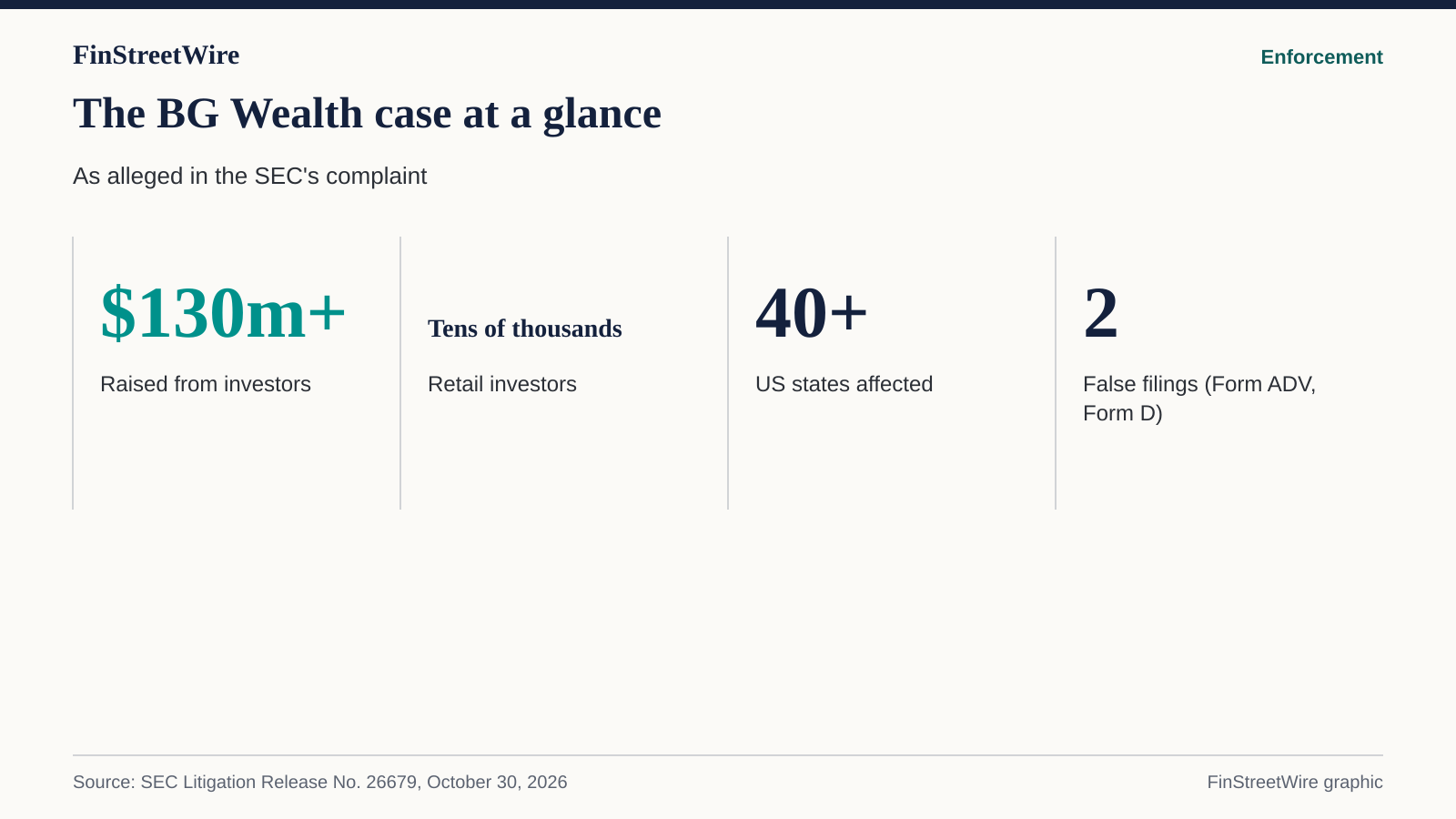
The US Securities and Exchange Commission has charged two firms with running a $130 million fraud that used the SEC's own filing system as its credibility engine. BG Wealth Sharing Ltd and DSJ Exchange Pty Ltd, both foreign-operated and incorporated in Colorado, are accused of raising the money from tens of thousands of retail investors by promising extraordinary, risk-free returns from crypto trading — and of filing false forms with the SEC to make the scheme look legitimate.[1]
The complaint was filed on October 29, 2026, in the US District Court for the Northern District of California. It charges both firms under the antifraud provisions of the 1933 Securities Act and the 1934 Exchange Act. BG Wealth faces two further charges, under the Investment Advisers Act — Sections 204(a) and 207. The SEC wants the court to bar the firms permanently, make them return the money with interest, and impose civil penalties — plus conduct-based injunctions against BG Wealth.[1]
How the scheme worked, as the SEC alleges
From at least October 2025 through June 2026, the SEC alleges, the two firms induced investors — many in more than 40 US states and multiple US territories — to join a supposed 'wealth-sharing program'. The pitch was returns that were both extraordinary and risk-free, supposedly produced by 'SI-generated signals' for trading crypto assets. The release does not expand the abbreviation 'SI', and gives no evidence that any such signals existed.[1]
The firms also presented themselves as established and regulated. BG Wealth described itself as the world's largest hedge fund and as an SEC-registered investment adviser, and presented DSJ Exchange as a licensed, secure crypto trading platform. The SEC says none of those claims was true.[1]
The filings were the proof
The distinctive part of the case is the mechanism. The SEC alleges the two firms filed a false Form ADV and a false Form D with the agency. Both documents were publicly viewable, and the firms used them to tell investors the SEC had licensed or approved them. A Form ADV is the registration form for investment advisers; a Form D is the notice of an exempt securities offering. The SEC says neither entity was registered with it, and the filings contained false information.[1]
The two filings have since been removed from the SEC's website. The SEC's investor-education office has warned that scammers use the SEC's exempt reporting adviser filings to make themselves look legitimate. The SEC points investors to Investor.gov to check the background of anyone offering them an investment.[1]
What happens next
The case is at the complaint stage: the SEC has filed charges, and the firms have not yet had the opportunity to answer them in court. The relief the SEC seeks — permanent injunctions, disgorgement with prejudgment interest, civil penalties and conduct-based injunctions — would, if granted, bar the firms from the conduct and require them to return the money. The SEC's investigation is being run by its Cyber and Emerging Technologies Unit, with the litigation led from the San Francisco Regional Office.[1]
The wider regulatory picture
The case is the latest in a run of US regulatory actions this month. The FTC narrowed its 2018 order on Northrop Grumman's rocket-motor business, and in crypto, Circle reported third-quarter growth carried by its Arc token presale — the legitimate side of the same market the SEC says BG Wealth and DSJ Exchange exploited.[1]
What to watch
- The defendants' response to the complaint in the Northern District of California.
- Whether the SEC names individuals or adds charges as the investigation continues.
- Any recovery or distribution to investors, if the SEC obtains disgorgement.
- Further investor alerts from the SEC on false registration claims, which the agency says are being used to lure investors.
Questions readers ask
- Were BG Wealth and DSJ Exchange registered with the SEC?
- No, the SEC says. Neither entity was registered with the SEC, and the Form ADV and Form D filings they submitted contained false information. The filings have been removed from the SEC website.[1]
- How did the scheme supposedly make money?
- By promising extraordinary, risk-free returns from so-called 'SI-generated signals' for crypto asset trading. The SEC alleges the returns pitch and the status claims — world's largest hedge fund, SEC-registered adviser, licensed platform — were all false.[1]
- What is the SEC asking the court for?
- Permanent injunctions, disgorgement with prejudgment interest and civil penalties against both firms, plus conduct-based injunctions against BG Wealth.[1]
Sources
- Two Entities Charged in $130 Million Fraud Scheme That Used False SEC Filings to Boost Investor Confidence. U.S. Securities and Exchange Commission, Litigation Release No. 26679; complaint filed Oct 29, 2026, N.D. Cal. No. 3:26-cv-12746; $130m+, tens of thousands of investors, 40+ states; false Form ADV and Form D; charges and relief sought; investigation and litigation teams. Accessed .
Corrections
- : Key Takeaways rewritten for concision: the same findings, now in shorter one-line bullets in the article's writer voice. No facts, figures or body text changed.