Banco Macro's 455bn-peso headline is nine months, not one quarter — the quarter made 78.4bn
Banco Macro earned ARS 78.4bn in the third quarter, down 64% on the second quarter. The ARS 455bn figure in the headlines covers nine months, not three.
5 min read

Banco Macro reported third-quarter net income of ARS 78.4bn on November 25, a fall of 64% from the second quarter. The number that traveled furthest was a different one: ARS 455bn, which several summaries attached to the quarter. That figure is the bank's profit for the first nine months of 2026, not for the three months to September 30. The quarter itself supplied about 17% of it, by our calculation.[1]
The 455bn figure is nine months of profit
The confusion is understandable. The bank's board approved quarterly statements for the period ended September 30, and the filing's headline profit number — ARS 455,088,057 thousand, or about ARS 455.1bn — covers the whole nine-month period. It is the total the bank earned across the first three quarters, after two much stronger quarters. The third quarter's ARS 78.4bn is the smallest of the three: the 64% sequential drop implies second-quarter profit of about ARS 217.8bn, by our calculation, leaving roughly ARS 158.9bn for the first quarter.[1][2]
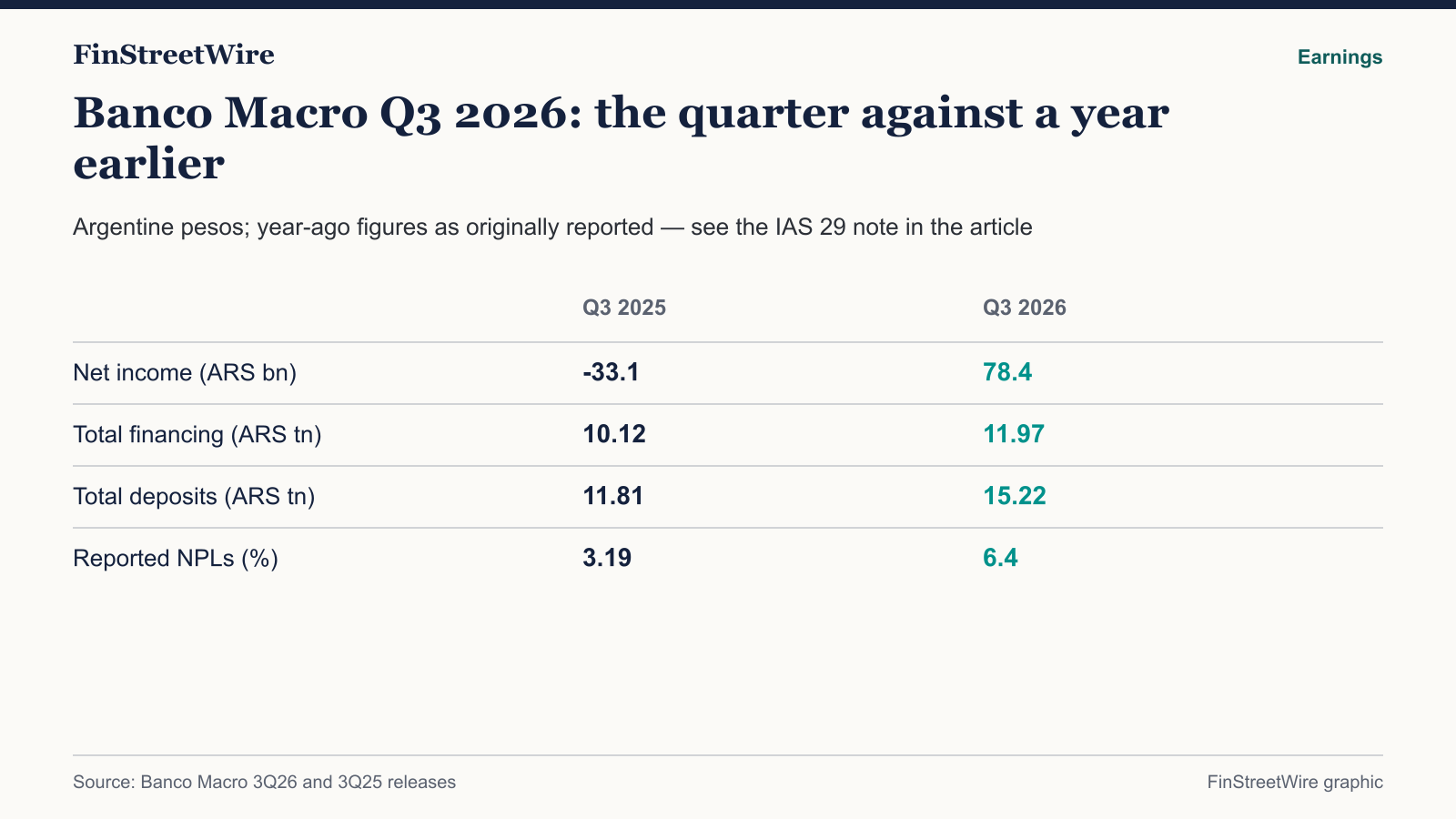
Set against a year earlier, the quarter still looks like a recovery. Banco Macro lost ARS 33.1bn in the third quarter of 2025, so the swing to a ARS 78.4bn profit is ARS 111.5bn, by our calculation. The nine-month comparison points the same way: ARS 455.1bn against ARS 176.7bn for the first nine months of 2025. Readers should treat that comparison with care, though. Argentina reports under IAS 29, the inflation-accounting standard, so earlier periods are restated into end-of-period pesos; a nominal comparison across years overstates the real increase.[1][3]
| Measure | Q3 2025 | Q2 2026 | Q3 2026 |
|---|---|---|---|
| Net income (ARS bn) | -33.1 | ~217.8* | 78.4 |
| Net interest margin | — | 24.1%* | 20.5% |
| Total financing (ARS tn) | 10.12 | — | 11.97 |
| Total deposits (ARS tn) | 11.81 | — | 15.22 |
* Our calculation from the bank's stated changes (net income down 64% quarter on quarter; margin down 360 basis points). Year-ago levels are as originally reported; the bank restates earlier periods for inflation under IAS 29, so nominal comparisons across years overstate real change. Source: Banco Macro 3Q26 and 3Q25 releases.
Margins narrowed as funding costs bit
The profit drop had a clear engine: the interest margin. Net interest income — the gap between what the bank earns on loans and pays on deposits — fell 15% from the second quarter, though it was still 2% higher than a year earlier. The net interest margin, which expresses that income as a share of earning assets, reached 20.5%, down 360 basis points from the second quarter and 180 from a year earlier on the bank's restated figures. Strip out foreign exchange and securities income and the margin was 15.6%, against 17.6% in the second quarter. The bank blamed smaller contributions from currency moves and securities.[1]
Returns on equity and assets tell the same story of a thin quarter. Annualized return on average equity was 4.6% and return on average assets 1.2%. The quarter also carried ARS 39.6bn of restructuring costs, ARS 25.7bn after tax, tied to early-retirement and severance programs. Without them, adjusted net income was ARS 104.1bn, with adjusted returns of 6.2% on equity and 1.6% on assets. Even on that cleaner basis the quarter was weak: adjusted profit was still roughly a third above the reported figure, by our calculation, and still well short of the second quarter.[1]
Lending shrank and bad loans doubled
The balance sheet contracted. Total financing fell 3% from the second quarter to ARS 11.97tn, led by commercial lending: overdrafts dropped 19%. Peso lending fell 7%, or ARS 645.1bn, while dollar lending grew 6% in dollar terms, adding USD 120m. Deposits fell 2% to ARS 15.22tn as private-sector time deposits dropped 7%, partly offset by higher public-sector deposits.[1]
Credit quality worsened. Reported non-performing loans rose 15 basis points to 6.4% of financing, and Stage 3 loans — the riskiest bucket — rose 58 basis points to 4.66%. A year earlier the non-performing ratio was 3.19%, so it has roughly doubled. The bank said part of the rise reflects mandatory reclassifications across the Argentine system rather than new defaults. Its coverage still looks solid: provisions cover 104.27% of bad loans, against 88.2% for the system, and its 6.4% bad-loan ratio sits below the system's 7.1%.[1][3]
Capital is not the worry. Tier 1 capital was 34.2% of risk-weighted assets, and the bank held ARS 4.8tn of capital above the minimum. Liquid assets covered 75% of deposits, and loans were 78% of deposits, almost unchanged from the second quarter. The efficiency ratio — costs as a share of income — was 40.1%, which the bank said was sharply lower than a year earlier as its cost-cutting program continued. The bank ended the quarter with 394 branches and 8,025 staff serving 6.39 million retail customers and more than 230,000 corporate clients across 23 of Argentina's 24 provinces.[1]
What to watch
- The earnings call on Monday, November 30, at 11:00 a.m. Eastern, when management will face questions on the margin slide and the restructuring.
- Whether non-performing loans keep rising in the fourth quarter, or the reclassification effect washes through.
- Deposit flows: private time deposits fell 7% in the quarter, and further outflows would tighten funding.
- Whether the restructuring delivers the cost savings the bank is counting on, and what the next quarter's underlying profit looks like without the charge.
Questions readers ask
- Why do some headlines say Banco Macro made ARS 455bn in the third quarter?
- Because the filing's headline profit figure — ARS 455,088,057 thousand — covers the nine months to September 30, 2026, not the quarter alone. The third quarter's profit was ARS 78.4bn; the first two quarters supplied the other ARS 376.7bn, by our calculation.[1][2]
- What does IAS 29 restatement mean for the year-ago comparisons?
- Argentina is a hyperinflationary economy, so Banco Macro restates earlier figures into pesos of the current period's purchasing power. That makes profit and balance-sheet levels from a year ago look larger than originally reported, so nominal growth rates across years overstate the real change.[1]
- Did the market punish the results?
- Not on the day. The New York-listed shares closed at $50.35 on November 25, up 0.5% on the session, and added 2.4% after hours to $51.54. The shares are still down about 39% over the past year, according to Finnhub data.[4]
Sources
- Banco Macro Announces Results for the Third Quarter of 2026. Banco Macro S.A. via PR Newswire, Summary: Q3 net income ARS 78.4bn down 64% QoQ; NII down 15% QoQ, up 2% YoY; ROAE 4.6%, ROAA 1.2%; restructuring ARS 39.6bn pre-tax / ARS 25.7bn after tax; adjusted net income ARS 104.1bn; NIM 20.5%, down 360 bps QoQ and 180 bps YoY; ex-FX/securities NIM 15.6% vs 17.6% in 2Q26; financing ARS 11.97tn down 3% QoQ; deposits ARS 15.22tn down 2% QoQ; efficiency 40.1%; Tier 1 34.2%, excess capital ARS 4.8tn; liquid assets 75% of deposits; loans-to-deposits 78%; NPLs 6.4%, Stage 3 4.66%, coverage 104.27% vs system 88.2%, system NPL 7.1%; 394 branches, 8,025 employees, 6.39m retail customers, 230,897 corporate customers; call Nov 30, 2026. Accessed .
- Banco Macro Reports Third-Quarter Financial Results on Nov. 25. TipRanks, Board-approved statements for the period ended September 30, 2026: total net income 455,088,057 thousand pesos; total net shareholders' equity 6,735,757,939 thousand pesos. Accessed .
- Banco Macro Announces Results for the Third Quarter of 2025. Banco Macro S.A. via PR Newswire, 3Q25 net income a Ps. 33.1 billion loss; 9M25 net income Ps. 176.7 billion; total financing Ps. 10.12 trillion; total deposits Ps. 11.81 trillion; non-performing ratio 3.19%, coverage 120.87%; Tier 1 29.2%; excess capital Ps. 3.3 trillion. Accessed .
- Banco Macro SA (BMA): Financial Market Data. Finnhub, Nov 25, 2026 close $50.35, up $0.26 (+0.52%) on the prior close of $50.09; after-hours $51.54 (+2.36%); 1-year return -38.75%. Accessed .