RTX's $25 billion quarter hides a flat Pratt & Whitney margin
A $0.25 tariff refund lifted RTX's earnings, but Pratt & Whitney's margin was flat once it is stripped out — and free cash flow fell 47%.
5 min read
RTX's third quarter looks strong at the top of the release and weaker underneath it. Sales rose double digits, the full-year outlook went up, and the backlog hit a record. But a quarter of the earnings beat came from a tariff refund, the cash flow fell by nearly half, and the engine business — the one investors watch most closely — earned no more margin than it did a year ago once the refund is removed.[1]
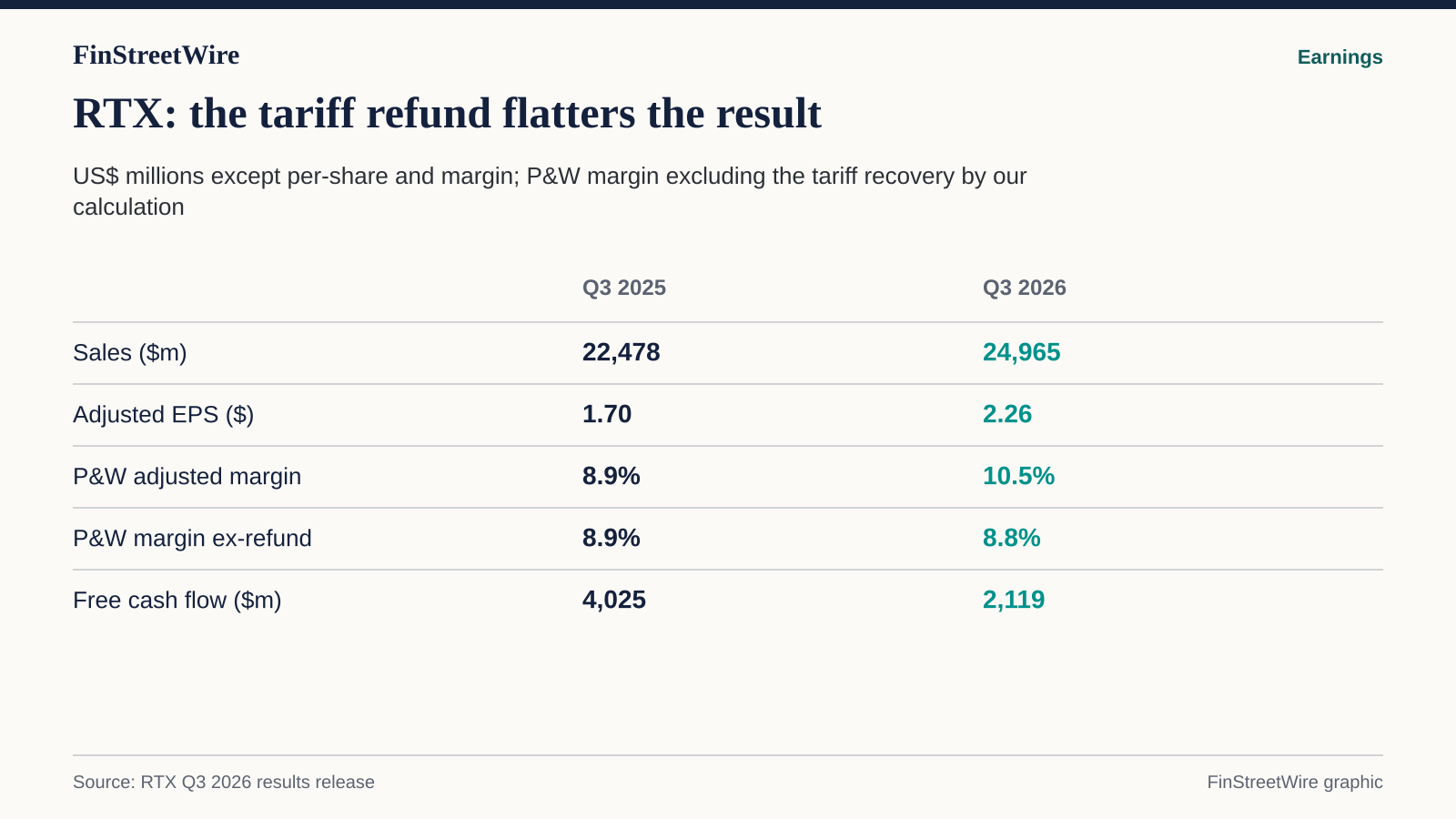
Sales were $24,965 million for the three months ended September 30, up 11% on a year earlier and 12% on an organic basis. GAAP net income rose 35% to $2,583 million and GAAP earnings per share rose 34% to $1.89. Adjusted net income rose 34% to $3,091 million, and adjusted earnings per share rose 33% to $2.26, against $1.70 a year ago.[1]
The tariff refund did the heavy lifting
The release is explicit about how much of the result the refund supplied. Segment operating profit grew by $1.1 billion on an adjusted basis, and $0.4 billion of that growth was the recovery of tariff costs under IEEPA. Adjusted earnings per share included $0.25 from that recovery — more than a tenth of the $2.26 total.[1]
The refund was spread across the segments: about $250 million at Collins Aerospace and about $160 million at Pratt & Whitney. At Collins it helped lift adjusted operating profit 50% to $1,788 million, a margin of 21.3% against 15.7% a year ago. At Raytheon, adjusted operating profit rose 32% to $1,134 million, a margin of 14.1%, helped by about $85 million of benefits from an international contract modification and a favourable offset obligation adjustment.[1]
Strip the refund out and the earnings picture changes. Adjusted net income of $3,091 million includes the $0.4 billion recovery; by our calculation, without it adjusted net income would be about $2.69 billion, up about 16% on the $2,311 million of a year earlier rather than 34%. The company does not disclose an ex-refund earnings per share figure, so the exact number is not stated — but the direction is clear from the segment figures.[1]
| Segment | Sales ($m) | Adjusted operating profit ($m) | Adjusted margin |
|---|---|---|---|
| Collins Aerospace | 8,382 | 1,788 | 21.3% |
| Pratt & Whitney | 9,231 | 968 | 10.5% |
| Raytheon | 8,031 | 1,134 | 14.1% |
Adjusted figures as reported by RTX. Segment sales do not sum to consolidated sales of $24,965 million because segment sales exclude eliminations and other items. Source: RTX Q3 2026 results release.
Pratt & Whitney's margin was flat without the refund
Pratt & Whitney is the story the headline misses. Sales rose 10% to $9,231 million, with commercial aftermarket up 21% on demand for geared turbofan engines, military up 2% and commercial original equipment down 5%. Reported operating profit fell 19% to $608 million, a margin of 6.6% against 8.9% a year ago, after a $363 million charge for a customer bankruptcy.[1]
On an adjusted basis the business looks better — operating profit of $968 million, up 29%, a margin of 10.5% against 8.9% a year ago. But about $160 million of that profit was the tariff recovery. Strip it out and adjusted operating profit is about $808 million, a margin of about 8.8% — down about 15 basis points on a year earlier, not up 160. The margin improvement is the refund, not the engines.[1]
“Our strong execution and operational focus in the third quarter enabled RTX to deliver double-digit organic sales growth across commercial aerospace and defense.”
The bankruptcy charge matters because it is the reason reported profit fell while adjusted profit rose. The release does not name the customer or say how much of the $363 million may be recovered. What it does say is that the charge, not the tariff refund, drove the reported result down 19%.[1]
Cash flow fell by nearly half
The cash figures are the weakest part of the quarter. Operating cash flow was $2,868 million, down 38% from $4,639 million a year earlier, including about $0.3 billion of tariff recovery. Capital expenditure was about $0.7 billion, leaving free cash flow of $2,119 million, down 47% from $4,025 million.[1]
The release does not explain the cash decline in detail. What it does show is that the shortfall is not the tariff story: even including the $0.3 billion recovery, operating cash flow fell by $1.77 billion on a year earlier. The full-year free-cash-flow outlook was raised to $9.0 to $9.2 billion from $8.50 to $8.75 billion, which implies a strong fourth quarter.[1]
The backlog gives the company room to recover the cash. It reached $340 billion at the end of the quarter, $176 billion commercial and $164 billion defense, after more than $81 billion of new awards — including multi-year production contracts for Tomahawk and AMRAAM missiles that were not yet fully priced. The shares closed at $193.34 on October 20, up 0.6% on the day, and at $198.48 on November 27.[1][2]
What to watch
- Pratt & Whitney's adjusted margin excluding tariff recovery in the fourth quarter, against about 8.8% in the third.
- Whether operating cash flow recovers in the fourth quarter toward the $9.0 to $9.2 billion full-year free-cash-flow outlook.
- Further charges or recoveries from the $363 million customer bankruptcy at Pratt & Whitney.
- Backlog conversion: how much of the $340 billion, and the $81 billion of new awards, turns into 2027 sales.
- Any further tariff-cost recovery, and whether it is recurring or one-off.
Questions readers ask
- Did RTX really beat expectations?
- Sales rose 11% and adjusted earnings per share rose 33% to $2.26, but $0.25 of that came from a tariff refund. Excluding the $0.4 billion recovery, adjusted net income rose about 16% rather than 34%. The beat is real, but about half of it is the refund.[1]
- Why is Pratt & Whitney's margin flat?
- Adjusted margin was 10.5%, up from 8.9% a year ago, but about $160 million of the $968 million adjusted operating profit was tariff recovery. Without it the margin is about 8.8%, essentially unchanged. Reported margin fell to 6.6% after a $363 million customer bankruptcy charge.[1]
- What does RTX expect next?
- Full-year adjusted sales of $97.0 to $97.5 billion, organic growth of 10% to 11%, adjusted earnings per share of $7.65 to $7.75 and free cash flow of $9.0 to $9.2 billion — all raised from the prior outlook. The backlog stands at $340 billion.[1]
Sources
- RTX Reports Q3 2026 Results. RTX Corporation, Headline results, segment results, IEEPA cost recovery, cash flow, backlog, full-year outlook, CEO quote. Accessed .
- RTX Corporation (RTX): Historical Data. Yahoo Finance, Daily closes: Oct 19 2026 $192.11; Oct 20 $193.34; Nov 27 $198.48. Accessed .
Corrections
- : Key Takeaways rewritten for concision: the same findings, now in shorter one-line bullets in the article's writer voice. No facts, figures or body text changed.