USTR proposes tariffs of up to 35% on 14 economies — but nothing takes effect before late January
USTR proposed tariffs of 15% to 35% on 14 economies whose industrial policies it found burden US commerce. The rates are ceilings, net of existing duties.
4 min read
The United States Trade Representative on November 25 proposed additional tariffs on 14 economies, from 15% to 35%, after finding that their industrial policies on structural excess capacity in manufacturing are unreasonable and burden or restrict US commerce. The action, under Section 301 of the Trade Act of 1974, covers, in alphabetical order, Bangladesh, Cambodia, China, the European Union, India, Indonesia, Japan, Korea, Malaysia, Singapore, Switzerland, Taiwan, Thailand and Vietnam. No determination was made for Mexico or Norway, the other two economies investigated.[1]
The rates, economy by economy
| Economy | Proposed ceiling | Conditions |
|---|---|---|
| Bangladesh | 18% | Net of existing Section 301 tariffs |
| Cambodia | 18% | Net of existing Section 301 tariffs |
| China | 20% | Net of forced-labour Section 301 rate; Annex A goods 10%; Annex B exempt |
| European Union | 15% | Net of MFN rates and existing Section 301 tariffs |
| India | 25% | Net of existing Section 301 tariffs; 17% with a responsive trade agreement |
| Indonesia | 18% | Net of existing Section 301 tariffs |
| Japan | 15% | Net of MFN rates and existing Section 301 tariffs |
| Korea | 15% | Net of MFN rates and existing Section 301 tariffs |
| Malaysia | 18% | Net of existing Section 301 tariffs |
| Singapore | 20% | Net of existing Section 301 tariffs; 10% with a reciprocal trade agreement |
| Switzerland | 15% | Net of MFN rates and existing Section 301 tariffs |
| Taiwan | 15% | Net of MFN rates and existing Section 301 tariffs |
| Thailand | 18% | Net of existing Section 301 tariffs |
| Vietnam | 35% | Net of existing Section 301 tariffs; 20% with a responsive trade agreement |
Rates are ceilings on all goods except products exempted in the annexes to each Federal Register notice. Source: USTR, November 25, 2026.
The investigations began on March 11, 2026, covering 16 economies. The determinations rest on economy-specific reports that catalogue industrial plans, production incentives, financial repression, weak labour protections and reliance on inputs from non-market economies, and conclude that those practices cut commercial opportunities for US producers, cost US production, exports, jobs and investment, and raise US economic security risks.[1]
The fine print: ceilings, carve-outs and trade-deal discounts
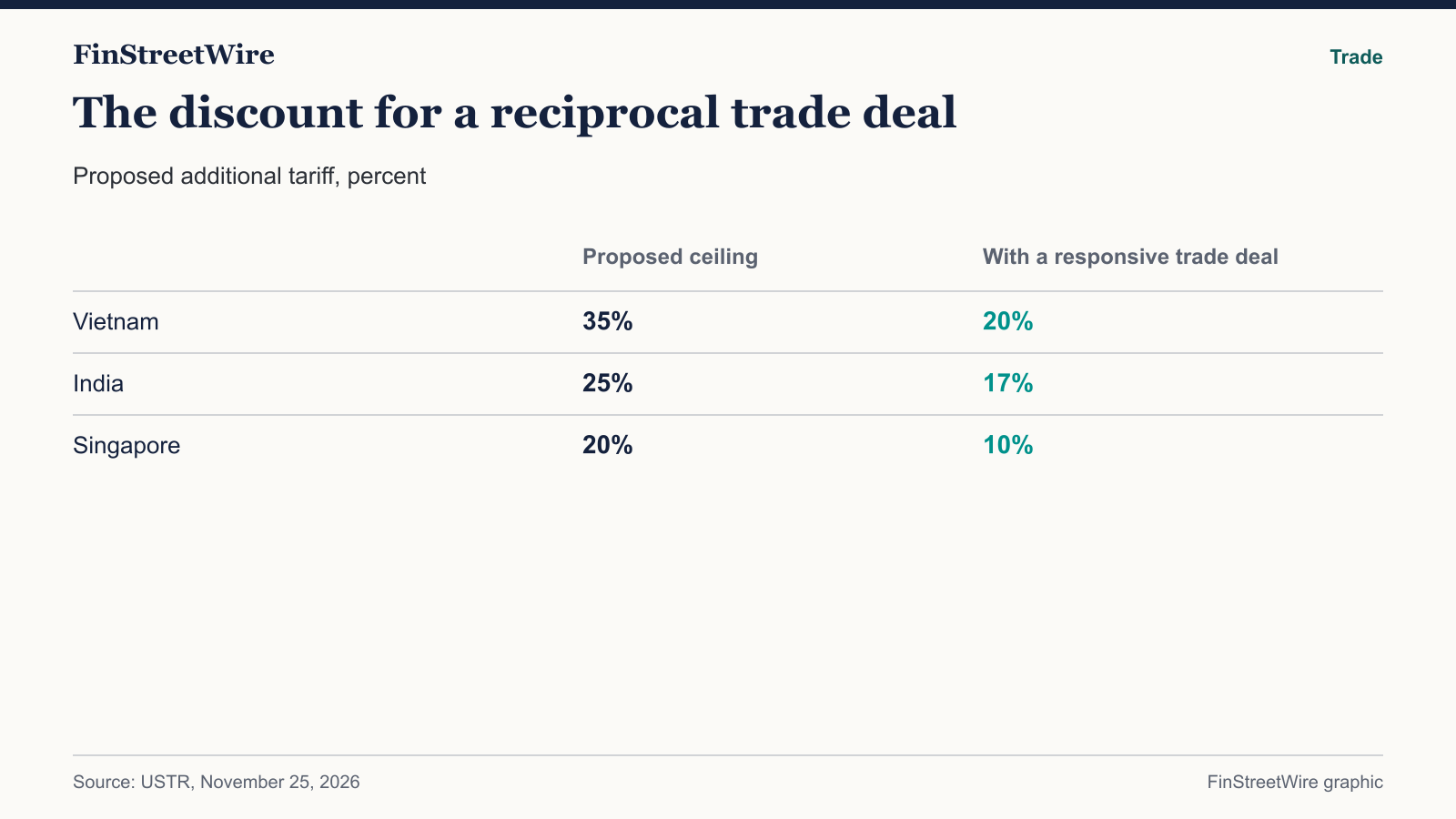
Three features of the proposal matter more than the headline numbers. First, every rate is a ceiling, stated as up to the figure given, and most are stated net of existing Section 301 duties, so the additional charge on goods already carrying such duties would be smaller than the headline rate. For the EU, Japan, Korea, Switzerland and Taiwan, the rate is also net of most-favoured-nation duties. Second, the annexes exempt certain goods entirely: for China, goods in Annex A face at most 10% and goods in Annex B, the US-China Board of Trade's 30-For-30 list, are exempt. The China proposal also takes into account the 20% rate in the arrangement Presidents Trump and Xi agreed in Kuala Lumpur on October 30, 2025. Third, three economies can cut their rate by reaching a trade deal: India from 25% to 17%, Vietnam from 35% to 20% and Singapore from 20% to 10%.[1]
“But where successive statements at the G7, G20, WTO and other fora have not resulted in change, President Trump is proposing to take action to bring about the elimination of these unfair acts, policies, and practices.”
Why Section 301, and why now
The proposal follows the Supreme Court's decision on February 20, 2026, which held by 6-3 that the International Emergency Economic Powers Act does not authorise the President to impose tariffs, WCMU reported, closing the route used for the earlier tariff programme. With that route closed, the administration has turned to statutes that expressly provide tariff authority, including Section 301 of the Trade Act of 1974.[1][2]
What happens next
Interested persons must submit hearing requests with a summary of testimony, and written comments, by January 5, 2027. USTR will hold hearings on January 25, 2027. Only after that process could duties be imposed, and the final rates could differ from the proposals, including lower rates for economies that reach responsive trade agreements.[1]
- The January 5, 2027 deadline for written comments and hearing requests.
- The January 25, 2027 hearings, and any changes USTR makes to the proposed rates afterwards.
- Whether India, Vietnam or Singapore reach reciprocal trade agreements that would cut their rates to 17%, 20% and 10%.
- The annexes to each Federal Register notice, which exempt certain goods from the new duties.
Questions readers ask
- Are the tariffs in effect?
- No. USTR has proposed them and invited public comment. Written comments and hearing requests are due January 5, 2027, and hearings are scheduled for January 25, 2027. Nothing can take effect before that process runs.[1]
- Which economy faces the highest proposed rate?
- Vietnam, at up to 35% on all goods, net of existing Section 301 tariffs. The rate would fall to 20% if Vietnam reaches a reciprocal trade agreement with the United States that is responsive to the investigation's findings.[1]
Sources
- USTR Makes Determinations and Proposes Actions in 14 Section 301 Investigations Relating to Structural Excess Capacity and Production in Manufacturing Sectors. Office of the United States Trade Representative, Determinations for 14 economies; no determination for Mexico or Norway; proposed tariff rates by economy; Annex A and B; comments due January 5, 2027; hearings January 25, 2027; investigations opened March 11, 2026. Accessed .
- Supreme Court strikes down Trump's tariffs. WCMU, Supreme Court held 6-3 on February 20, 2026 that IEEPA does not authorise tariffs. Accessed .