Houthi strikes reach Saudi Arabia's Red Sea ports, the route the kingdom relies on to bypass Hormuz
A projectile hit Jazan port and a drone was downed near Jeddah, the coalition said, as attacks also targeted Ras Tanura and Riyadh's financial district.
3 min read
Yemen's Houthis have extended their attacks on Saudi Arabia to its Red Sea ports, the coast the kingdom has relied on more heavily for exports during the US-Iran war.[1][2]
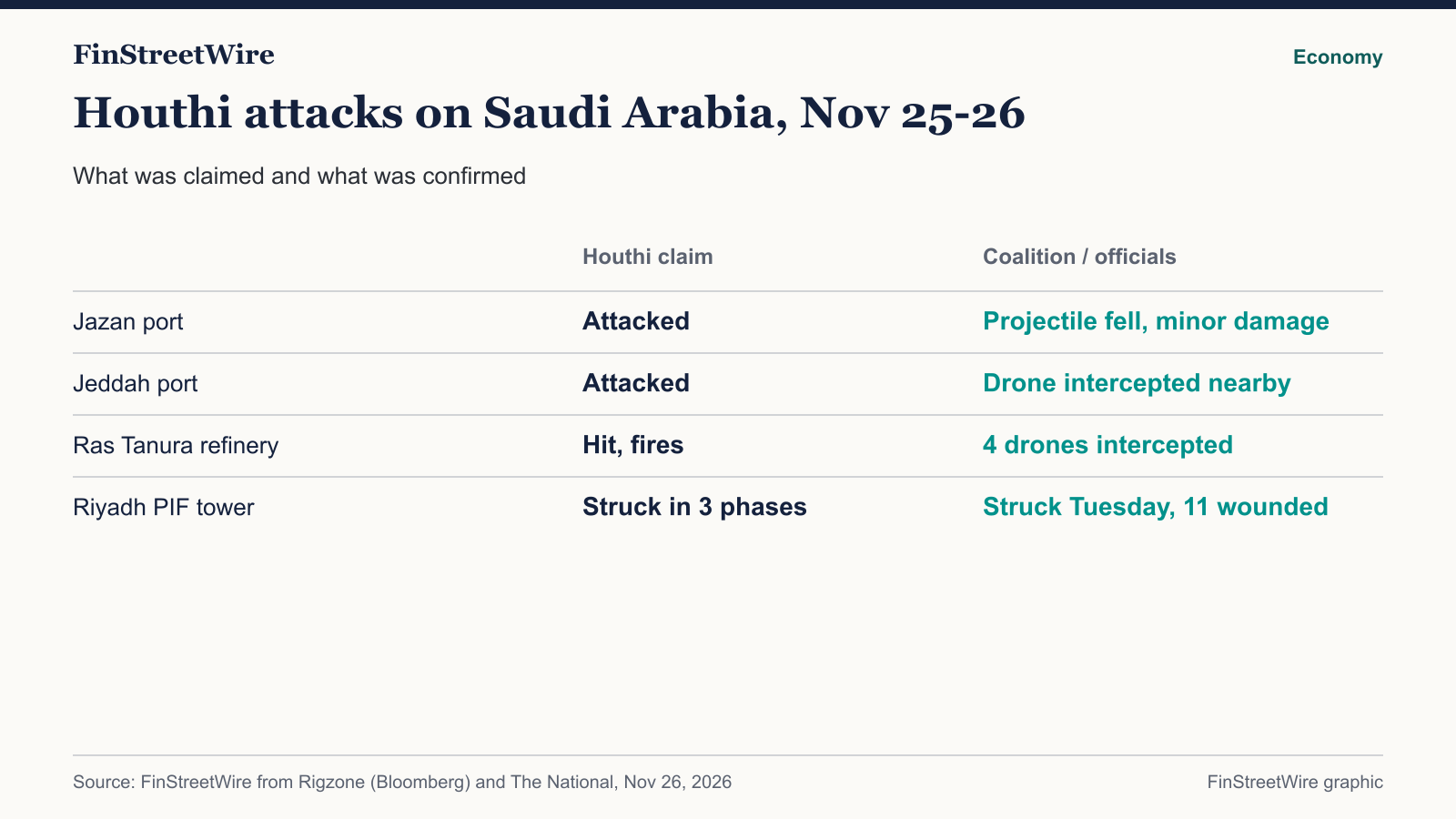
On Wednesday a projectile fell on Jazan port, causing minor damage and no civilian casualties, and a drone was intercepted near Jeddah Islamic Port, the kingdom's biggest, according to coalition spokesman Turki al-Maliki. The Houthis said both were retaliation for coalition strikes on the Yemeni port of Hodeidah.[1][2]
The coalition reported further interceptions on Thursday, including two ballistic missiles fired towards Riyadh and two drones over the Eastern Province, The National reported.[2]
Why the Red Sea coast matters now
Attacks on ports carry a different economic weight from strikes on cities. Since the US-Iran war raised the risk of shipping through the Strait of Hormuz, Saudi Arabia has leaned more heavily on its Red Sea coast. The Ras Tanura complex on the Gulf served as the kingdom's main crude export terminal until the war increased the importance of Yanbu on the Red Sea, which receives crude through the East-West pipeline, The National reported.[2]
Jazan and Jeddah are not the main crude export points, and the reported damage so far is small. But striking the Red Sea coast at all signals that the route Saudi Arabia uses to avoid the Gulf is within range. The Houthis have also made gains near Bab el-Mandeb, the strait at the southern end of the Red Sea through which ships reach the Suez Canal, Rigzone reported.[1][2]
Claims and confirmations
Several claims remain unconfirmed. The Houthis said they targeted Ras Tanura, a refinery with capacity of 550,000 barrels a day, and their spokesman Yahya Saree said the strike caused fires; the coalition said it intercepted four drones over the site without saying the facility was hit. A strike in October damaged the refinery and kept its main crude unit offline for at least a month, according to consultancy Energy Aspects as cited by Rigzone.[1][2]
In Riyadh, the tower housing the Public Investment Fund's headquarters was hit on Tuesday for the second time in a week, wounding 11 people, according to Saudi civil defense. Earlier attacks have temporarily disrupted some Saudi Aramco operations and led to the cancellation of most international flights to Riyadh, The National reported.[2]
The economic backdrop
The conflict is already in the numbers. Saudi Arabia expects its $1.3 trillion economy to contract 2.1% this year and its fiscal deficit to widen to 4.9% of output, according to the Rigzone report, while Finance Minister Mohammed Al-Jadaan has played down the impact of the Houthi conflict. The kingdom has postponed its flagship Future Investment Initiative conference until October 2027.[1]
For markets, the questions are whether attacks on export infrastructure succeed rather than being intercepted, and whether shipping insurers start to price the Red Sea coast as they have the Gulf. A truce from 2022 ended in July when the Houthis announced a blockade of Saudi ports; since then the attacks have widened from cities to energy sites, airports and now ports.[1]
Questions readers ask
- Was Jeddah port damaged?
- There was no immediate confirmation. The coalition said a drone was intercepted near Jeddah Islamic Port; the confirmed damage was at Jazan, described as minor.[1][2]
- Was the Ras Tanura refinery hit?
- The Houthis claimed it was and said fires broke out; the coalition said it intercepted four drones and did not say the facility was hit.[1][2]
Sources
- Houthis Strike Saudi Ports on Red Sea (Bloomberg). Rigzone, Full report. Accessed .
- Saudi Arabia intercepts wave of retaliatory Houthi attacks. The National, Full report. Accessed .
Corrections
- : Tightened the summary, key takeaways and opening for readability and applied house spelling. No facts or figures changed.