Cogent’s Ekitna wins FDA approval with 16.5-month median PFS in GIST
Ekitna plus sunitinib kept advanced GIST from progressing for a median 16.5 months, against 9.2 months for sunitinib alone, in the PEAK trial.
5 min read

The Food and Drug Administration approved Cogent Biosciences’ Ekitna on November 24 for adults with advanced gastrointestinal stromal tumors (GIST) who have already received imatinib, the first new treatment for that group in more than 20 years.[1][2]
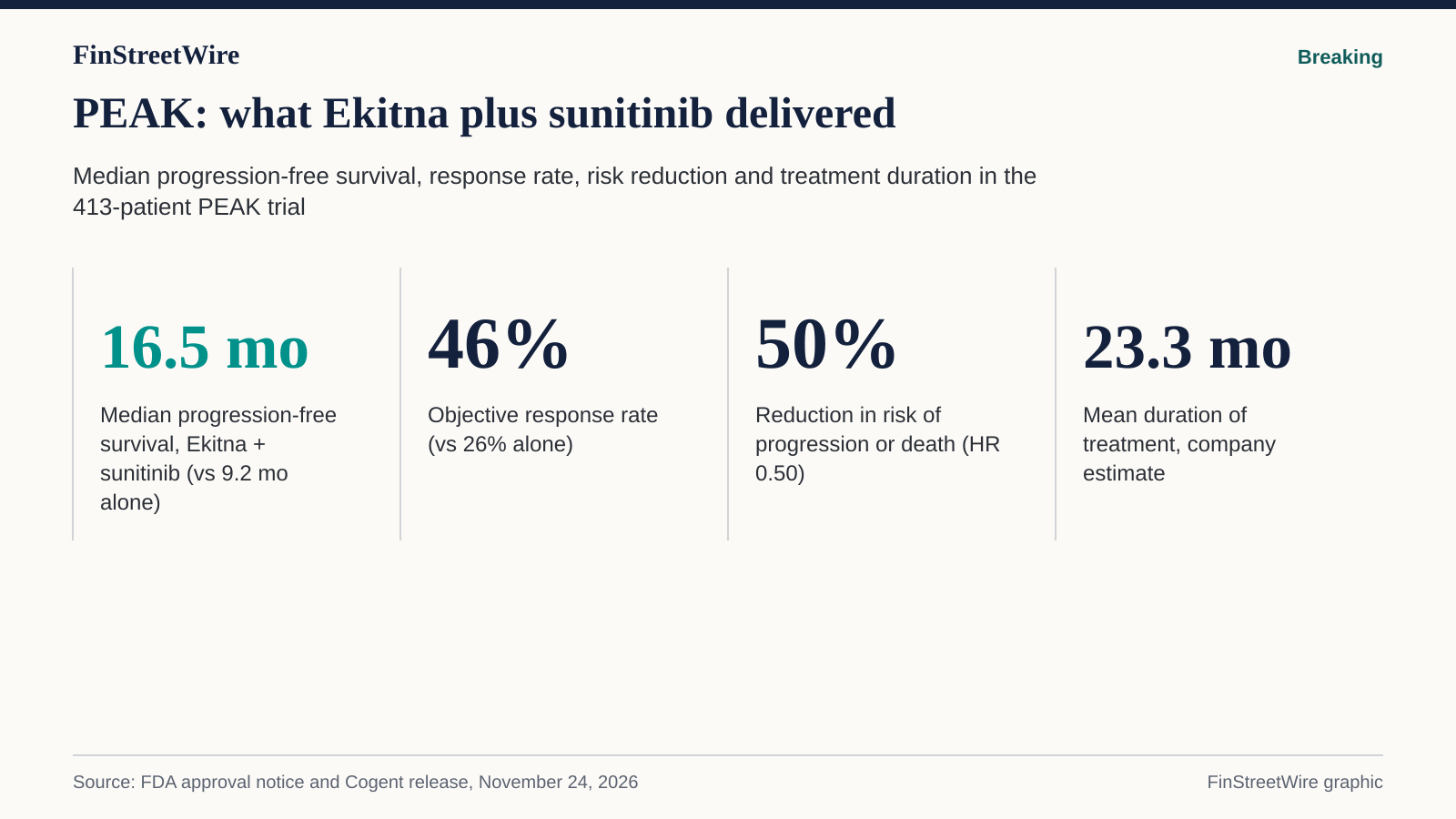
The approval rests on the PEAK trial, where Ekitna plus sunitinib held the cancer in check for a median 16.5 months, against 9.2 months for sunitinib alone — a 50% reduction in the risk of progression or death — and shrank tumors in 46% of patients, against 26% on sunitinib alone. Overall survival data were not yet mature when the progression-free survival analysis was done.[1][2]
The FDA announced the approval on November 24, and Cogent said the drug is now available by prescription in the United States, with a patient support program, Cogent Connect, to help with access. The shares climbed 20% to $33.86 on November 24, Dow Jones reported.[1][2][4]
What the PEAK trial showed
PEAK enrolled 413 patients with advanced GIST whose disease had progressed on imatinib or who could not tolerate it, and randomized them to Ekitna plus sunitinib or sunitinib alone, each taken once a day. The main measure was progression-free survival — how long patients lived without the cancer growing — judged by blinded independent central review. Patients on sunitinib alone were allowed to cross over to the combination after their cancer progressed.[1][2]
The gap was wide and it appeared early. Cogent said Ekitna was the first GIST treatment to show a statistically significant progression-free survival benefit against an active comparator, rather than against a placebo. The company also puts the mean duration of treatment at about 23.3 months for patients on the combination, a figure that matters because GIST is treated continuously until the cancer progresses.[1][2]
| Measure | Ekitna + sunitinib | Sunitinib alone |
|---|---|---|
| Median progression-free survival | 16.5 months (95% CI 13.8–19.2) | 9.2 months (95% CI 7.2–11.0) |
| Hazard ratio, progression or death | 0.50 (95% CI 0.39–0.65), p<0.0001 | — |
| Objective response rate | 46% (95% CI 39–53) | 26% (95% CI 20–32) |
| Overall survival | Not mature | Not mature |
Progression-free survival by blinded independent central review. Source: FDA approval notice and Cogent Biosciences release, November 24, 2026.
The safety warning and the dose
The label carries a boxed warning for hepatotoxicity — liver injury. Liver enzymes rose in 43% of patients on the combination, with severe (Grade 3) rises in 8%, and bilirubin rose in 13%, with severe rises in 0.5%. Most first rises in liver enzymes happened within the first four months, and the label tells clinicians to check liver tests before starting and during treatment, and to pause, lower the dose or stop Ekitna depending on severity.[1][2]
The recommended dose is bezuclastinib 600 mg taken by mouth once a day, together with sunitinib 37.5 mg once a day. The FDA reviewed the application under its Real-Time Oncology Review program, which lets the agency start its assessment before the full application is filed, and granted it priority review. Bezuclastinib also holds breakthrough therapy and orphan drug designations for this use.[1]
“On behalf of all Cogent employees, we are extremely proud to launch Ekitna, which brings new hope to GIST patients searching for better treatment options.”
What comes next for bezuclastinib
GIST is the first of three decisions Cogent is waiting on for bezuclastinib. The drug is also under review for systemic mastocytosis, a rare disease driven by the same KIT D816V mutation the drug is designed to block, with target decision dates of December 30, 2026 for non-advanced disease and June 29, 2027 for advanced disease. Cogent plans to present bezuclastinib data at the American Society of Hematology meeting in New Orleans on December 12–15, 2026.[2][3]
The launch will be funded from a strong balance sheet. Cogent held $791.1 million in cash, cash equivalents and marketable securities at September 30, 2026, which it expects to fund operations into late 2028, well past all three decision dates for bezuclastinib. That gives the company room to build the Ekitna launch without raising money first.[3]
Approved drugs command large prices: Sanofi’s $41 billion acquisition of Insmed, at $175 a share in cash, was built around two lung drugs, one of them newly launched. It follows Neuralink’s FDA approval for its first pivotal brain-computer trial, another first for its field.[2]
“This approval represents a major step forward for the GIST community and reflects the tireless progress made in improving the lives of people living with this disease.”
Questions readers ask
- What is GIST, and who gets Ekitna?
- GIST is a cancer of the gastrointestinal tract that depends heavily on KIT signaling. Ekitna, taken with sunitinib, is for adults with advanced GIST who have already received imatinib and whose cancer progressed or who could not tolerate it.[1][2]
- How much longer did Ekitna keep the cancer in check?
- A median 16.5 months, against 9.2 months for sunitinib alone, in the 413-patient PEAK trial. That is a 50% lower risk of progression or death, and tumors shrank in 46% of patients on the combination against 26% on sunitinib alone.[1][2]
- What is the main safety concern?
- Liver injury. The label carries a boxed warning for hepatotoxicity: liver enzymes rose in 43% of patients on the combination, with severe rises in 8%. Clinicians must check liver tests before starting and during treatment.[1][2]
Sources
- FDA approves bezuclastinib in combination with sunitinib for advanced gastrointestinal stromal tumors. U.S. Food and Drug Administration, Approval, PEAK efficacy (mPFS, ORR, OS), boxed warning, recommended dose, RTOR/priority review/breakthrough/orphan designations. Accessed .
- Cogent Biosciences Announces FDA Approval and Launch of EKITNA (bezuclastinib) for the Treatment of Patients with Gastrointestinal Stromal Tumors (GIST) Who Have Received Prior Treatment with Imatinib. Cogent Biosciences, Approval, first-in-20-years, PEAK data, 23.3-month mean duration of treatment, Cogent Connect, Robbins and Wagner quotes; release text in staged sidecar. Accessed .
- Cogent Biosciences Reports Recent Business Highlights and Third Quarter 2026 Financial Results. Cogent Biosciences (via Nasdaq), Cash $791.1 million at September 30, 2026, funded into late 2028; PDUFA dates December 30, 2026 (NonAdvSM) and June 29, 2027 (AdvSM); ASH posters December 12-15, 2026. Accessed .
- Cogent Biosciences Shares Climb on FDA Approval for Tumor Treatment. Dow Jones Newswires (via Morningstar), Shares climbed 20% to $33.86 on November 24; still down about 5% in 2026. Accessed .
Corrections
- : Key Takeaways correction: one bullet restored a dropped attribution or qualifier that the concision rewrite had removed. No facts, figures or body text changed.