Kymera’s KT-621 cuts eczema severity 72% in trial, then raises $2.01 billion
KT-621 cut eczema severity by 72% at the mid dose, against 27% for placebo, and Kymera priced a $1.75 billion offering that day, closing it at $2.01 billion.
6 min read
Kymera Therapeutics’ oral eczema drug KT-621 cut disease severity by 72% in a Phase 2b trial, against 27% for a placebo, and the company raised about $2 billion in new shares on the same day, pricing the offering hours after the results.[1][2][3]
The result matters because KT-621 is a pill, not an injection, and it targets STAT6, the transcription factor that drives IL-4 and IL-13 signaling in Type 2 inflammation. The approved biologics for eczema are all injected, and Kymera says an oral drug that matches them could reach far more patients — including the millions who never start an injectable. The company put the mid dose’s placebo-adjusted EASI reduction at 45%, EASI-75 at 40% and itch response at 38%, and said the profile was at least comparable to approved pathway biologics.[2]
Kymera announced the results on November 23 and filed them with the Securities and Exchange Commission the same day. The offering, priced that evening at $150.37 a share, closed on November 25 after the underwriters exercised their full option to buy 1,745,700 more shares.[1][2][3]
What BROADEN2 showed at Week 16
BROADEN2 enrolled 244 adults and adolescents with moderate to severe atopic dermatitis — the most common form of eczema — and randomized them one-to-one-to-one-to-one to a low dose (61 patients), a mid dose (61), a high dose (63) or a placebo (59), taken once a day for 16 weeks. The average eczema severity score at entry was about 28, the average itch score 7.1, 38% had severe disease and a third had already tried a biologic. Of the 244, 234 finished the 16 weeks and 230 went on to a 52-week open-label extension.[1][2]
The mid dose, chosen to hit the optimal STAT6 pharmacology, delivered the largest numerical improvements on every measure. The low dose cut EASI by 64% and the high dose by 61%, both statistically significant, but the mid dose led on all of them. Clear or almost clear skin — a score of 0 or 1 on the validated Investigator Global Assessment — was reached by 38% of mid-dose patients, against 11% on placebo.[1][2]
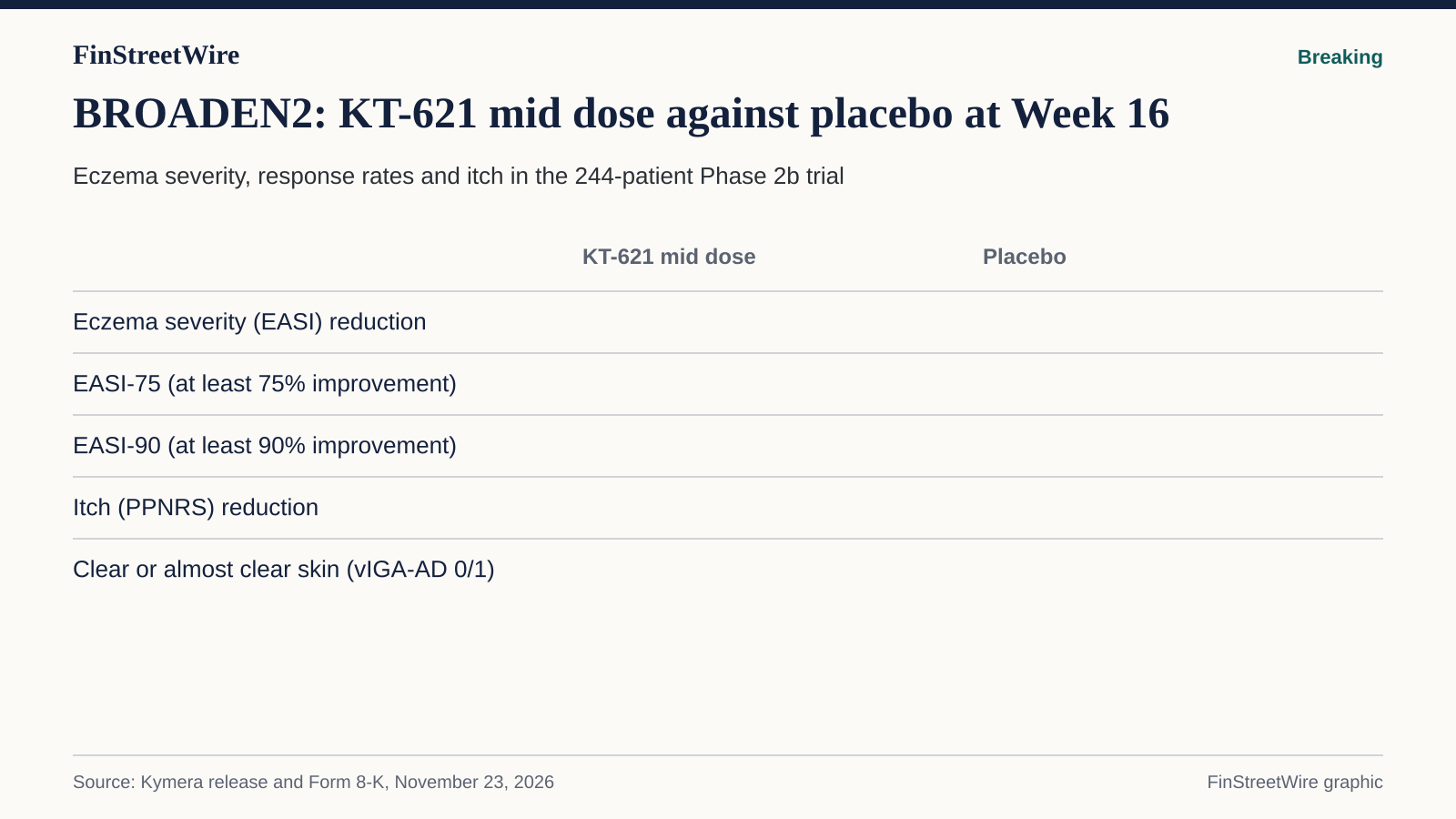
| Measure | KT-621 mid dose | Placebo |
|---|---|---|
| EASI change from baseline | −72% | −27% |
| EASI-75 (at least 75% improvement) | 62% | 22% |
| EASI-90 (at least 90% improvement) | 43% | 10% |
| Clear or almost clear skin (vIGA-AD 0/1) | 38% | 11% |
| Itch (PPNRS) change from baseline | −58% | −21% |
| At least a 4-point itch improvement | 52% | 13% |
Placebo-adjusted differences as reported by Kymera: EASI 45%, EASI-75 40%, at least a 4-point itch improvement 38%. All p<0.0001 except vIGA-AD 0/1 (p=0.0008). Source: Kymera release and Form 8-K, November 23, 2026.
The safety profile, and the one side effect to watch
KT-621 was well tolerated over 16 weeks. Side effects were mostly mild or moderate, with no pattern by dose and no meaningful gap against placebo — except conjunctivitis, an eye inflammation already seen with other drugs that hit this pathway. Pooled conjunctivitis rates were 19.7% at the low dose, 13.1% at the mid dose and 11.1% at the high dose. Every conjunctivitis case in KT-621 patients was mild or moderate, and none led to stopping treatment.[1][2]
Across all four arms, four participants reported serious adverse events: two cases of worsening atopic dermatitis, one hand fracture and one case of schizoaffective disorder in a participant with a prior history of the condition. All four were deemed unrelated to the study drug.[1][2]
“What stands out is the combination of improvements in disease severity and itch beginning as early as Week 1, significant continued responses across all dose cohorts at Week 16, and a favorable safety profile.”
A $2 billion raise in one day
The raise was opportunistic, not desperate. Kymera held $1.65 billion in cash and marketable securities at the end of September 2026, which it had told investors was enough to fund the company into 2029. But the BROADEN2 result moved the shares about 34% on November 23, and the company used the window: it announced a $1.5 billion offering late that afternoon, upsized it to $1.75 billion by 9:50 p.m., and priced it at $150.37, the closing price. The underwriters then exercised their full option, taking the total to 13,383,700 shares and about $2.013 billion gross.[3][4][6]
Seven banks ran the deal as joint bookrunners: Morgan Stanley, J.P. Morgan, Jefferies, TD Cowen, Goldman Sachs, Stifel and Wells Fargo. The money funds a Phase 3 program that is far more expensive than a 244-patient Phase 2b, and a pipeline of follow-on Type 2 indications the company wants to move in parallel.[3][4]
Big drug companies are paying up for approved and late-stage medicines: Sanofi’s $41 billion acquisition of Insmed, at $175 a share in cash, was built around two lung drugs, one of them newly launched. It follows Neuralink’s FDA approval for its first pivotal brain-computer trial, another first for its field.[2]
“A targeted oral therapy that combines robust clinical activity with favorable safety and tolerability could expand the number of patients receiving systemic treatment and help them achieve and maintain disease control.”
What happens next
Subject to alignment with regulators, Kymera plans to start its first Phase 3 trial in atopic dermatitis by mid-2027. The BREADTH Phase 2b trial, testing KT-621 in moderate to severe eosinophilic asthma, reports topline data in late 2027. The company says those two studies will set the dose and the design for parallel Phase 3 trials across Type 2 dermatology, gastroenterology and respiratory indications — including chronic obstructive pulmonary disease, eosinophilic esophagitis and chronic rhinosinusitis with nasal polyps.[1][2]
Questions readers ask
- What is KT-621 and how does it work?
- KT-621 is a first-in-class, once-daily oral degrader of STAT6, the transcription factor responsible for IL-4 and IL-13 signaling and the central driver of Type 2 inflammation. It is the first oral drug aimed at this target; the approved biologics for eczema are injected.[2]
- How well did it work in BROADEN2?
- At the mid dose, eczema severity (EASI) fell 72% at Week 16, against 27% for placebo, a placebo-adjusted 45%. EASI-75 was reached by 62% against 22%, EASI-90 by 43% against 10%, and itch fell 58% against 21%. Improvements appeared as early as Week 1.[1][2]
- How much did Kymera raise, and why now?
- Kymera priced an upsized $1.75 billion offering of 11,638,000 shares at $150.37 on November 23, the day of the BROADEN2 results, and closed it on November 25 at about $2.013 billion after the underwriters exercised their full option. It already held $1.65 billion in cash, enough to fund it into 2029, so the raise was opportunistic.[3][4][6]
Sources
- Form 8-K, Item 8.01: KT-621 BROADEN2 Phase 2b Trial. Kymera Therapeutics (SEC), Item 8.01: BROADEN2 design, baseline, Week 16 results, safety, next steps; text in staged sidecar. Accessed .
- Kymera Therapeutics Announces Positive Results from BROADEN2 Phase 2b Clinical Trial of KT-621, a First-in-Class, Oral STAT6 Degrader, in Patients with Moderate to Severe Atopic Dermatitis. Kymera Therapeutics (GlobeNewswire), Placebo-adjusted figures (EASI 45%, EASI-75 40%, PPNRS 38%), Mainolfi and Simpson quotes, KT-621 and AD background; release text in staged sidecar. Accessed .
- Kymera Therapeutics Announces Pricing of Upsized $1.75 Billion Public Offering. Kymera Therapeutics (GlobeNewswire), 11,638,000 shares at $150.37, ~$1.75 billion gross, underwriters’ 30-day option 1,745,700 shares, joint bookrunners, expected close November 25; release text in staged sidecar. Accessed .
- Kymera Therapeutics Announces Closing of Upsized $1.75 Billion Public Offering and Full Exercise of Underwriters’ Option to Purchase Additional Shares. Kymera Therapeutics (GlobeNewswire, via Morningstar), Closed November 25: 13,383,700 shares including full option exercise, $150.37 per share, ~$2.013 billion gross proceeds. Accessed .
- Kymera Therapeutics. The Pharma Letter, Shares rose 34% by late morning, BioPharma Dive reported; same-day pricing of 11,638,000 shares at $150.37. Accessed .
- Goodwin Advises Kymera Therapeutics in $1.75 Billion Upsized Public Offering. Goodwin, Cash and marketable securities $1.65 billion at end of September 2026, enough to fund the company into 2029. Accessed .
Corrections
- : Key Takeaways rewritten for concision: the same findings, now in shorter one-line bullets in the article's writer voice. No facts, figures or body text changed.