Neuralink gets FDA approval for first pivotal brain-computer trial
Neuralink can start the LINK Pivotal Study, the first pivotal trial of an implantable brain-computer interface in the US. The implant is not yet approved.
5 min read
Neuralink has FDA approval to run the first pivotal trial of an implantable brain-computer interface in the United States — but the approval covers the trial, not the device. The N1 Implant remains investigational, and it cannot be sold until the FDA grants marketing authorization on the basis of the trial's data.[1][2]
The LINK Pivotal Study, announced November 25, will test whether the Neuralink BCI system is safe and effective in people with severe paralysis caused by amyotrophic lateral sclerosis (ALS), the progressive disease that destroys the nerve cells controlling voluntary movement. Participants will be asked to control digital devices through thought, with the study focused on functional outcomes that improve independence in daily life.[1]
What the approval does — and does not — cover
A pivotal trial is the study a medical-device maker runs to support a future application to market the device. The FDA's approval to launch the LINK Pivotal Study is an approval of the study design and protocol, not of the implant. Neuralink's own trial page states the N1 Implant is an investigational device that the FDA has not approved for general use, and that it can only be used inside the study under an Investigational Device Exemption, known as an IDE.[2]
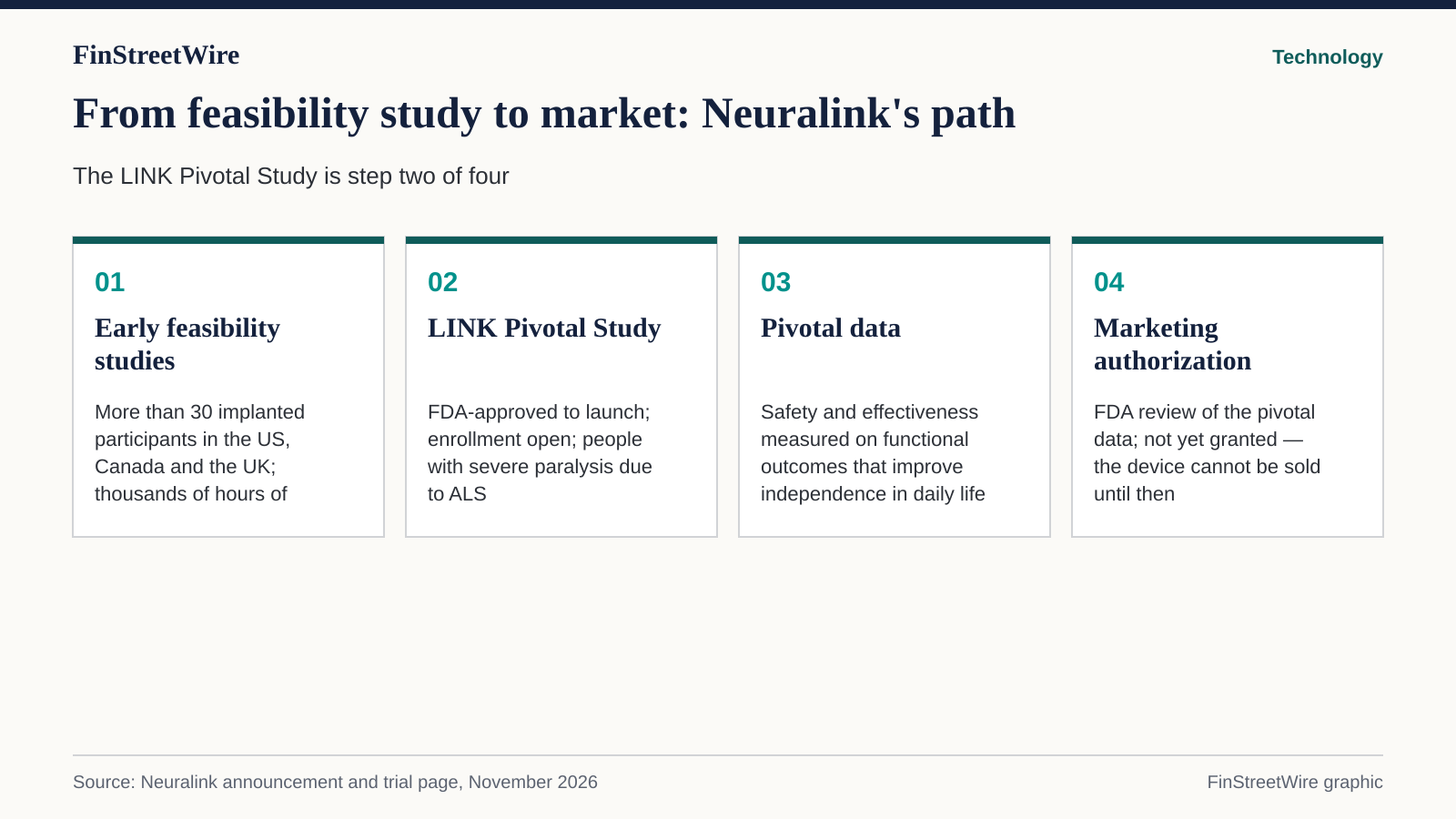
That distinction matters because headlines about FDA approval are routinely read as approval to sell. Here the sequence is: early feasibility studies first, then a pivotal trial, then — if the data support it — a marketing application. Neuralink has cleared the second step. The device will not reach the market until the FDA reviews the pivotal data and grants marketing authorization, a step the company has not yet reached.[1][2]
What the trial will test
Participants will be tested on whether they can operate a computer and other digital devices by thinking, with the emphasis on practical gains in day-to-day independence. The study will also keep tracking the system's safety and reliability over the long term at several clinical sites.[1]
The implant picks up brain signals using hair-thin threads fitted with thousands of sensors, placed in the motor cortex — the part of the brain that plans movement. A brain surgeon places the N1 while the patient is asleep, with a robot placing the threads; most participants go home within a day, and the device is switched on after about 10 days of healing.[2]
It is not a cure. Neuralink is clear that the implant does not restore movement, feeling or speech. What it does is let users move a cursor, click and type. The device charges wirelessly, runs for about four hours on a full charge, and can be used while it is charging.[2]
The first participant, Noland Arbaugh, received the N1 Implant in January 2024. Participants in the early studies have used their implants to pursue higher education, express their creativity, play video games and communicate with loved ones, according to the company.[1][2]
Who can take part, and what it involves
The study is for adults aged 18 and over who have little or no use of both hands and arms because of ALS, a spinal cord injury or a brain stem stroke, and who have a consistent, reliable caregiver. Participants stay in the study for 24 months, with follow-up visits at about 10 and 45 days, then at 3, 6, 12 and 24 months. There is no cost to participate.[2]
The risks are set out on the trial page and include bleeding, infection, seizures and brain swelling, as well as device failure, the implant moving, battery problems and privacy and security risks. Neuralink notes its devices are still investigational and remain unapproved by the FDA and other regulators.[2]
Why it matters beyond Neuralink
Neuralink is a private company, so there is no share price to move on the news. The consequence sits with the listed medical-device makers, whose own devices face the same FDA pathway, and with the wider AI and semiconductor complex, where investor attention has been fixed on the largest names. A successful pivotal trial would de-risk the whole implantable BCI category; a failure would set it back years.[1][2]
What comes next
Neuralink has not disclosed how many people the pivotal study will enroll, how long it will run, or which clinical sites are taking part. Those details, and the timeline to a marketing application, will determine how quickly an implantable BCI can reach patients beyond a trial. The company describes the approval as an important step toward bringing implantable BCI technology to market. It is a step: the device still has to prove itself in the pivotal trial before the FDA will consider letting it be sold.[1]
What to watch
- Enrollment numbers and the first sites to open for the LINK Pivotal Study.
- Whether the trial expands beyond ALS to spinal cord injury and brain stem stroke, which the trial page lists as eligible conditions.
- Any FDA decision on marketing authorization, which would follow the pivotal data — and any competing BCI pivotal trial.
- Neuralink's next update on the early feasibility studies, which have more than 30 implanted participants.
Questions readers ask
- Is Neuralink's brain implant now approved by the FDA?
- No. The FDA has approved the LINK Pivotal Study — the trial of the implant — not the implant itself. The N1 Implant is an investigational device that can only be used inside the study under an Investigational Device Exemption. It cannot be sold until the FDA grants marketing authorization.[1][2]
- Who is the trial for?
- Adults aged 18 and over with severe paralysis due to ALS, who have little or no use of both hands and arms and have a consistent caregiver. The trial page also lists spinal cord injury and brain stem stroke as eligible conditions.[1][2]
- What does the implant actually do?
- It reads brain activity through fine threads placed in the motor cortex and lets the user move a cursor, click and type on a computer. It does not restore movement, feeling or speech, and it is not a cure for paralysis.[2]
Sources
- Neuralink Receives FDA Approval to Launch LINK Pivotal Study. Neuralink, FDA approval to launch the LINK Pivotal Study; first pivotal trial for an implantable BCI in the US; ALS population; 30+ early feasibility participants; enrollment open. Accessed .
- Telepathy — Device Control (LINK Pivotal Study trial page). Neuralink, Device not approved by the FDA; investigational under an IDE; N1 Implant description, surgery, follow-up schedule, eligibility, risks, 24-month participation. Accessed .
Corrections
- : Key Takeaways rewritten for concision: the same findings, now in shorter one-line bullets in the article's writer voice. No facts, figures or body text changed.