AI capex slipped one quarter, it did not fall — $207 billion says so
The four hyperscalers spent $207.4 billion in the September quarter and their guidance implies $720 billion for the year. The money slipped a quarter, not away.
6 min read
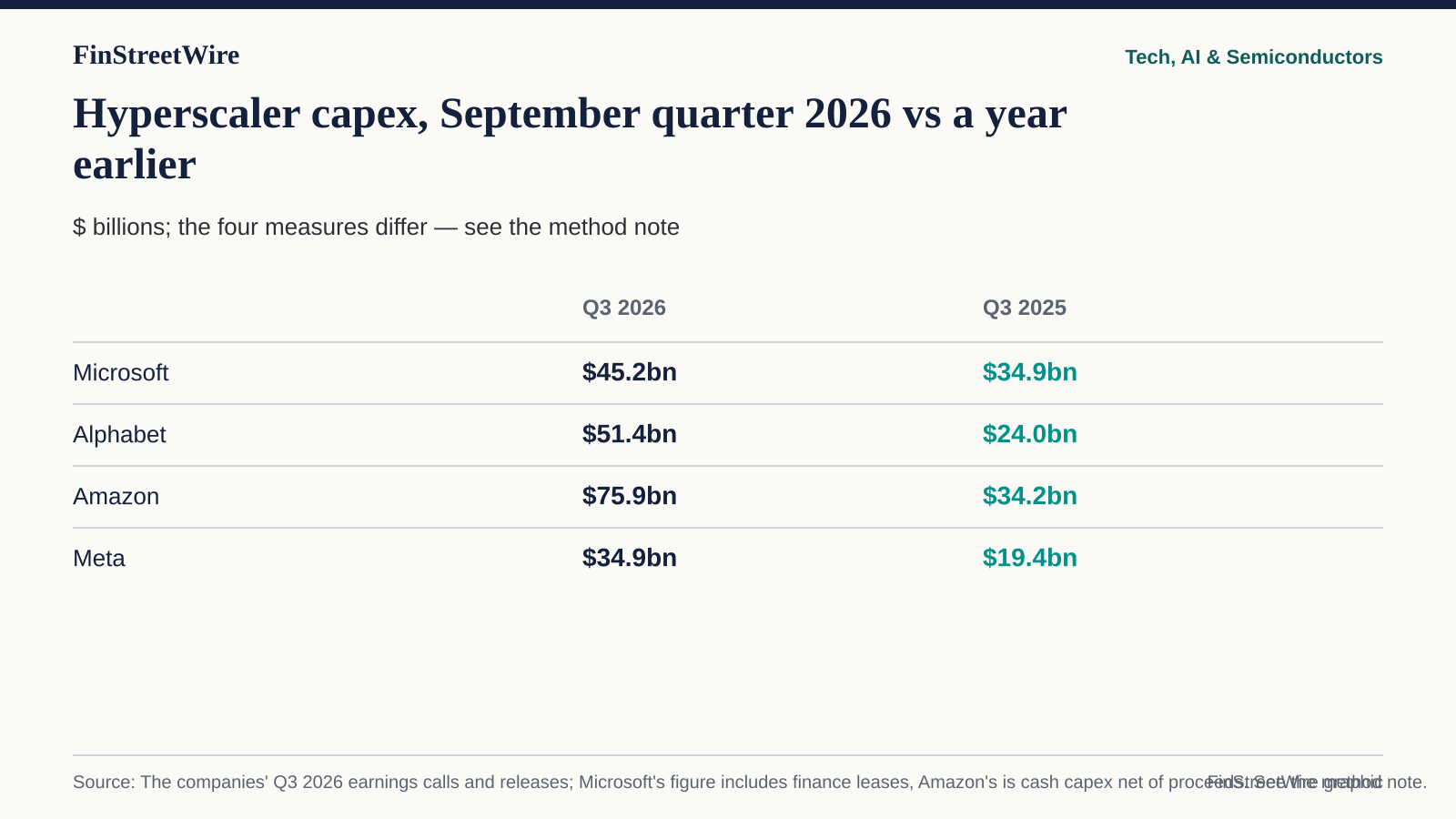
The four companies that buy most of the world's AI hardware spent $207.4 billion on capital expenditure in the September quarter, by our calculation — up about 84% on a year earlier. Their guidance implies roughly $720 billion to $740 billion for 2026, with Alphabet and Meta alone still to spend $112 billion to $132 billion in the December quarter.[1][2][3][4]
The selloff that took the S&P 500 into a correction on November 20 was priced as a demand cut. The companies' own accounts say something narrower: the spending slipped a quarter. Microsoft's chief financial officer, Amy Hood, told investors that some third-party capacity deliveries expected in the September quarter were delayed, and Microsoft said customer demand continues to exceed available supply.[1]
Nvidia's own numbers agree. Revenue was $115.8 billion in its fiscal third quarter, up 103% on a year earlier, with data-centre revenue of $107.6 billion, and it guided to $130.0 billion for the current quarter. Its Vera Rubin systems shipped in the quarter, the fastest product ramp in the company's history. The chipmaker's problem is not demand: it is whether its customers can build the data centres fast enough to house the chips.[5]
| Company | Q3 2026 capex | Q3 2025 capex | 2026 guidance |
|---|---|---|---|
| Microsoft | $45.2bn* | $34.9bn* | ~$170bn (calendar 2026) |
| Alphabet | $51.4bn | $24.0bn | $195–205bn |
| Amazon | $75.9bn† | $34.2bn† | ~$220bn |
| Meta | $34.9bn | $19.4bn | $135–145bn |
* Microsoft's figure includes finance leases; cash paid for property and equipment was $39.4 billion, vs $19.4 billion a year earlier. † Amazon's figure is cash capital expenditure, net of proceeds and incentives; its purchases of property and equipment were $77.3 billion. The four measures differ: see the method note. Sources: the companies' third-quarter 2026 earnings calls and releases, October 2026.
The scale, the mix and the timing
Three things stand out. First, the scale: Amazon's $75.9 billion of cash capital expenditure in one quarter is more than double its $34.2 billion a year earlier, and Alphabet's $51.4 billion is up 114%. Second, the mix: Microsoft says about 75% of its spending is on short-lived assets, primarily CPUs and GPUs, and Alphabet says about 65% of its technical infrastructure spending is on servers and networking — the money is going into the machines, not the buildings. Third, the timing: the guidance implies a larger December quarter for Alphabet and Meta, which is where the slipped spending lands.[1][2][3][4]
“Capital expenditures were $45.2 billion as some third-party capacity deliveries we expected in Q1 were delayed.”
How the $207 billion is measured
The four companies do not measure capital expenditure the same way, and the table does not pretend they do. Microsoft's $45.2 billion includes finance leases; its cash paid for property and equipment was $39.4 billion. Amazon's $75.9 billion is cash capital expenditure net of proceeds and incentives; its purchases of property and equipment were $77.3 billion. Alphabet reports purchases of property and equipment. Meta reports capital expenditure of $34.91 billion, of which $33.94 billion was property and equipment and $0.96 billion was finance-lease principal repayments. The combined $207.4 billion is the sum of the four headline figures, and it is approximate — the point is the direction and the order of magnitude, not the last billion.[1][2][3][4]
The same caution applies to the combined 2026 guidance of roughly $720 billion to $740 billion. Microsoft's fiscal year ends in June, so its calendar-2026 figure of about $170 billion is an estimate from its own call, not a reported total; Alphabet, Amazon and Meta report on the calendar year. The four companies' guidance still implies a December quarter larger than the September one for Alphabet and Meta: Alphabet must spend $63 billion to $73 billion to reach $195 billion to $205 billion, and Meta $49 billion to $59 billion to reach $135 billion to $145 billion.[1][2][3][4]
“We still expect 2026 cash CapEx of approximately $220 billion, the majority for AWS, and expect to spend meaningfully more in 2027 with a clear line of sight to attractive financial returns, as I laid out on our last call.”
Who pays for the catch-up
The catch-up is not free. Alphabet's free cash flow was negative $9.1 billion in the quarter, after a $5.2 billion European Commission fine payment, and Meta's was negative $2.12 billion against $10.63 billion a year earlier. Microsoft's free cash flow was $18.6 billion. Amazon's $75.9 billion of quarterly capital expenditure is more than two and a half times its $28.1 billion of quarterly operating income. The companies are funding the build from their balance sheets and from cash flow, and the market on November 20 asked whether the returns justify it.[2][3][4]
The November 20 selloff was the market's answer, for one day at least. The S&P 500 fell 3.7% to 6,910.39, entering a correction — more than 10% below its October 6 high — and the Nasdaq Composite fell 5.3%, going negative for the year. Nvidia fell 13.8% that day, its ninth down day in ten, and was down more than 25% since the scandal around its chief executive erupted earlier in November.[6]
“The whole notion that AI can continue to spend unlimited amounts of money and support the stock market, I think the notion of that is ending as we speak, that's what's being priced right now”
What to watch
- Alphabet's and Meta's fourth-quarter results, against the implied $63 billion to $73 billion and $49 billion to $59 billion of capital expenditure.
- Microsoft's December-quarter capital expenditure, guided above $50 billion, and whether the delayed third-party capacity arrives.
- Amazon's 2027 capital expenditure, which Jassy said would be meaningfully more than $220 billion, and what it says about returns.
- Nvidia's fourth-quarter revenue against its $130.0 billion guide, and whether data-centre demand stays ahead of supply.
Questions readers ask
- Did AI demand actually fall?
- Not on the companies' own accounts. The four hyperscalers spent about $207.4 billion in the September quarter, up about 84% on a year earlier, and their guidance implies roughly $720 billion to $740 billion for 2026. What slipped was the timing of some deliveries, not the orders.[1][2][3][4]
- Why did the market sell off on November 20 then?
- The S&P 500 fell 3.7% into a correction and the Nasdaq fell 5.3% as investors questioned whether the spending would earn its return, with Nvidia down 13.8% that day. The companies say demand still exceeds supply; the market is pricing whether the returns justify the build.[6][1]
Sources
- Microsoft (MSFT) Q1 2027 Earnings Call Transcript. The Motley Fool, Capital expenditures $45.2bn incl finance leases; cash paid for P&E $39.4bn vs $19.4bn; ~75% short-lived assets; year-ago capex $34.9bn; Hood quote. Accessed .
- Alphabet (GOOGL) Q3 2026 Earnings Call Transcript. The Motley Fool, Purchases of P&E $51.4bn vs $24.0bn; quarterly progression Q1 $35.7bn, Q2 $44.9bn, Q3 $51.4bn; 2026 guidance $195-205bn; Cloud revenue $30.7bn, backlog $561bn. Accessed .
- Amazon (AMZN) Q3 2026 Earnings Call Transcript. The Motley Fool, Cash capex $75.9bn net, +122% vs $34.2bn; 2026 cash capex ~$220bn; AWS revenue $46.0bn, backlog $578bn; Jassy quote. Accessed .
- Meta Reports Third Quarter 2026 Results. Meta Platforms, Capex $34.91bn vs $19.37bn; 2026 guidance $135-145bn; free cash flow -$2.12bn; revenue $64.60bn. Accessed .
- NVIDIA Announces Financial Results for Third Quarter Fiscal 2027. NVIDIA, Revenue $115.8bn, +103%; Data Center $107.6bn; Q4 guidance $130.0bn ±3%; Vera Rubin shipped. Accessed .
- S&P 500 sinks 3.7% and the Nasdaq Composite goes negative for the year. Associated Press, S&P 500 fell 3.7% to 6,910.39 on November 20, entering a correction; Nasdaq fell 5.3%; Nvidia fell 13.8%; Antonelli quote. Accessed .
Corrections
- : Key Takeaways rewritten for concision: the same findings, now in shorter one-line bullets in the article's writer voice. No facts, figures or body text changed.