Singapore says it is in talks with Washington over AI chip access and has not confirmed an Nvidia halt
Deputy Prime Minister Gan Kim Yong spoke a week after US licence rules for advanced chips took effect for Singapore and four other countries.
3 min read
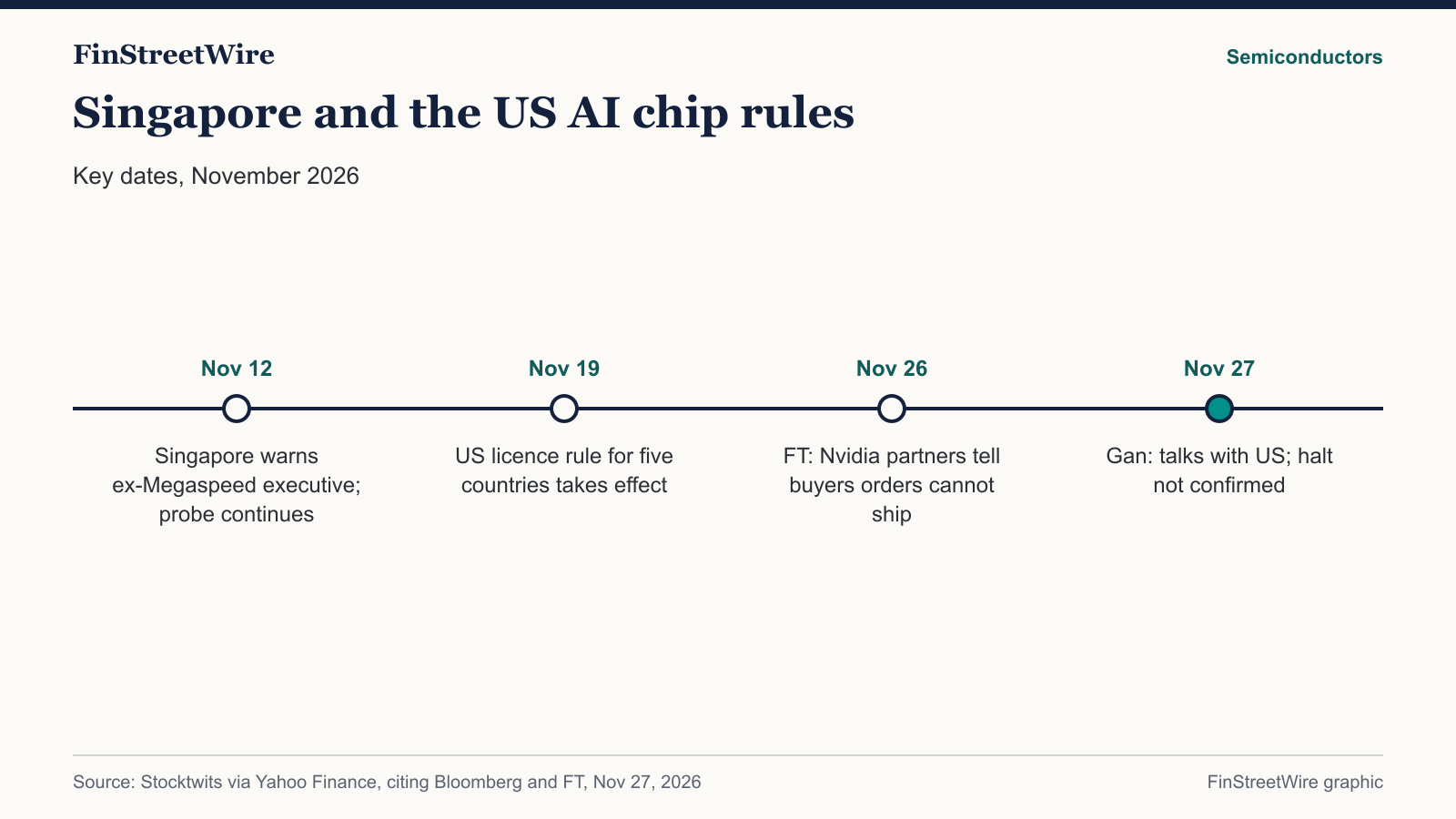
Singapore's government says it is negotiating with the United States to keep access to high-end AI chips after Washington tightened export controls on the city-state and four other countries. Deputy Prime Minister Gan Kim Yong said on Friday, November 27, at the Asia Future Summit that Singapore is reviewing its own procedures to stop illicit chip trading and will keep working with US authorities on their concerns, according to a Stocktwits report on Yahoo Finance citing Bloomberg.[1]
Gan was asked about a Financial Times report that Nvidia's server-making partners had told buyers in Southeast Asia their orders could not be shipped. He said the government had not confirmed it and was engaging businesses to assess how the restrictions affect them.[1]
“We have not confirmed it”
What the US rules require
The Commerce Department's controls took effect on November 19. Exporters now need a licence to send covered advanced semiconductors to Singapore, Malaysia, Thailand, Indonesia or Brazil, which Washington regards as higher-than-normal diversion risks. A second element targets data centres abroad that rent large amounts of computing power to China-based companies and to firms in some other restricted places.[1]
There is an important exemption: chips destined for US-headquartered companies do not need the five-country licence, subject to reporting conditions. That carve-out means the rules fall hardest on local and third-country data-centre operators rather than on the US cloud companies that also build in the region.[1]
| Item | Detail | Status |
|---|---|---|
| Licence requirement | Singapore, Malaysia, Thailand, Indonesia, Brazil | In force since Nov 19 |
| Remote-access curb | Overseas data centres serving China-headquartered firms | In force |
| Exemption | Chips for US-headquartered companies, with reporting | In force |
| Server shipment halt | Super Micro and Dell buyers in four countries told orders cannot ship | Reported by FT; not confirmed by Singapore |
| Singapore-US talks | To retain access to advanced chips | Ongoing |
Source: Stocktwits via Yahoo Finance, citing Bloomberg and the Financial Times, November 27, 2026.
Why it matters for US-listed companies
For Nvidia and its server partners, the issue is timing. The Financial Times reported that Super Micro Computer and Dell Technologies had told buyers in Singapore, Malaysia, Thailand and Indonesia that orders could not be shipped. If that persists until licences are granted, shipments that would have been booked as sales could slip, though neither the length of any pause nor the value of affected orders has been disclosed.[1]
The talks also sit against a criminal investigation. On November 12, Singapore's home affairs ministry said police had looked into Alice Huang, a former executive of Nvidia customer Megaspeed International, over suspected false declarations in server purchases. It found too little evidence to charge her with those offences, gave her a stern warning and banned her from returning, and said its inquiry into Megaspeed is still open. Singapore's position is that it does not police other countries' unilateral export controls, but will pursue firms that break its own laws.[1]
Questions readers ask
- Has Nvidia stopped shipping AI servers to Singapore?
- The Financial Times reported that Nvidia's partners Super Micro and Dell told buyers in four Southeast Asian countries that orders could not be shipped. Singapore's deputy prime minister said the government had not confirmed it.[1]
- Which countries do the new US chip licence rules cover?
- Singapore, Malaysia, Thailand, Indonesia and Brazil, from November 19. Chips for US-headquartered companies are exempt, subject to reporting.[1]
Sources
- Singapore Reportedly In Talks With US To Retain Advanced AI Chip Access As Washington Tightens Export Restrictions. Stocktwits via Yahoo Finance (citing Bloomberg and the Financial Times), Full article. Accessed .