Secret links sent to Chinese AI firm MiniMax were opened by others; Singapore hosting did not stop it
Dragos says secret links in prompts routed to MiniMax were later opened, one from devices in Beijing and Shanghai, while MiniMax points to a security scanner.
3 min read
Confidential links that customers submitted to Chinese AI developer MiniMax were later opened by unidentified parties, a cybersecurity researcher told Reuters, sometimes even when users had asked for no data retention.[1]
HD Moore, chief research officer at US firm Dragos, named MiniMax as the company behind findings his firm had published on November 19 without identifying it.[1]
How the test worked
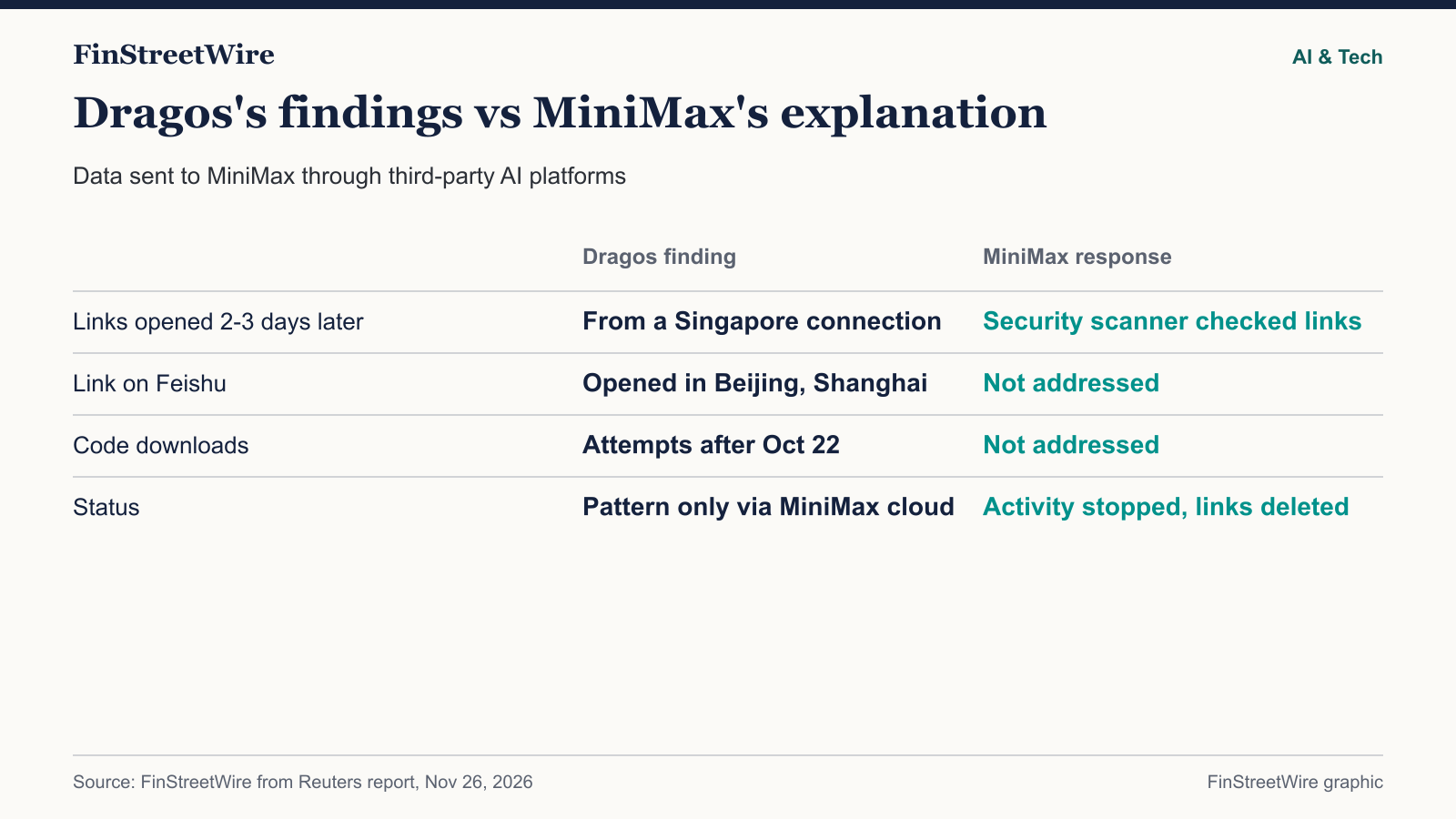
From July to November, Dragos planted secret links and dummy login credentials in close to 2 million requests to AI services and then monitored whether anyone used them. According to Moore, links routed through several providers kept being opened after a delay of two or three days, from a Singapore-based connection, even where customers had asked for nothing to be kept. The pattern appeared only when requests were forwarded to MiniMax's own cloud, not when other companies ran MiniMax's models on their own systems.[1]
Two further findings go beyond automated scanning, according to Moore. One secret link turned up weeks later in a chat channel on Feishu, the workplace platform made by ByteDance, where it was opened by devices in Beijing and Shanghai. And after the link scraping appeared to stop on October 22, researchers saw attempts to download private software code referenced in MiniMax requests. Dragos also saw unusual activity from the Moscow region, though the evidence did not show that links were opened from Russia.[1]
MiniMax's explanation
MiniMax's explanation, issued on Tuesday, is that a security tool gathered and kept the web addresses found in prompts reaching its models via third-party platforms, and visited some automatically to screen them for threats. It said it did not retain full conversations, had deleted the stored addresses, had stopped the activity and had found no evidence that customer conversations or AI responses were disclosed to third parties.[1]
The statement did not address the attempted code downloads or the Feishu incident, Reuters reported. Those are the two findings an automated threat scanner would not obviously explain, which is why they matter for customers deciding how far to accept MiniMax's account.[1]
Why Singapore hosting was not enough
Atlas Cloud, a US company that offers access to MiniMax's models, said it had chosen MiniMax's Singapore data centers so that customer data would not be processed in China. Information submitted through its platform was still potentially exposed once it reached MiniMax. Atlas has stopped forwarding requests and told users of its M3, M2.7 and M3.1 Flash models to treat any secrets they submitted as exposed. OpenRouter, a platform that routes requests to many models, said it removed three providers, tightened privacy requirements and notified potentially affected customers, with no sign its own systems were breached.[1]
The lesson for companies is about who ultimately processes a prompt, not where the server sits. Chinese models were the three most used on OpenRouter in October by volume of text, Reuters said, largely because of price and capability. Anything placed in a prompt, including links to internal documents, should be assumed visible to the model operator. MiniMax, which listed in Hong Kong this year, has not said how many customers were affected.[1]
Questions readers ask
- Did MiniMax leak customer conversations?
- MiniMax says it found no evidence that conversations or responses were disclosed. Dragos's findings concern secret links in prompts being opened later, and attempted code downloads.[1]
- Does hosting in Singapore protect data from China?
- Not by itself. Atlas Cloud used MiniMax's Singapore data centers, but data was potentially exposed once it reached MiniMax's systems.[1]
Sources
- Exclusive-Data from Chinese AI firm MiniMax accessed by unidentified parties, researcher says (Reuters). 93.3 The Drive (Reuters syndication), Full Reuters report. Accessed .
Corrections
- : Tightened the summary, key takeaways and opening for readability and applied house spelling. No facts or figures changed.