Nvidia reinstates Huang 11 days after his resignation — and discloses US government input
Nvidia's board unanimously reinstated Jensen Huang as chief executive 11 days after he resigned, disclosing input from senior levels of the US government.
5 min read
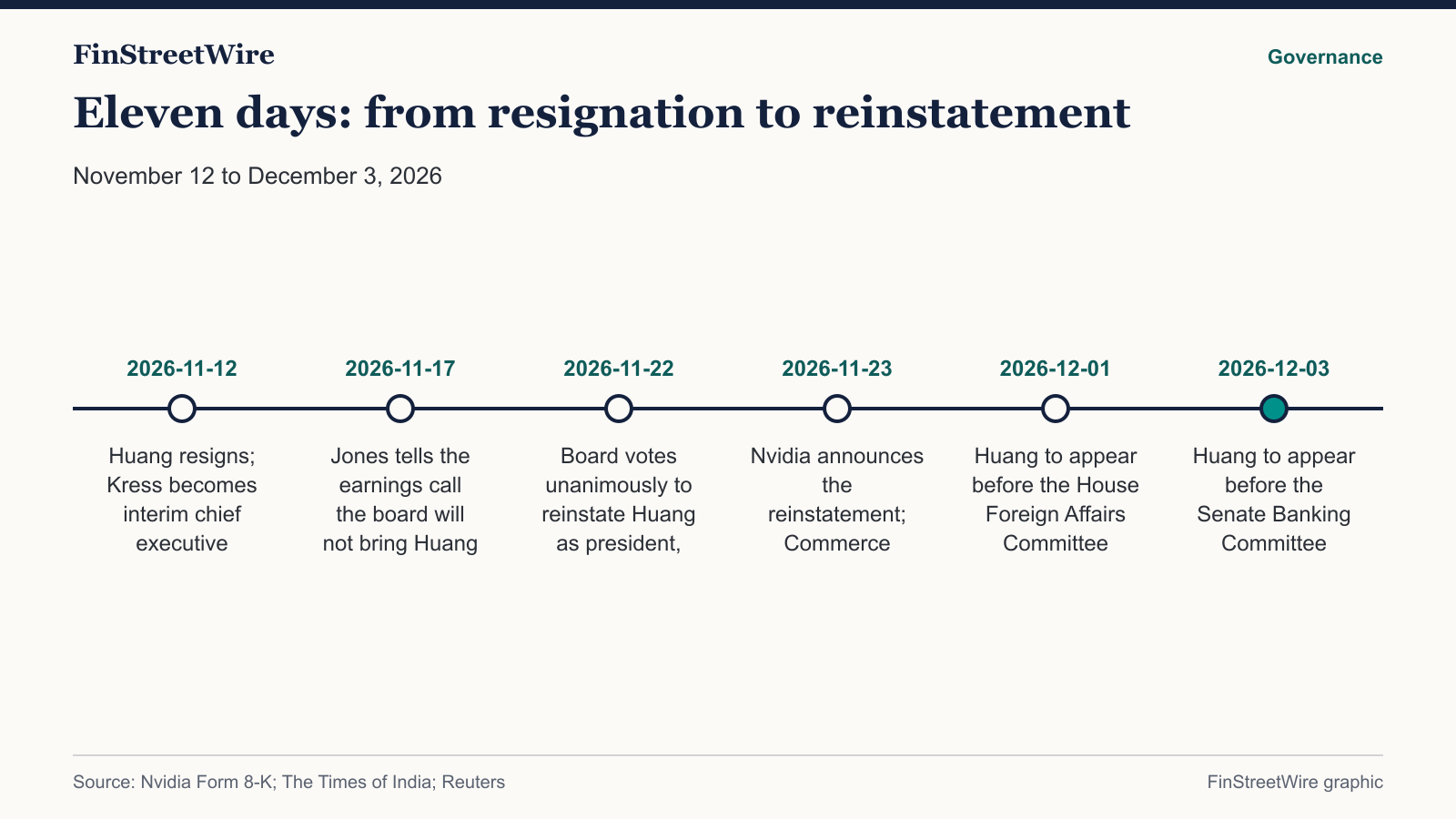
Nvidia has brought Jensen Huang back as chief executive 11 days after he resigned, the company said on November 23. The board voted unanimously to reinstate him as president, chief executive and board member, effective November 22. Colette Kress, who served as interim chief executive, continues as chief financial officer, and Harvey C. Jones remains board chair.[1]
Five days earlier, the board had said the opposite. On the November 17 earnings call, board chair Harvey Jones told investors the board had unanimously accepted Huang's resignation and did not intend to reinstate him as chief executive. The call came as Nvidia reported third-quarter revenue of $115.84bn, more than double a year earlier and ahead of the $109.11bn analysts expected. The board had also engaged Heidrick & Struggles to run the search for a permanent chief executive.[3]
What the board disclosed
The reinstatement came with an unusual disclosure: senior American government officials had given the board input, and on that basis the board was confident the move posed no national security risk. Board chair Harvey Jones said the directors were convinced Huang was the person to run the company and that bringing him back served shareholders, staff, partners and customers.[1]
“I am honored to return to NVIDIA and lead one of the most consequential technology companies in the world at the beginning of a new industrial revolution”
The wartime law that was discussed
The government's part went further than the input the board disclosed. Over the weekend before Monday's announcement, senior Pentagon officials — Defense Secretary Pete Hegseth, his deputy Steve Feinberg and chief technology officer Emil Michael — talked about using the Defense Production Act, a wartime law from 1950, to push Nvidia's board to restore Huang, the Post reported, citing three people who knew of the discussions.[2]
The law gives no straightforward way to put a chief executive in place, but it could have obliged Nvidia to move more production to military work, a Trump administration official told the Post. Whether any of it got as far as Nvidia is unknown, as is whether Trump or Vance ever heard of it. People close to the board said the directors were unmoved by the government's case.[2]
The Pentagon said the talks never happened. No president has ever used the Defense Production Act to put a leader in charge of a private firm: Congress passed it soon after the Korean War began, and in the Covid-19 pandemic the first Trump administration turned it on General Motors to build ventilators. Bill Greenwalt, who studies the Act at the American Enterprise Institute, said export controls would have been a better lever.[2]
“The conversations described between DOW senior leaders never happened and no such proposal was made by the Secretary, Deputy Secretary, or Under Secretary”
The idea had already been going around Silicon Valley for days. Investor Balaji Srinivasan had posted the week before, suggesting the Department of War might intervene for Huang. The Financial Times said friends of Huang, among them Travis Kalanick and Brad Gerstner, organised a lobbying push aimed at the board, with Marc Andreessen also involved, and in time drew in Trump and Vance. The Wall Street Journal said Trump and Vance spent the weekend reassuring directors, with Attorney General Todd Blanche giving his word that no Justice Department probe targeted Huang. Semafor said Trump supported the return because Huang backs open-weight AI models in the US.[2]
What is still open
The reinstatement does not close the investigation. After reports that a foreign intelligence service had targeted Huang, the board set up a committee of independent directors to look into it, and the committee hired independent counsel. The board said the inquiry would run to its conclusion, with Huang's support. The board also set up its new National Security and Export Control Committee, made up of independent directors only, and Nvidia is looking for a chief compliance officer. The company said it would keep cooperating with the government's continuing investigations.[1]
Huang is to appear before the House Foreign Affairs Committee on Tuesday, December 1, then the Senate Banking Committee on Thursday, December 3. Megaspeed was put on the Commerce Department's blacklist on Monday. Nvidia shares jumped more than 30% on the news, The Wall Street Journal reported, the largest one-day market-value gain ever recorded for a US company. Separate filings published around Huang's return put the company's commitments at $390bn.[2]
What to watch
- Huang's appearances before the House Foreign Affairs Committee on December 1 and the Senate Banking Committee on December 3.
- The conclusion of the independent directors' investigation into the foreign intelligence effort.
- The appointment of a chief compliance officer and the work of the new National Security and Export Control Committee.
- Whether the export-control questions around Megaspeed produce further action against Nvidia or its partners.
Questions readers ask
- Why did Nvidia's board change its mind in five days?
- The board has not said what changed between November 17, when it said it did not intend to reinstate Huang, and November 22, when it voted unanimously to do so. It said talks with Huang had satisfied it about his candour and his ability to lead, and disclosed input from senior US government officials. The Washington Post reported that Pentagon officials had discussed using the Defense Production Act as leverage over the same weekend.[1][2]
- Could the Defense Production Act have forced Huang's return?
- Not directly. The 1950 law lets the president put military and emergency needs first, but no president has ever used it to put a leader in charge of a private firm, and it gives no straightforward way to do that. It could have obliged Nvidia to move more production to military work, which would have dented its plans and profits.[2]
Sources
- Form 8-K: NVIDIA Board Reinstates Jensen Huang as President, CEO and Board Director. NVIDIA Corporation, Date of report November 22, 2026; reinstatement effective immediately; unanimous vote; government input and no national security risk; Kress continues as CFO; Jones remains chair; Jones and Huang quotes; independent-director investigation; National Security and Export Control Committee; Chief Compliance Officer search. Accessed .
- US government considered using a 76-year-old Cold War law in a way never tried before to bring back Nvidia CEO Jensen Huang. The Times of India, Washington Post: Pentagon officials discussed the Defense Production Act; three people familiar; Pentagon denial; DPA history; Bill Greenwalt; Balaji Srinivasan; Financial Times war room; Huang resigned November 12; shares jumped more than 30% (Wall Street Journal); Trump and Vance assurances; Semafor; Huang all-hands Tuesday; House and Senate hearings; Megaspeed blacklisted. Accessed .
- Nvidia chair dismisses idea of rehiring Huang and vows fast search. Reuters, Jones on November 17 earnings call: board does not intend to reinstate Huang; Heidrick & Struggles hired; Q3 revenue $115.84bn, beating $109.11bn estimate. Accessed .