Nvidia stops AI server shipments to four South-East Asian countries as new US license rule bites
Dell and Supermicro told buyers in Malaysia, Singapore, Thailand and Indonesia their orders cannot ship, the FT reported; how to get licenses is unclear.
4 min read

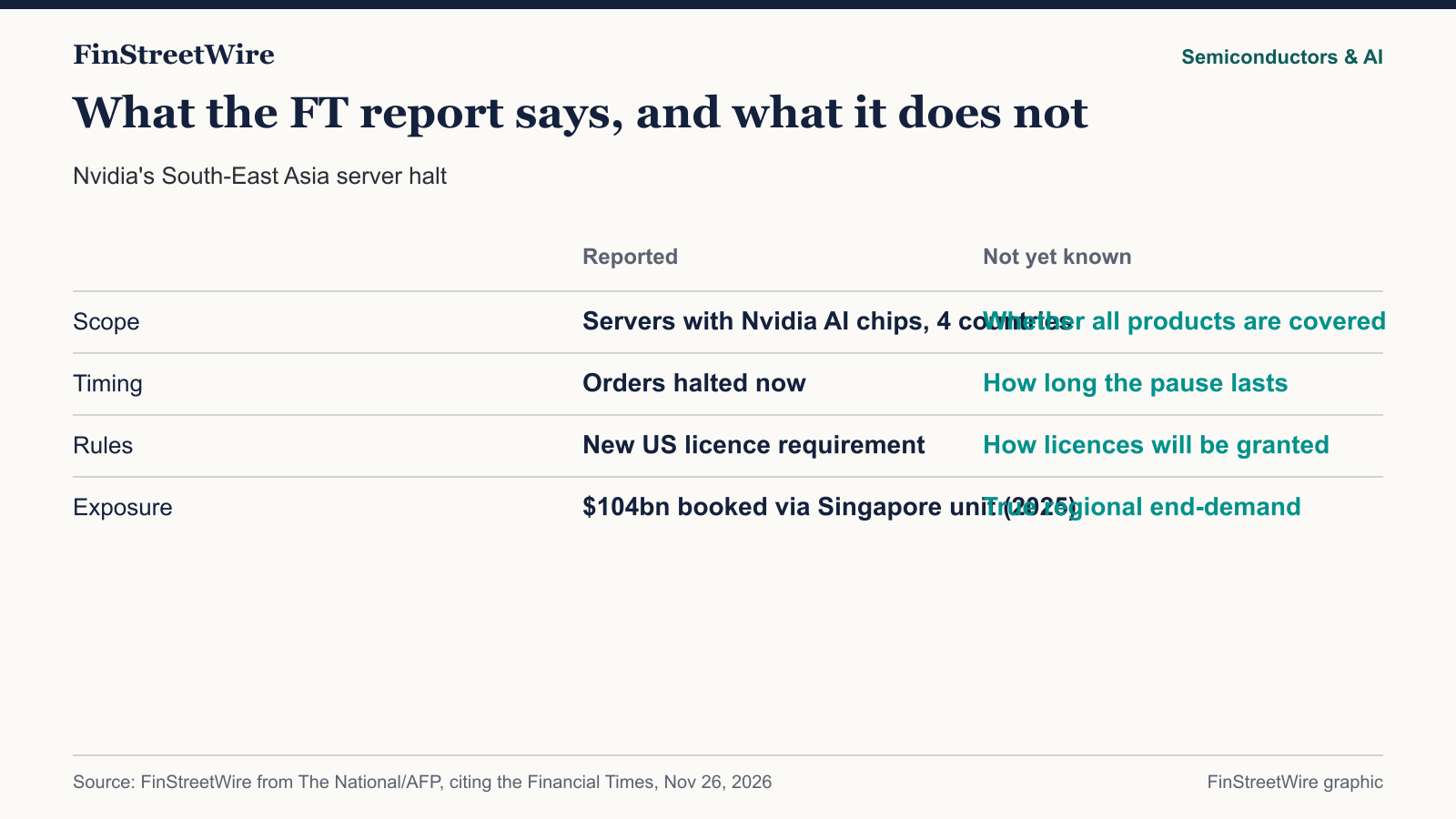
Nvidia (Nasdaq: NVDA) has asked the companies that build servers around its AI chips to stop shipping them to Malaysia, Singapore, Thailand and Indonesia, the Financial Times reported on Thursday.[1]
Server makers including Dell and Supermicro have told customers in those countries that Nvidia will not authorize their orders, according to the report, which was carried by AFP and The National.[1]
Neither the length of the pause nor its exact scope is public. The FT's sources said it was unclear whether the suspension is temporary while Nvidia and its partners work out how to comply with Washington's latest export rule.[1]
The rule behind the pause
The halt follows a US Commerce Department rule introduced last week that requires licenses for advanced AI chips going to data centers in the region through which China-headquartered companies could rent large amounts of computing power. The aim is to close a route Chinese developers have used to reach Nvidia's most advanced processors without buying them directly.[1]
According to the FT, the problem for operators is not the principle but the mechanics. A cloud-provider executive told the paper that there was a rule but no guidance on how to execute it, and that nobody knew how to apply for a license while a 90-day period was running. Until that is resolved, server makers appear unwilling to ship hardware that could later be found to need a license.[1]
The four countries have been a focus of US enforcement for months. Singapore-based Megaspeed, which rents out computing power, is among companies examined over possible diversion of advanced chips to China.[1]
How much revenue is at stake
The headline number in the report is large: Nvidia recorded $104 billion of revenue through its Singapore subsidiary in 2025, up 72% from a year earlier, according to company accounts cited by the FT. It is not a measure of South-East Asian demand. The same report notes that Nvidia books some of its Taiwan and China revenue through the Singapore unit, so the figure mixes billing location with where chips are finally installed.[1]
A better reading is that the region matters in two ways. It is a fast-growing data-center market in its own right, which the halt disrupts directly, and it has been a channel through which demand from elsewhere, including China, may have reached Nvidia's hardware. The second is exactly what the rule targets, so some of the lost shipments may not come back even once licenses flow.[1]
Update: sellers now rule out any Chinese renters
Chip sellers have gone further than the pause on shipments. They have told neoclouds, the firms that rent out AI computing capacity, that they cannot buy Nvidia chips if any of that capacity will be rented to Chinese companies, CNBC reported on Thursday, citing two people familiar with the situation. Before the rule was announced, Nvidia had said it would not sell to customers renting more than 50% of their GPUs to Chinese companies.[2]
The licensing rule was announced by the Commerce Department's Bureau of Industry and Security on November 16 and took effect on November 19, according to CNBC. Some sellers appear to be looking for new buyers for GPUs originally meant for data centers that would have served Chinese renters, the outlet reported, citing people familiar with the matter. US Trade Representative Jamieson Greer told CNBC the rule was meant to close loopholes, including remote access from data centers in third countries.[2]
What to watch
Three things will show whether this is a short pause or a lasting cut. The first is whether Commerce publishes licensing guidance or approves the first applications. The second is whether Nvidia quantifies any effect in its next guidance. The third is whether governments in the region, several of which are courting data-center investment, reach arrangements with Washington that allow legitimate operators to keep buying.[1]
Questions readers ask
- Has Nvidia stopped selling chips in South-East Asia altogether?
- The FT reported a halt on shipments of servers containing Nvidia's AI chips to four countries. It is not clear whether all products are covered or how long the pause will last.[1]
- Is the $104 billion all South-East Asian sales?
- No. It is revenue booked through Nvidia's Singapore subsidiary, which also records some Taiwan and China revenue, according to the FT.[1]
Sources
- Nvidia halts chip shipments to South-East Asia amid US crackdown (AFP, citing the Financial Times). The National, Full report. Accessed .
- Nvidia chip buyers told to rule out Chinese renters to purchase GPUs, sources say. CNBC, Full report. Accessed .
Corrections
- : Tightened the summary, key takeaways and opening for readability and applied house spelling. No facts or figures changed.
- : Added CNBC's report that chip sellers are refusing to supply neoclouds that rent any capacity to Chinese companies, and the rule's announcement and effective dates.