Lam Research's record quarter ran on China demand as its shares fell 57% from June
Revenue hit a record $8.22 billion, but China supplied about $1.14 billion of the $1.50 billion sequential gain — and the shares sit 57% below their June peak.
7 min read
Lam's September quarter was the strongest in its history by revenue, and the market's answer has been to keep selling the shares. The reason sits in the regional breakdown: about three-quarters of the growth came from one country.[1][4]
Revenue reached $8.22 billion for the three months ended September 27, up 54% on a year earlier and 22% on the June quarter. GAAP diluted earnings per share were $2.19, against $1.24 a year earlier, and non-GAAP diluted earnings per share were $2.20, against $1.82 in June. The non-GAAP gross margin set a record at 52.4%, and the non-GAAP operating margin passed 40% for the first time, at 40.2%.[1][2]
China supplied about three-quarters of the sequential growth
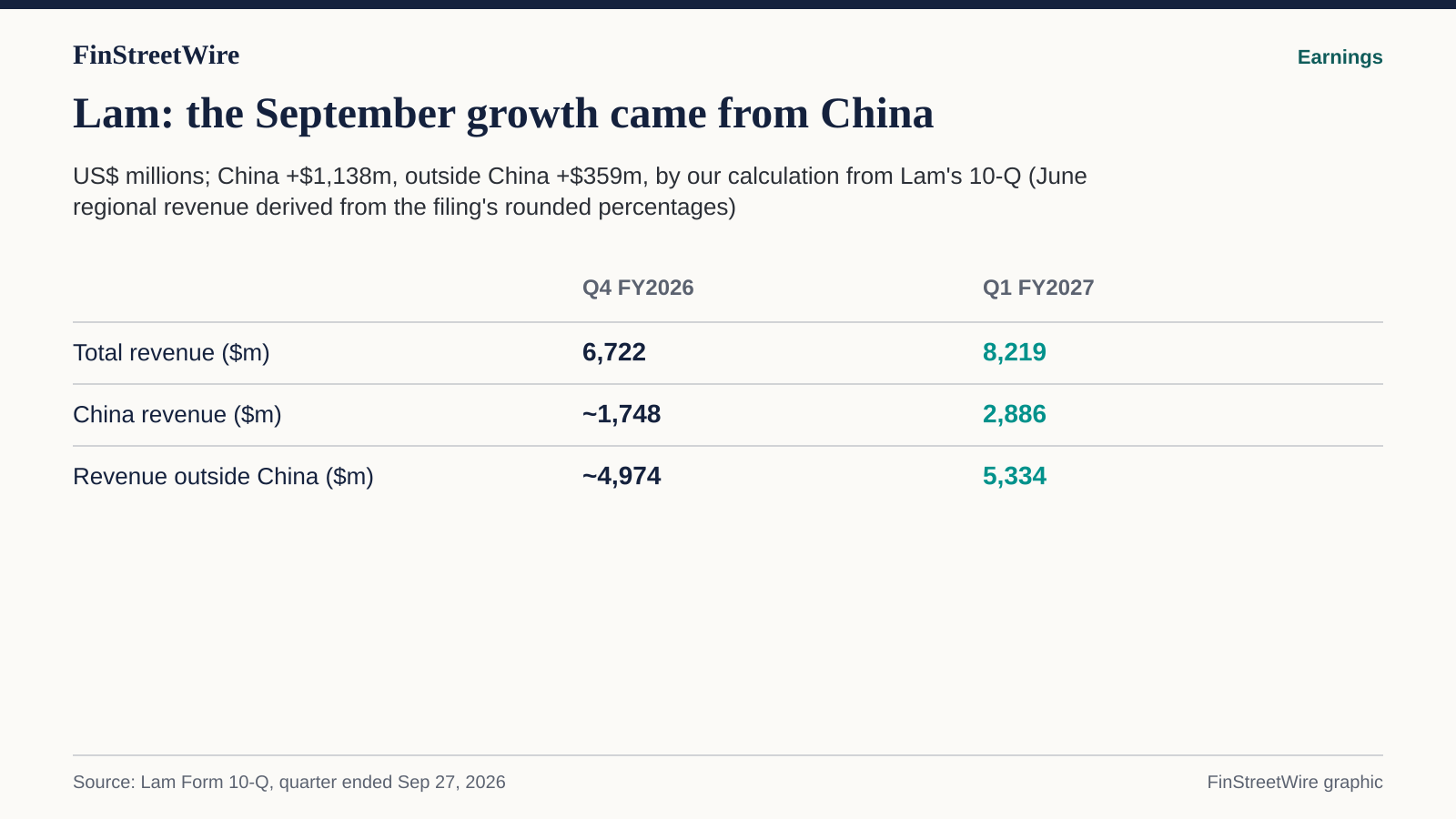
The regional tables in Lam's quarterly filing show where the $1.50 billion sequential revenue increase came from. China rose about $1.14 billion, or 65%, to $2.89 billion, equal to 35% of total revenue, while revenue from everywhere else rose about $359 million — 24% of the increase. That is the arithmetic behind the 76% figure: about $1.14 billion of $1.50 billion.[2]
One caveat: the June China figure of about $1.75 billion is derived from the 26% share the filing reports, so the 76% share carries a range of about 74% to 78%. The direction is not in doubt.[2]
The filing puts the foundry strength behind the China increase down to the timing of mature-node investment in China — older, established production lines rather than the leading edge. On the earnings call, chief financial officer Doug Bettinger said the September strength came from both domestic and multinational customers in China. Memory was 46% of systems revenue, a record in dollars and up 120% on a year earlier, with NAND revenue up about 40% on the quarter; foundry was also 46% of systems revenue, a record, helped by leading-edge work and advanced packaging as well as the mature-node spending in China.[2][4]
Year on year the picture is different, and the difference matters. China revenue rose only 26% on a year earlier, supplying $603 million of the $2.90 billion annual increase — 21%, by our calculation. Korea added $858 million, more than doubling, and Taiwan added $455 million. The September quarter's dependence on China is a one-quarter event, not the year's story.[2]
| Region | Q4 FY2026 | Q1 FY2027 | Change |
|---|---|---|---|
| China | ~1,748 | 2,886 | +~1,138 |
| Korea | ~1,344 | 1,634 | +~290 |
| Taiwan | ~1,815 | 1,482 | −~333 |
| Japan | ~605 | 722 | +~117 |
| United States | ~605 | 663 | +~58 |
| Southeast Asia | ~336 | 532 | +~196 |
| Europe | ~269 | 301 | +~32 |
| Total | 6,722 | 8,219 | +1,497 |
Revenue by customer location, $m. June-quarter figures are derived from the percentages in Lam's 10-Q; the filing reports dollar figures by region only for the September and year-ago quarters. September figures are exact from the filing. Source: Lam Form 10-Q for the quarter ended September 27, 2026.
The shares fell 12% the day after the results — then kept falling
The 57% fall needs a date on it. Lam shares closed at $433.33 on June 30 — the year's closing high — and had already fallen to $260.81 by October 21, the day the results were released, a 40% decline by our calculation from Finnhub data. The record quarter did not reverse it: the shares fell 11.8% to $230.15 the next day, and slid through November to close at $185.01 on November 25.[3]
“With AI driving higher semiconductor demand and greater device complexity, our focus on operational execution helped Lam deliver record revenue, profit, and earnings per share in the September quarter.”
Nothing in the release explains a 57% fall, and the filing does not try to. What the numbers do show is a record quarter in which China supplied about three-quarters of the sequential growth, while the December guidance was held back by supply-chain constraints the company says it is working through. Add a valuation set at the June peak, and the market has had reasons to discount the headline.[1][2][4]
What the December guidance implies
The December quarter should change the mix. Lam guided to revenue of $8.6 billion, plus or minus $400 million, with non-GAAP diluted earnings per share of $2.33, plus or minus $0.15. On the earnings call, chief financial officer Doug Bettinger said China would be a significantly lower percentage of revenue than September's 35%, with the drop driven by domestic customers in China, while multinational customers there were expected to stay reasonably strong.[1][4]
At the $8.6 billion midpoint, China would need a share of about 34% just to match September's $2.89 billion in dollars — so “significantly lower” means a dollar decline, with the rest of the business making up the difference.[1][2]
The mix inside the December quarter also stays tilted toward memory and foundry, each 46% of systems revenue in September. Lam put the wafer fabrication equipment market in the mid-$150 billion range for 2026 and expects it to pass $200 billion in 2027, with growth led by DRAM, then leading-edge foundry logic and NAND. At the December guidance midpoint, the company expects calendar 2026 systems revenue to grow well over 40% on the year.[4]
The China risk is stated in the company's own words. The quarterly filing says US export license requirements have limited the market for Lam's products in China, hit revenues there and increased its exposure to foreign competition, and that further controls could do more damage. China was about 35% of revenue in the September quarter and about 34% in each of the last two fiscal years.[1][2]
The margin and cash-flow test
The quarter passes the profitability test comfortably. The non-GAAP gross margin reached a record 52.4% and the non-GAAP operating margin 40.2%, the first time above 40%. Operating cash flow was $3.50 billion, against $1.78 billion a year earlier, and after $258 million of capital spending, free cash flow was $3.24 billion — a record for a September quarter and 39% of revenue. Lam returned about $1.35 billion to shareholders through buybacks of about $1.02 billion and dividends of $325 million, about 41% of free cash flow, against a long-term plan to return 85%.[1][2][4]
The cash position strengthened with it. Cash balances ended the quarter at $7.45 billion, up from $5.60 billion in June, and deferred revenue rose $227 million to $2.66 billion. Days sales outstanding fell to 63 days from 72, and inventory turns reached 3.4 times, the highest in nearly seven years, even as inventory rose to $4.6 billion. One headwind: the non-GAAP tax rate rose to 16.5% from 11% in June, and management expects it to stay there — a drag on earnings growth that the revenue record does not remove.[1][2][4]
What to watch
- December-quarter revenue and the China share: management expects a significantly lower percentage than September's 35%, with domestic customers driving the drop.
- Whether Korea and Taiwan revenue recover as the mix shifts away from China.
- Memory's share of systems revenue and the NAND upgrade cycle, with 384-layer devices now shipping.
- Gross margin against the 52.5% non-GAAP December guidance, and any change in the 2027 wafer equipment outlook above $200 billion.
- Any new US export-control measures affecting sales to customers in China, which the company flags as a risk to its largest regional market.
Questions readers ask
- How can revenue be a record if the shares fell 57%?
- The record is real — $8.22 billion, up 54% on a year earlier — but the shares had already fallen 40% from their June 30 closing high before the results were released, and about three-quarters of the September growth came from China while management guided December's China share significantly lower. The market is pricing the mix, not the total.[1][2][3]
- Did China really supply 76% of Lam's growth?
- Of the sequential growth, by our calculation, yes: China revenue rose about $1.14 billion on the June quarter, out of a $1.50 billion total increase. The June figure is derived from the 26% share the filing reports, so the share carries a range of about 74% to 78%. But year on year China supplied only 21% of the $2.90 billion increase, with Korea adding more. The 76% figure describes one quarter, not the year.[2]
- What does Lam expect next?
- Revenue of $8.6 billion, plus or minus $400 million, in the December quarter, with non-GAAP earnings per share of $2.33, plus or minus $0.15, and China a significantly lower share of sales. Management also expects the wafer equipment market to pass $200 billion in 2027.[1][4]
Sources
- Lam Research Corporation Reports Financial Results for the Quarter Ended September 27, 2026. Lam Research Corporation, Headline results, Q2 FY2027 guidance, CEO quote, balance sheet and cash flow; release published on Lam investor relations site (investor.lamresearch.com) and furnished as Exhibit 99.1 to Form 8-K. Accessed .
- Form 10-Q for the quarterly period ended September 27, 2026. Lam Research Corporation (SEC), Geographic revenue tables (Q1 FY27 vs Q1 FY26 in dollars; Q4 FY26 in percentages), systems and customer support split, cash flow statement, MD&A on regional and market drivers, China export-control risk factors. Accessed .
- Lam Research Corporation (LRCX): Financial Market Data. Finnhub, Daily closes: Jan 30 2026 $233.46; Jun 30 $433.33 (52-week closing high; intraday high $438.50); Oct 21 $260.81; Oct 22 $230.15; Oct 27 $240.85; Oct 30 $239.11; Nov 5 $185.20; Nov 13 $225.92; Nov 19 $203.68; Nov 20 $183.27; Nov 23 $209.76; Nov 24 $196.16; Nov 25 $185.01. Accessed .
- Lam Research (LRCX) Q1 2027 Earnings Call Transcript. The Motley Fool, Bettinger on China mix (35% Sep, 26% Jun; significantly lower in December, driven by domestic customers), FCF $3.24bn, buybacks $1bn plus dividends $325m, WFE outlook above $200bn in 2027, supply-chain constraints, fifth consecutive record revenue, non-GAAP operating margin 40.2%. Accessed .
Corrections
- : Key Takeaways correction: one bullet restored a dropped attribution or qualifier that the concision rewrite had removed. No facts, figures or body text changed.