Black Friday online sales hit $13.1 billion, beating Adobe's forecast
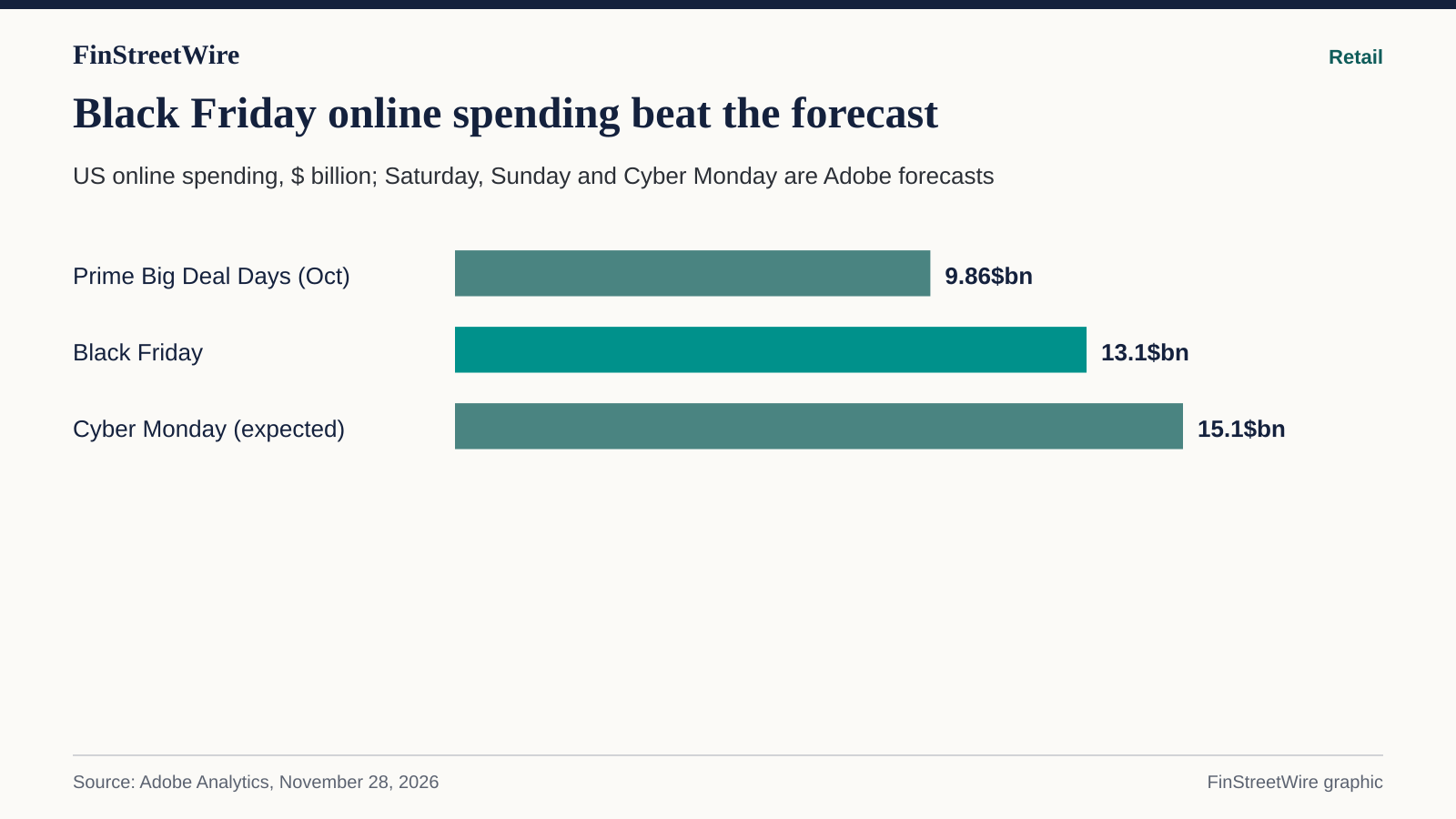
US online spending reached $13.1 billion on Black Friday, up 11.1% on last year and past Adobe's $12.9 billion forecast.
3 min read
US shoppers spent $13.1 billion online on Black Friday, Adobe Analytics data showed on Saturday, beating the $12.9 billion Adobe had forecast.[1][2]
Adobe had forecast $12.9 billion in September, growth of 9.2% on last year. The actual growth of 11.1% puts the day ahead of that pace. Through 6:30 p.m. ET on Friday, spending had already reached $9.7 billion, up 12.8% on the same hours a year earlier, and Adobe said then that the final total would land between $13 billion and $13.4 billion.[1][3]
What shoppers bought
Gaming and electronics were the standout categories, Adobe's report said, but the deals also pulled in spending on everyday goods. Shoppers used the discounts to buy household goods in bulk, from cleaning supplies to pet care products. Retailers cut prices on apparel and appliances to draw in Americans squeezed by inflation and high gas prices, Reuters reported.[2][3]
Shoppers also leaned on AI to compare prices before buying, and Adobe expects that habit to keep growing. AI-driven traffic to retail sites is projected to grow 130% over the whole holiday season, and on Thanksgiving Day it rose 163% on a year earlier. Adobe's survey found 69% of shoppers say an AI-assisted purchase is one they are less likely to send back.[1][2]
The rest of the weekend, and Cyber Monday
Adobe expects Saturday online spending of $6.1 billion, up 6% on last year, and Sunday spending of $6.4 billion, up 7.5%. Across the five days from Thanksgiving to Cyber Monday, it expects US online spending to climb 7.4% to $47.5 billion. Cyber Monday itself is expected to reach $15.1 billion, up 6.2%, which Adobe says would make it the first single day past $15 billion.[1][3]
Buy now, pay later also features in Adobe's numbers: it expects $1.09 billion of BNPL spending on Cyber Monday, up 5.3% on last year, and Adobe said shoppers have spent $1.3 billion more through buy now, pay later than in 2025.[1][2]
Salesforce, which tracks spending across its own retail platform, counted $5.9 billion of US online sales and $30.7 billion globally in the first half of Black Friday. It projects $18.7 billion for the full day in the US, up 4% on last year, and $83 billion worldwide, up 5.2%. Its figures measure a different set of retailers than Adobe's, so the two are a cross-check rather than a single count.[3]
| Day | Spend | Change on last year | Status |
|---|---|---|---|
| Amazon Prime Big Deal Days (Oct) | 9.86 | +8.5% | Actual |
| Black Friday | 13.1 | +11.1% | Actual |
| Saturday | 6.1 | +6% | Adobe forecast |
| Sunday | 6.4 | +7.5% | Adobe forecast |
| Cyber Monday | 15.1 | +6.2% | Adobe forecast |
Black Friday and Prime Big Deal Days are Adobe Analytics actuals; Saturday, Sunday and Cyber Monday are Adobe forecasts. Source: Adobe holiday shopping report, November 28, 2026.
What to watch
- Cyber Monday spending against Adobe's $15.1 billion forecast — the first $15 billion day if it lands.
- Whether the strong Friday pulled demand forward from the weekend, or the weekend holds its own.
- Buy now, pay later spending on Cyber Monday, which Adobe expects at $1.09 billion, up 5.3% on last year.
- Whether discounts deepen or narrow as the season goes on, and what that says about retailers' margins.
Questions readers ask
- How much did shoppers spend online on Black Friday?
- US shoppers spent $13.1 billion online on Black Friday, up 11.1% on last year, according to Adobe Analytics data released on November 28.[1][2]
- Did Black Friday beat Adobe's forecast?
- Yes. Adobe had forecast $12.9 billion, growth of 9.2%, in September. The $13.1 billion actual beat that by about $200 million, by our calculation, and grew 11.1% instead of 9.2%.[1][2]
- What is expected on Cyber Monday?
- Adobe expects $15.1 billion, up 6.2% on last year, which would make it the first single day past $15 billion in US online spending. It also expects $1.09 billion of that to come through buy now, pay later, up 5.3%.[1][2]
Sources
- 2026 Holiday Shopping Trends, Statistics & Actuals. Adobe, Black Friday $13.1 billion (+11.1% YoY); Prime Big Deal Days $9.86 billion (+8.5%); Cyber Monday expected $15.1 billion (+6.2%); AI traffic growth 130% season, 163% Thanksgiving Day; BNPL $1.3 billion more than 2025. Accessed .
- Black Friday online shopping rises to $13.1 billion in the US, Adobe Analytics data shows. Reuters, Final $13.1 billion total; forecast $12.9 billion; discounts on apparel and appliances; AI price comparison; BNPL $1.09 billion expected on Cyber Monday (+5.3%); gaming and electronics standout; essentials stock-up. Accessed .
- US Black Friday online sales to cross $13 billion, Adobe says. Reuters via Channel News Asia, $9.7 billion through 6:30 p.m. ET (+12.8%); final expected $13 billion to $13.4 billion; Saturday $6.1 billion (+6%), Sunday $6.4 billion (+7.5%); Salesforce US $5.9 billion first half, $30.7 billion global; five-day $47.5 billion (+7.4%). Accessed .