Palo Alto Networks sued over early sales bookings; its 10-K shows the growth was bought
A former vice president says Palo Alto pushed resellers to book orders before customers approved them. The two deals total about $9 million.
6 min read
Palo Alto Networks was sued on November 20 by a former regional vice president who says senior leaders endorsed booking sales before customers approved them, Bloomberg Law reported on November 25. The company denies the claims.[1][2]
The scale is the first thing to get right. The two deals the complaint names total about $9 million, against annual revenue of $11.48 billion in the year just ended. The second thing is what the company's own numbers say about where its growth came from: much of it was bought, in the two largest acquisitions in its history.[3][5]
The complaint, filed by McGill in a New York federal court, was reported on November 25. Palo Alto reported its fiscal first-quarter 2027 results a week earlier, on November 18, the same day it announced a $4.5 billion all-stock deal to buy Applied Compute.[1][4]
What the complaint says
McGill, who joined Palo Alto in June 2015 and was promoted to regional vice president for the company's East state, local and education business in July 2023, says his supervisor, Darren Estridge, twice directed resellers to issue purchase orders without a customer order behind them. The first was a deal of about $4 million with the Fire Department of New York in July 2023: the complaint says Estridge had him ask a second-level reseller, QnA, to place the order with the distributor, Carahsoft, without the fire department knowing, so the deal would count before the fiscal year ended on July 31. The department issued its own order around August 22, about three weeks later.[3][2]
The second was a three-year, $5 million deal with the New York State Office of Information Technology Services in April 2024. The agency had issued a purchase order on March 22 covering only the first year; the complaint says Estridge told McGill to record the full three-year order anyway and to give the reseller, Dyntek, extra incentives. McGill says he objected to both, was stripped of his territory, and was fired after the company manufactured a misconduct investigation, including a fabricated account of an altercation with a competitor's employee.[3][2]
The complaint brings two whistleblower retaliation claims, under the Sarbanes-Oxley Act and New York labor law. None of the allegations has been tested in court, and no court has made findings on them. As of November 25, the docket showed no filing from Palo Alto in the case.[2][3]
“completely meritless”
What the 10-K shows: how much growth was bought
Palo Alto's fiscal 2026 revenue was $11.48 billion, up 24% on fiscal 2025's $9.22 billion. Product revenue rose 27% to $2.28 billion and subscription and support rose 24% to $9.20 billion. But the growth came with a cost the income statement shows plainly: GAAP operating income fell to $695 million from $1.24 billion, while non-GAAP operating income rose to $3.36 billion from $2.65 billion, as acquisition-related costs and amortisation of acquired intangibles rose. Goodwill on the balance sheet jumped to $22.01 billion from $4.57 billion.[5]
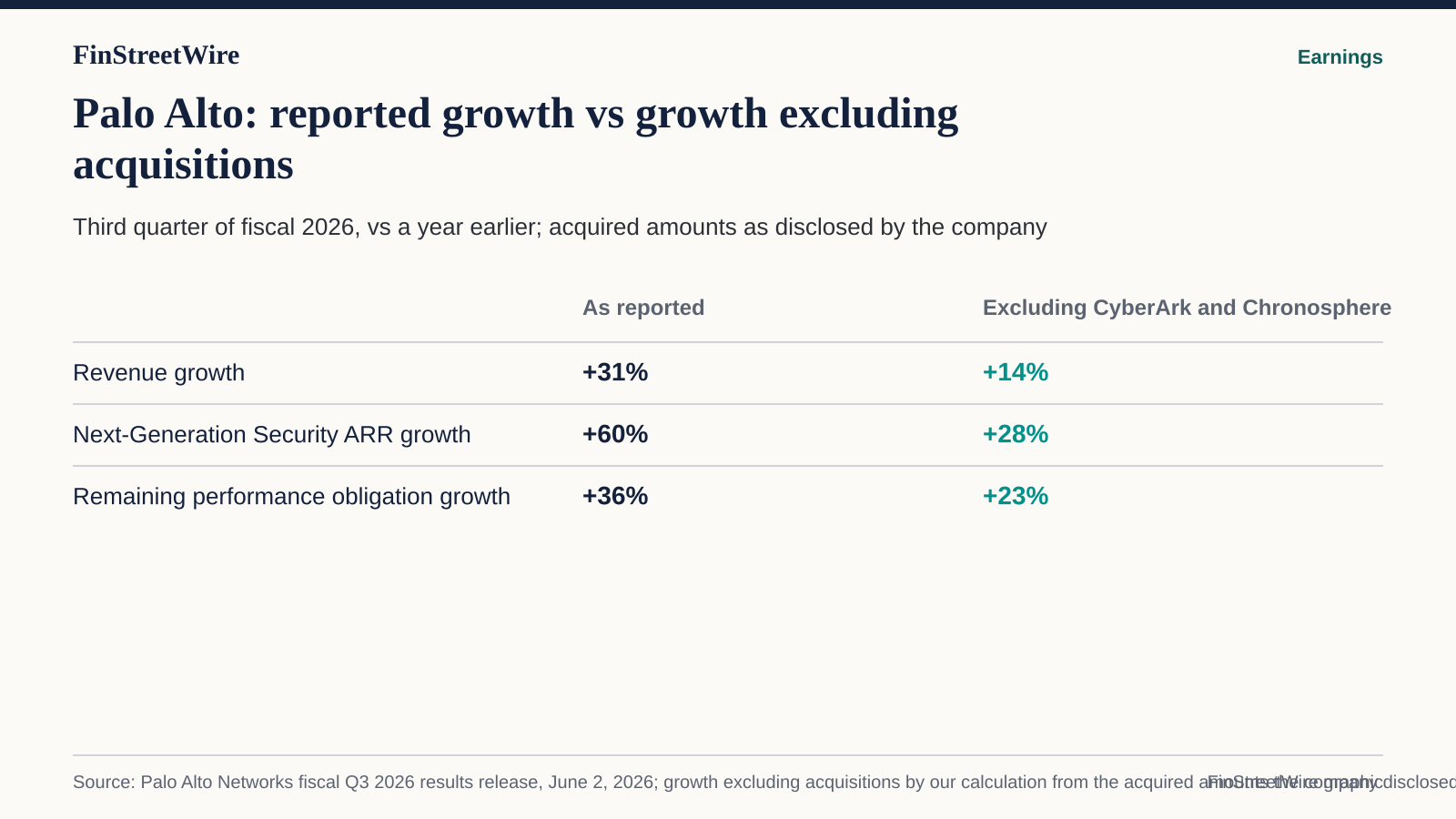
The third quarter of fiscal 2026 shows the split most clearly. Revenue of $3.00 billion grew 31%, but $388 million of it came from CyberArk and Chronosphere, the identity and observability companies Palo Alto bought in February and January 2026 for $21.1 billion and $3.0 billion. Excluding them, revenue was $2.61 billion against $2.29 billion a year earlier, growth of about 14% by our calculation — less than half the reported rate.[6][8]
| Measure | As reported | Excluding CyberArk and Chronosphere |
|---|---|---|
| Revenue | $3.00bn, +31% | $2.61bn, +14%* |
| Next-Generation Security ARR | $8.1bn, +60% | $6.5bn, +28%* |
| Remaining performance obligation | $18.4bn, +36% | $16.6bn, +23%* |
* By our calculation from the company's release: reported figures less the acquired amounts it disclosed ($388m revenue, $1.6bn Next-Generation Security ARR, $1.8bn remaining performance obligation), against the year-ago bases implied by the reported growth rates. Source: Palo Alto Networks fiscal Q3 2026 results release, June 2, 2026.
The first quarter of fiscal 2027, reported on November 18, kept the pattern going. Revenue rose 39% to $3.44 billion, Next-Generation Security annual recurring revenue rose 66% to $9.73 billion, and remaining performance obligations rose 35% to $21.0 billion. Palo Alto raised its full-year revenue guidance to $14.52 billion to $14.57 billion, from $14.10 billion to $14.20 billion, and its non-GAAP earnings per share guidance to $4.26 to $4.30, from $4.16 to $4.19.[4]
“We had a strong start to the year with a record Q1 and delivered one of our highest NGS ARR beats ever as our customers turn to us to protect them against an unprecedented threat environment”
The same day, Palo Alto announced its intent to buy Applied Compute, a company that builds software for post-training and running open-weight AI models, in an all-stock deal valued at $4.5 billion, at $337.16 a share — the volume-weighted average price over the 15 trading days through November 17. It expects to complete the purchase in the quarter ending April 2027. The company also closed the Koi Security acquisition during the year.[4][5]
Context: a two-tier sales chain
The complaint turns on how Palo Alto sells to government customers. It sells to distributors, which sell to resellers, which sell to the end customer. Two distributors accounted for 25% of revenue in the quarter ended October 31, 2026, and 30% of revenue in fiscal 2026. That chain is why a reseller's purchase order matters: it is the document that lets a sale be booked.[2]
The shares had jumped 9.9% on November 18, the day Palo Alto reported the quarter and announced the Applied Compute deal, and even after the after-hours fall on November 25 they were 10% above their November 17 close of $309.29.[2]
What to watch
- Palo Alto's response to the complaint, and any court dates set in the Southern District of New York.
- Fiscal second-quarter results for the quarter ending January 31, 2027, against guidance of $3.53 billion to $3.55 billion of revenue.
- Whether Next-Generation Security annual recurring revenue keeps growing without the acquired contribution: it was $9.73 billion at October 31, up 66%.
- The Applied Compute close, expected in the quarter ending April 2027, and any change to its $4.5 billion all-stock terms if the share price moves.
Questions readers ask
- How big are the deals in the lawsuit compared with Palo Alto's revenue?
- About $9 million combined — $4 million for the Fire Department of New York and $5 million for a New York State deal. Each is about 0.06% of Palo Alto's revenue in the fiscal year it was booked, by our calculation.[3][7]
- Did Palo Alto's growth come from acquisitions?
- Part of it did. In the third quarter of fiscal 2026, $388 million of $3.00 billion of revenue came from CyberArk and Chronosphere, and excluding them revenue grew about 14% rather than the reported 31%. The company bought CyberArk for $21.1 billion and Chronosphere for $3.0 billion in early 2026.[6][8]
Sources
- Palo Alto Networks Accused by Ex-Manager of Accounting Fraud (1). Bloomberg Law, Complaint filed Friday in New York; senior leadership endorsed inducing resellers to issue purchase orders before customer approval. Accessed .
- Ex-Palo Alto Networks (PANW) exec alleges accounting fraud. AIStockWire, Case opened November 25 in Manhattan; spokesperson called the allegations 'completely meritless'; shares $356.14 close, $340.31 at 5:41 p.m. ET, down 4.4%; two distributors 25% of Q1 FY2027 revenue, 30% of FY2026. Accessed .
- PANW Stock Slips After-Hours On Former Executive's Accounting Fraud Allegations: Firm Denies Claims. Stocktwits, FDNY $4m deal, July 2023, via reseller QnA and distributor Carahsoft; New York State $5m deal, April 2024, via reseller Dyntek; fabricated altercation as dismissal pretext. Accessed .
- Palo Alto Networks Reports Fiscal First Quarter 2027 Financial Results. Palo Alto Networks (PR Newswire), Q1 FY2027 results, guidance raise, Applied Compute announcement, Arora quote. Accessed .
- Palo Alto Networks Reports Fiscal Fourth Quarter and Fiscal Year 2026 Financial Results. Palo Alto Networks (PR Newswire), FY2026 statements of operations and balance sheet: revenue $11,480m, goodwill $22,010m, GAAP operating income $695m. Accessed .
- Palo Alto Networks Reports Fiscal Third Quarter 2026 Financial Results. Palo Alto Networks (PR Newswire via Stockwatch), Q3 FY2026: revenue $3,002m incl $388m from CyberArk and Chronosphere; NGS ARR $8.1bn incl $1.6bn; RPO $18.4bn incl $1.8bn. Accessed .
- Palo Alto Networks Reports Fiscal Fourth Quarter and Fiscal Year 2024 Financial Results. Palo Alto Networks (PR Newswire), FY2024 revenue $8,027.5m; FY2023 revenue $6,892.7m. Accessed .
- Palo Alto Networks' acquisitions: what it paid, per SEC filings. Dealroom, CyberArk closed February 11, 2026, $21.1bn consideration; Chronosphere closed January 29, 2026, $3.0bn; both per the company's filings. Accessed .
Corrections
- : Key Takeaways correction: one bullet restored a dropped attribution or qualifier that the concision rewrite had removed. No facts, figures or body text changed.