Black Friday's first AI-agent results: shoppers using a retailer's agent spent 43% more per order
Salesforce's first results put agent shoppers well ahead on order value, while its own first-half count put global Black Friday online sales at $30.7 billion.
6 min read

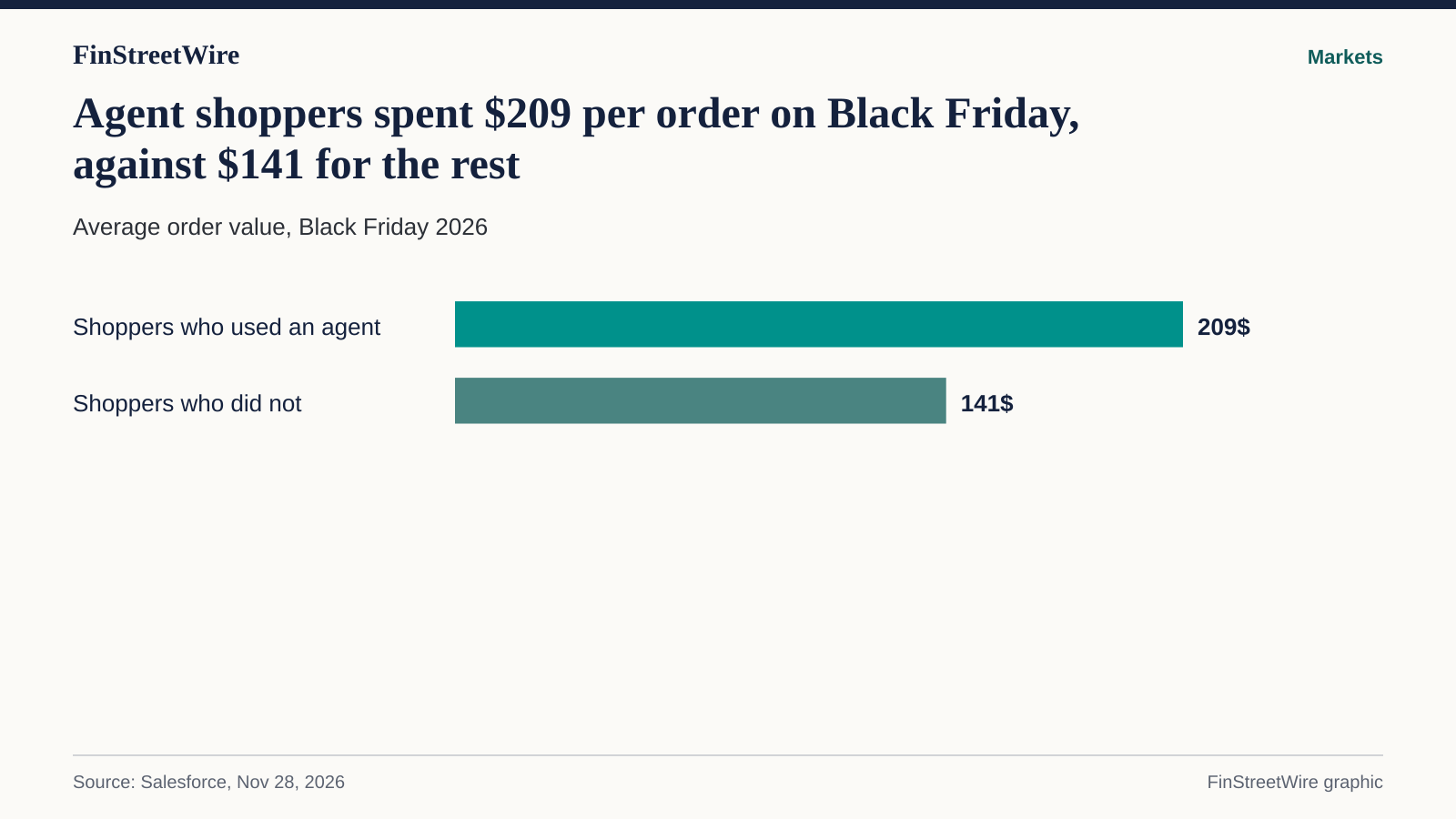
Black Friday's first agent-shopping results are in, and the gap is wide: shoppers who used a retailer's AI agent spent 48% more per order than those who did not, Salesforce said on Saturday, November 28.[2]
The gap is the first hard evidence that an agent changes what shoppers spend, not just how they browse. The question now is whether the edge holds once Cyber Monday's discounts peak, and whether retailers without an agent are already losing sales they never see.[1][2]
The short answer: agents lifted order values sharply on both days, but the figures come from Salesforce's own platform, and Salesforce sells the agents it is measuring.[1][2][3]
What the first half counted
By midday on Black Friday, Salesforce's platform had recorded $5.9 billion of US sales and $30.7 billion worldwide. That kept the day on course for the $18.7 billion US total Salesforce had projected, up 4% on last year, and about $83 billion worldwide, up 5.2%. Those full-day totals are projections, not results, and are still to be confirmed.[4]
Adobe, which measures a different set of retailers, said US online spending reached $13.1 billion on Black Friday, up 11.1% on last year. The two counts are a cross-check on each other, not a single tally: Salesforce tracks spending across its own retail platform, while Adobe tracks a different panel of sites.[5][4]
The first-half global total of $30.7 billion was 37% of the $83 billion full-day total Salesforce had projected, by our calculation. The rest of the day, including the evening peak, had to deliver the remaining 63%.[4]
The agent gap, day by day
The 43% figure came with Thanksgiving Day's results. Salesforce said global online sales reached $37.2 billion that day, up 4.6% on last year, and AI sent shoppers 2.3 billion recommendations. The analysis covered more than 1.5 billion shoppers and 1.5 trillion page views.[1]
“Retailers with an AI agent saw 43% more per order from the shoppers who used it compared to shoppers who didn't.”
Black Friday's own cut was stronger. Shoppers who used an agent averaged $209 per order, against $141 for those who did not, 48% more on Salesforce's figures. Sites with a shopper agent grew sales 11% on last year, against 4.8% on sites without one, a gap of more than two to one.[2]
Show the data as a table
| Item | % year over year |
|---|---|
| Sites with a shopper agent | 11.0 |
| Sites without one | 4.8 |
Source: Salesforce, Nov 28, 2026. Growth is year over year on Salesforce's platform.
| Measure | Result | Comparison |
|---|---|---|
| US online sales, first half | $5.9bn | Projected $18.7bn full day, up 4% |
| Global online sales, first half | $30.7bn | Projected $83bn full day, up 5.2% |
| Average order, agent users (Black Friday) | $209 | 48% above $141 for non-users |
| Sales growth, sites with agents | +11% | Against +4.8% without agents |
| Average order, agent users (Thanksgiving) | +43% | Against shoppers who did not use an agent |
First-half sales are Salesforce platform data; full-day totals are Salesforce projections, not results. Source: Salesforce, Nov 28, 2026; Reuters, Nov 28, 2026.
What Salesforce expected before the weekend
Nine days before Black Friday, Salesforce had forecast a record Cyber Week: $357 billion of global online sales from November 24 to 30, up 6% on last year, with $84 billion of that in the US. It expected AI and agents to shape $75.8 billion of the total, 21% of global sales, up 13% from $67 billion in 2025. AI-driven traffic to retail sites was already up 104% on a year earlier.[3]
The forecast also set the bar the results have now cleared. Before the weekend, Salesforce's data had shoppers who engaged with a brand's shopper agent spending 8% more per order and buying 23% more items. The holiday results were far stronger: 43% more per order on Thanksgiving Day and 48% on Black Friday, more than five times the pre-season gap, by our calculation. One in three retailers was expected to have a shopper agent on its site by Cyber Week.[1][2][3]
Walmart is the largest live test of the idea. It opened its Black Friday deals to Meta's Muse through Walmart's Agent Gateway, letting the agent search for deals, fill a basket and check out, with the shopper setting a spending limit first.[6]
Why the numbers need a second look
First, the measurer sells the tool. Salesforce's Agentforce and Commerce Cloud power the shopper agents behind these figures, so the data comes from the vendor with the most to gain from a strong result. The posts give no count of how many shoppers actually used an agent, and no split between bigger baskets and higher-priced items. And most shoppers are still cautious: 73% said they would not give a personal agent their card details, and only 8% have let an agent complete a purchase.[1][2][3]
Against that, the direction of travel is corroborated. Adobe's independent count of the same day also came in strong, and AI-driven traffic to retail sites rose 163% on Thanksgiving Day, on Adobe's figures. Shoppers are arriving through AI in far greater numbers, whether or not they let an agent spend for them.[5]
Our read
Our read: the agent edge is real enough to change how retailers staff the holiday, the help desk is now the sales floor, but one weekend does not prove the habit sticks. The test that matters is Cyber Monday, when discounts peak and the novelty has worn off. If agent shoppers still outspend the rest by anything like 40%, every large retailer will need an agent on its site by next November.[1][2][3]
What to watch
Cyber Monday is the next marker. Adobe expects $15.1 billion of US online spending, up 6.2% on last year, and Salesforce's Cyber Week window closes the same day, November 30.[5][3]
- Salesforce's full Cyber Week results, due after November 30, and whether the AI-influenced share lands near the $75.8 billion forecast.
- Whether retailers without a shopper agent report slower growth, the 11% against 4.8% gap is the number to re-test.
- Whether Walmart or another large retailer discloses how many shoppers used an agent, and what they bought.
- Whether the 43% and 48% order-value gaps narrow once the deepest discounts arrive, or hold through Cyber Monday.
Questions readers ask
- How much more did AI-agent shoppers spend per order?
- On Thanksgiving Day, 43% more than shoppers who did not use an agent, Salesforce said. On Black Friday itself the gap was 48%, with agent users averaging $209 per order against $141 for others.[1][2]
- How much did Salesforce count in Black Friday online sales?
- In the first half of the day, Salesforce's platform recorded $5.9 billion of US sales and $30.7 billion worldwide. The full-day figures it had projected, $18.7 billion in the US and about $83 billion worldwide, are projections, not results.[4]
- Does this prove AI agents make shoppers spend more?
- No. The figures show a gap, not a cause: shoppers who choose an agent may already intend to spend more, and the data comes from Salesforce's own platform. Adobe's independent count confirms the day was strong, but it does not separate agent users from the rest.[1][5]
The holiday's first agent results are a signal, not a verdict. Cyber Monday will show whether the gap was a one-day novelty or the start of a new way to shop.[1][2]
Sources
- Salesforce (@salesforce) on X: agent shoppers spent 43% more per order. Salesforce, Post, Nov 28, 2026, 12:42 a.m. ET: 'Retailers with an AI agent saw 43% more per order from the shoppers who used it compared to shoppers who didn't'; Thanksgiving global online sales $37.2B (+4.6% YoY); 2.3B AI-powered recommendations; analysis of 1.5B+ shoppers, 1.5T page views. Accessed .
- Salesforce (@salesforce) on X: Black Friday agent results. Salesforce, Post, Nov 28, 2026: sites with shopper agents grew 11% YoY vs 4.8% without; agent users spent 48% more per order on average, $209 vs $141. Same figures in Salesforce's Instagram post, Nov 28, 2026 (instagram.com/p/DgS0t8mRDpj). Accessed .
- Record Cyber Week Expected to Deliver $75.8B in AI-Driven Sales. Salesforce, $357B global Cyber Week (+6%), $84B US (+6%); $75.8B AI-influenced (21%, up 13% from $67B in 2025); AI traffic +104% YoY; agent shoppers spend 8% more per order, 23% bigger baskets; 1 in 3 retailers to have shopper agents; 73% won't hand over card details; 8% had agent make purchases. Accessed .
- US Black Friday online sales to cross $13 billion, Adobe says. Reuters via Channel News Asia, Salesforce $5.9B US and $30.7B global in first half of Black Friday; projected $18.7B US (+4%) and $83B worldwide (+5.2%) for full day. Accessed .
- 2026 Holiday Shopping Trends, Statistics & Actuals. Adobe, Black Friday $13.1B (+11.1% YoY); Cyber Monday expected $15.1B (+6.2%); AI-driven traffic +163% on Thanksgiving Day; season AI traffic growth projected 130%. Accessed .
- Walmart's Black Friday Deals Continue. Meta's Muse Can Now Shop Them, Too.. Walmart Inc., Muse shops Black Friday deals via Walmart Agent Gateway; Agent Profiles with spending limits and purchase approval. Accessed .