House bitcoin reserve bill heads for a floor vote with a 20-year sales ban, minus its Fed funding idea
H.R. 8957 would write the Strategic Bitcoin Reserve into law and bar sales for 20 years, after committee edits cut its Fed and tariff funding options.
4 min read
A bill that would lock the US government's bitcoin away for two decades has cleared a House committee. It has not passed the House or the Senate and is not law.[1]
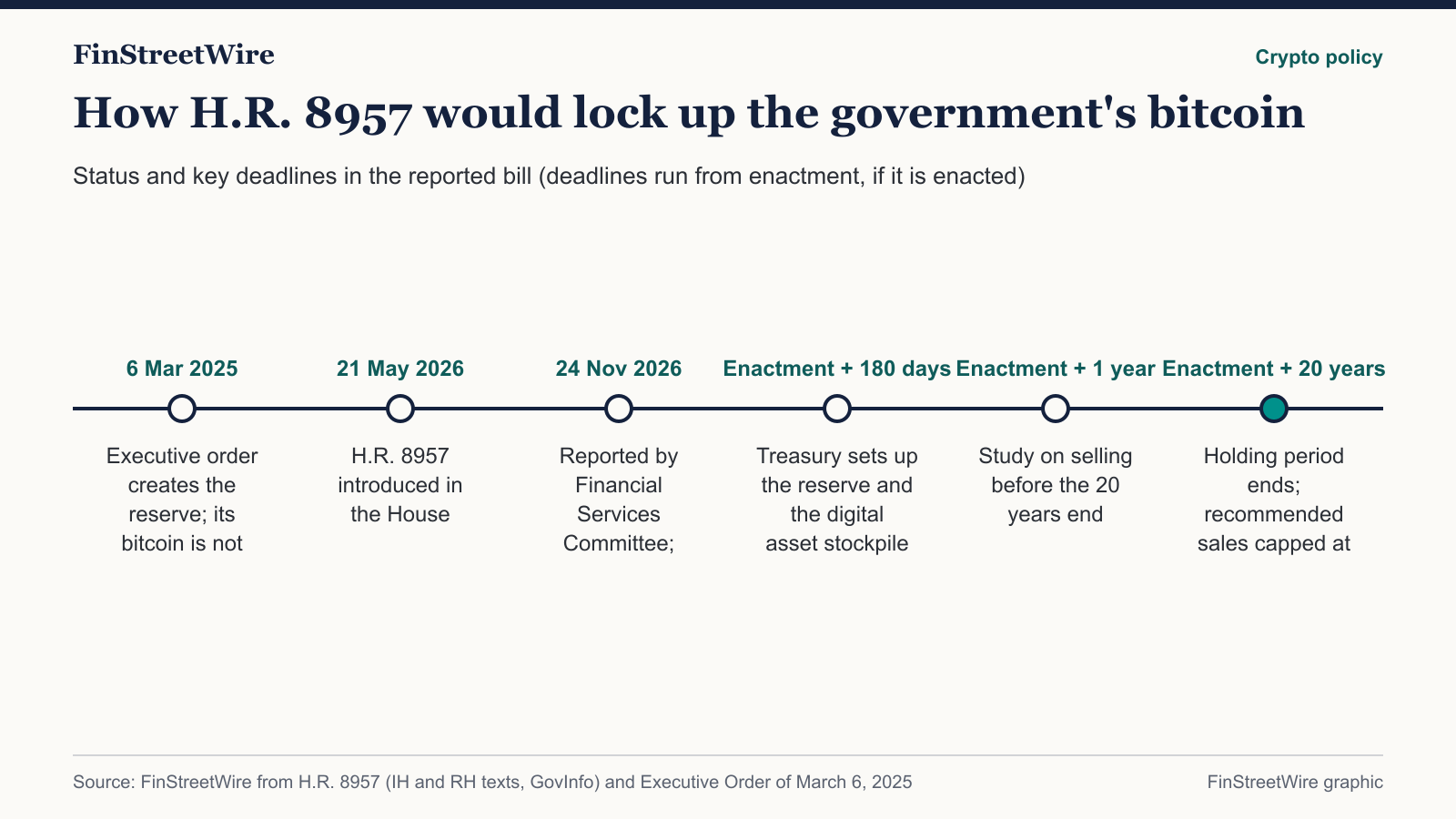
The Financial Services Committee reported H.R. 8957 with amendments on November 24, and the House placed it on the Union Calendar as No. 789 with Report No. 119-894.[1]
The bill, introduced in May by Representative Nick Begich of Alaska with more than 20 co-sponsors, would establish a Strategic Bitcoin Reserve and a separate Digital Asset Stockpile inside the Treasury within 180 days of enactment. Bitcoin the government owns outright, chiefly coins forfeited in criminal or civil cases, would move into the reserve; other seized tokens would go to the stockpile.[1][2]
The 20-year rule
Section 5 is the core. Treasury would have to keep every bitcoin deposited in the reserve for at least 20 years from the date the law takes effect, and until then the coins could not be sold, swapped, auctioned or pledged in any way. Two years before the period ends, the Treasury Secretary would recommend to Congress whether to keep holding or to release coins gradually. After it ends, the Secretary could recommend sales of no more than 10% of the reserve in any two-year period.[1]
The committee also asked for an early-exit study. Within a year of enactment, Treasury would report on conditions under which reserve bitcoin might be sold before the 20 years are up, including possible exceptions for national security and financial stability. Until the reserve exists, agencies holding qualifying bitcoin could not sell it except for national security, where another law requires it, or under court order or to return assets to identifiable victims of crime.[1]
What the committee changed
Comparing the reported text with the version introduced on May 21 shows three substantive edits. First, the introduced bill asked Treasury and Commerce to study buying more bitcoin over five years through mechanisms that included Federal Reserve surplus remittances, a revaluation of the gold certificates held by Reserve Banks, and tax payments or tariff revenue. The reported bill keeps the study but strikes those options, leaving conversion of other seized digital assets, forfeitures and penalties, and cooperative programs with states or partners.[1][2]
Second, it adds that nothing in the study section authorises pledging government assets as collateral to buy bitcoin, alongside the existing bar on borrowing, new taxes and deficit spending. The bill's long title no longer refers to offsetting costs with Federal Reserve resources, and a section on Exchange Stabilization Fund reporting is gone.[1][2]
Third, the clock changed. The introduced text started a fresh 20-year period for bitcoin deposited after enactment; the reported text runs a single period from the date of enactment for all reserve holdings. In practice, coins added in later years would become eligible for sale at the same time as the original stock.[1][2]
What already exists
A Strategic Bitcoin Reserve already exists on paper. President Trump's executive order of March 6, 2025 told Treasury to set one up, funded with forfeited bitcoin, and stated that government bitcoin deposited in it shall not be sold. The bill would turn that instruction into statute, fix a minimum term, require an annual proof-of-reserve report checked by an independent auditor with Government Accountability Office oversight, and let states store their own bitcoin in segregated accounts at Treasury.[1][3]
For markets, the practical difference is durability: an executive order can be rewritten by a later administration, whereas a statute would need another act of Congress. Neither the order nor the reported bill directs Treasury to buy bitcoin with new money; both rely on coins the government already has or receives through forfeiture.[1][3]
What happens next
The bill needs a vote of the full House, passage by the Senate and the President's signature. The 119th Congress ends on January 3, 2027, and bills not enacted by then lapse and would have to be reintroduced. No floor date had been announced in the record we reviewed.[1]
What we don't know
The bill does not say how much bitcoin the government holds, so the size of what would be locked up is not stated in the text. No floor date has been announced, and there is no sign in the record of when, or whether, the Senate would take it up before the Congress ends. The early-sale study could also recommend exceptions that change how binding the 20-year rule turns out to be.[1]
Questions readers ask
- Has the US passed a law banning bitcoin sales for 20 years?
- No. H.R. 8957 has been reported by a House committee and awaits a floor vote. It still needs House and Senate passage and the President's signature.[1]
- Would the bill make the government buy bitcoin?
- No. It orders a study of whether further purchases could be budget-neutral and bars borrowing, new taxes, deficit spending or pledging assets to fund them.[1]
Sources
- H.R. 8957, American Reserve Modernization Act of 2026, Reported in House (RH), Union Calendar No. 789, Report No. 119-894. U.S. Government Publishing Office (GovInfo), Header (reported November 24, 2026); sections 4, 5, 6, 7, 8 and 9. Accessed .
- H.R. 8957, American Reserve Modernization Act of 2026, Introduced in House (IH). U.S. Government Publishing Office (GovInfo), Sections 5, 9 and 11; long title. Accessed .
- Establishment of the Strategic Bitcoin Reserve and United States Digital Asset Stockpile (Executive Order). The White House, Sec. 3(a). Accessed .
Corrections
- : Tightened the summary and opening, applied house spelling, and added a section on what is not yet known. No facts or figures changed.