ExxonMobil starts Uaru, lifting Guyana's installed oil capacity to 1.1 million barrels a day
The fifth Stabroek development adds a 250,000 barrel-a-day vessel that ramps up through early 2027. Exxon holds 45%, Hess Guyana 30% and CNOOC 25%.
3 min read
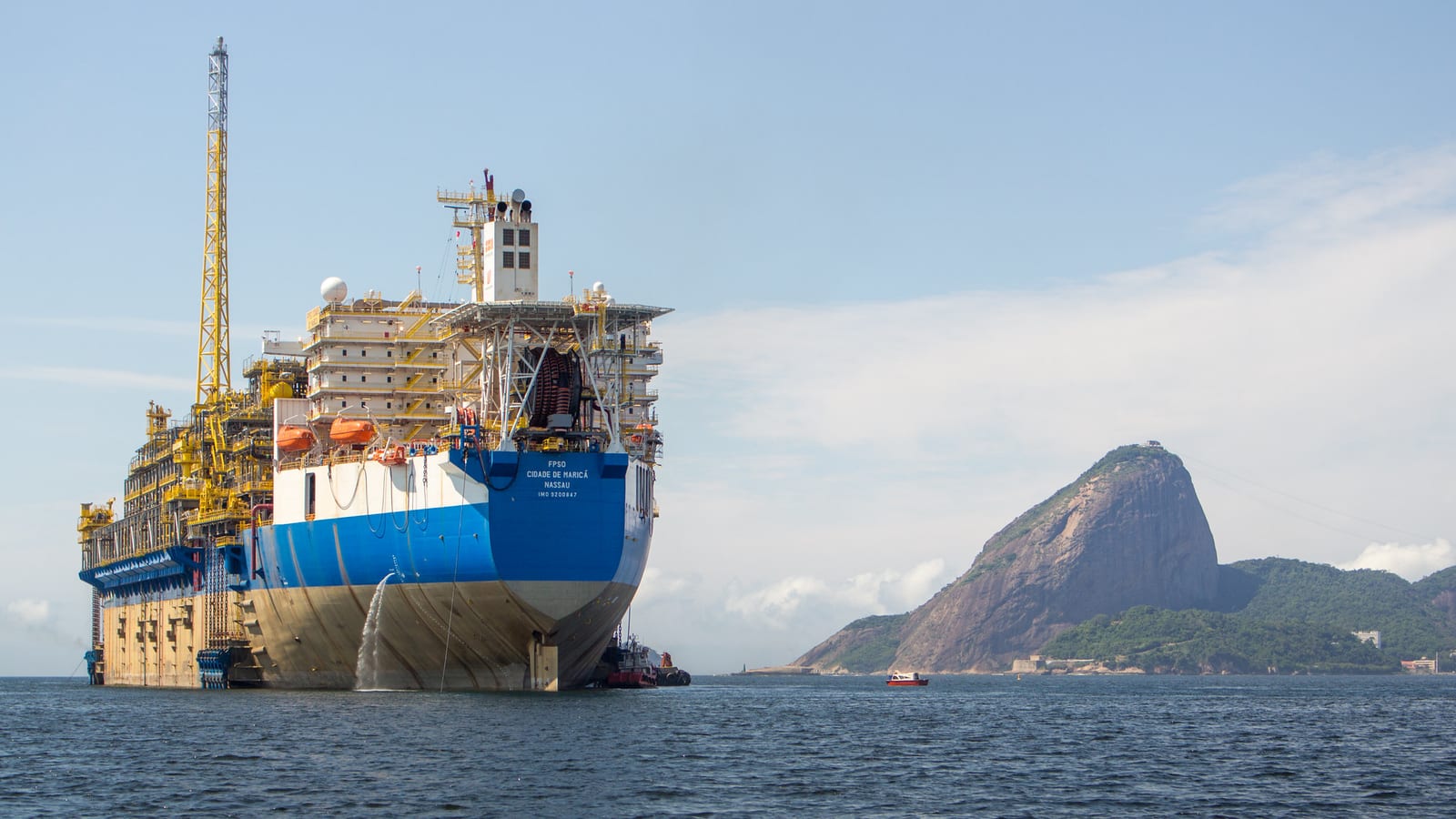
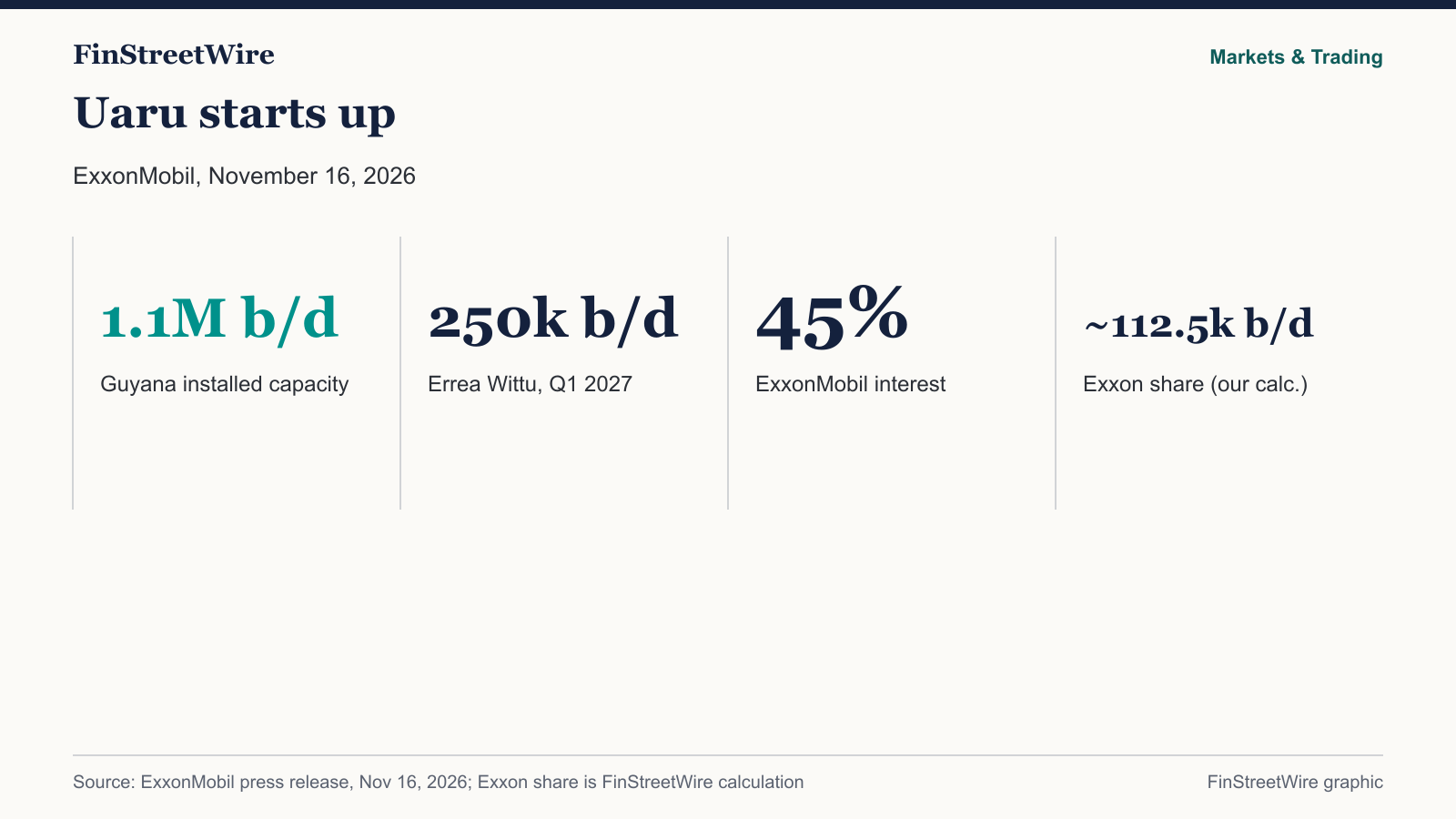
ExxonMobil (NYSE: XOM) has started oil production at Uaru, its fifth project in Guyana's Stabroek block, raising the country's installed production capacity to 1.1 million barrels a day. The company announced the startup on November 16, 2026.[1]
Installed capacity is what the five vessels can handle at full rates, not what Guyana is producing today. The new vessel, the Errea Wittu, is expected to reach its initial capacity of 250,000 barrels a day in the first quarter of 2027.[1]
What Uaru adds
| Item | Detail |
|---|---|
| Vessel | Errea Wittu FPSO; marks MODEC's entry into Guyana |
| Initial capacity | 250,000 b/d, expected in Q1 2027 |
| Storage | 2 million barrels |
| Guyana installed capacity | 1.1 million b/d across five FPSOs: Destiny, Unity, Prosperity, ONE GUYANA, Errea Wittu |
| Stabroek interests | ExxonMobil 45% (operator), Hess Guyana Exploration 30%, CNOOC Petroleum Guyana 25% |
| Next projects | Longtail, the eighth development, has reached a final investment decision |
An FPSO is a floating production, storage and offloading vessel. Source: ExxonMobil press release, November 16, 2026.
Applying each partner's stake to the new vessel's 250,000 barrels a day gives about 112,500 for Exxon, 75,000 for Hess Guyana and 62,500 for CNOOC at full initial capacity. Those are our calculations and assume the vessel runs at that rate.[1]
Why it matters for Exxon
Each new Guyana vessel adds a large block of capacity in a single step: the five vessels now total 1.1 million barrels a day, and Uaru alone adds 250,000. Exxon describes the country as one of the fastest-growing new sources of supply.[1]
“In just over a decade, Guyana has become one of the world's fastest-growing and most important new sources of energy supply.”
The release does not give production costs, the field's reserves or how quickly Uaru will reach full rates within the first quarter. Exxon notes that quantities it cites may include volumes not yet classed as proved reserves under SEC rules.[1]
Storage, spending and the next projects
Errea Wittu can store two million barrels. At its planned 250,000 barrels a day, that is about eight days of output between tanker loadings, on our arithmetic. Its name means abundance in the Warrau language, Exxon says.[1]
Exxon says the Stabroek partners have spent more than US$3.9 billion with Guyanese vendors since 2015. The vessel also marks the entry into Guyana of MODEC, which Exxon says builds on extensive experience in Brazil.[1]
Uaru is the fifth of at least eight planned developments. Exxon recently took a final investment decision on Longtail, the eighth, which means at least three more projects are in the pipeline after Uaru. The release does not give their start dates or capacities.[1]
What to watch
- Whether Errea Wittu reaches 250,000 barrels a day in the first quarter of 2027, as Exxon expects.
- Progress on the sixth and seventh developments before Longtail, which the release does not name.
- Guyana production in Exxon's fourth-quarter results, the first to include Uaru.
Questions readers ask
- Is Guyana producing 1.1 million barrels a day now?
- Not necessarily. 1.1 million barrels a day is installed capacity. The new vessel is still ramping up toward its initial capacity in the first quarter of 2027.[1]
- Who owns the Stabroek block?
- ExxonMobil Guyana operates it with 45%. Hess Guyana Exploration holds 30% and CNOOC Petroleum Guyana 25%.[1]
Sources
- ExxonMobil starts production at Uaru, raising Guyana's installed capacity to 1.1 million barrels per day. Exxon Mobil Corporation, Press release and editor's notes. Accessed .