ExxonMobil buys back $1.76 billion of bonds for about $1.6 billion, short of its $3 billion cap
Holders tendered 59% of the cap across four low-coupon notes, so nothing was prorated. Exxon retires the debt at roughly 91 cents on the dollar, by our math.
3 min read
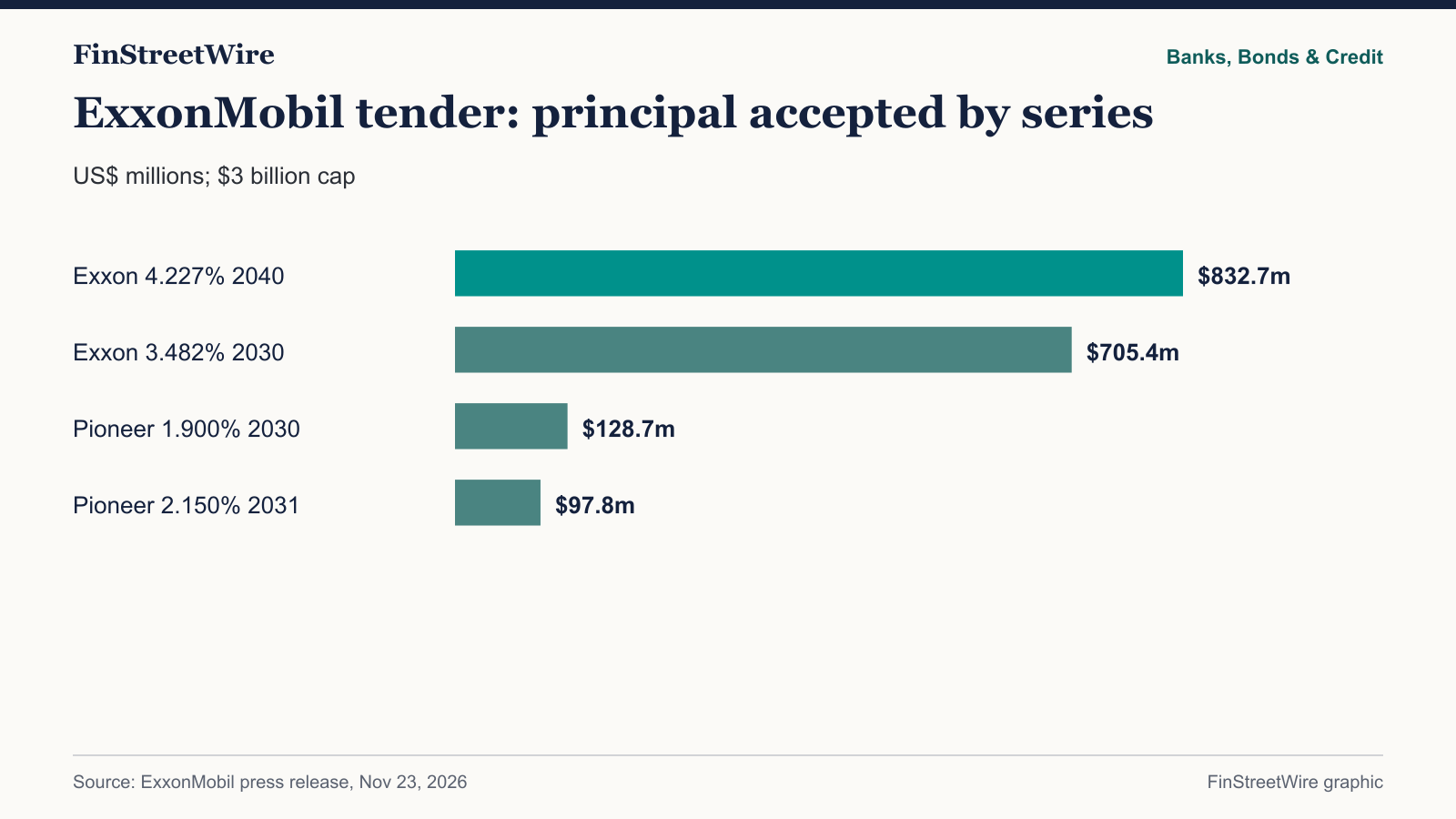
ExxonMobil (NYSE: XOM) has repurchased $1.76 billion of face value of its bonds through cash tender offers that could have taken up to $3 billion. The company announced the pricing and results on November 23, 2026, after the offers expired on November 20.[1]
In a tender offer, a company offers to buy its own bonds from investors at a set price, usually a spread over a Treasury yield. Here the offers were made by two subsidiaries: Pioneer Natural Resources, an Exxon subsidiary, for two of its notes, and Exxon Mobil Corporation for two of its own.[1]
What was bought, and at what price
| Notes | Spread over reference Treasury | Price per $1,000 | Principal accepted |
|---|---|---|---|
| Pioneer 1.900% due 2030 | 22 bp | $896.86 | 128.7 |
| Pioneer 2.150% due 2031 | 30 bp | $892.94 | 97.8 |
| Exxon 3.482% due 2030 | 12.5 bp | $957.85 | 705.4 |
| Exxon 4.227% due 2040 | 65 bp | $872.59 | 832.7 |
| Total | 1,764.6 |
Reference yields: 4.746% on the 4.750% Treasury due October 31, 2031 for the first three series; 4.946% on the 5.000% Treasury due November 15, 2036 for the 2040 notes. All validly tendered notes were accepted; the total is our addition. Source: ExxonMobil press release, November 23, 2026.
Why the bonds cost less than face value
All four series carry coupons below the yields investors can now earn on comparable Treasuries, so their market prices sit below $1,000 per bond. Exxon priced the offers at small spreads over those Treasuries, from 12.5 to 65 basis points, which reflects its strong credit standing.[1]
Multiplying each price by the principal accepted gives about $1.60 billion of cash, plus accrued interest, for $1.76 billion of face value. That is roughly 91 cents on the dollar overall, or about $160 million less than the debt's face amount. Those are our calculations from the release.[1]
That gap is not necessarily an accounting gain. Debt taken on through an acquisition is generally recorded at fair value at closing, so any gain or loss depends on carrying values the release does not give.[1]
Why the take-up fell short of the cap
Holders tendered 59% of the $3 billion maximum, on our arithmetic. Participation varied widely by series: the two Exxon notes made up about 87% of what was accepted, while the Pioneer notes, with smaller amounts tendered, made up the rest.[1]
The release does not give the outstanding amount of each series, so the share of each bond retired cannot be calculated from it. Investors who did not tender keep their notes on the original terms.[1]
Questions readers ask
- Did ExxonMobil buy all the bonds that were offered?
- Yes. Tenders totalled less than the $3 billion cap, so all validly tendered notes were accepted without proration.[1]
- Do tendering holders get accrued interest?
- Yes. Accrued and unpaid interest up to the settlement date is paid on top of the stated consideration.[1]
Sources
- ExxonMobil: Announces Pricing Terms, Expiration and Results of Cash Tender Offers for Outstanding 2030 1.900% Senior Notes, 2031 2.150% Senior Notes, 2030 3.482% Notes and 2040 4.227% Notes. Exxon Mobil Corporation, Results table and notes. Accessed .
- ExxonMobil press releases index (earlier tender results, September 15, 2026). Exxon Mobil Corporation, Release list. Accessed .