Fed's Bowman says bank supervision is being reorganized under regional leaders to act faster on big risks
She tied the overhaul to the SVB review, which counted 54 supervisory findings but none ordering the bank to cut its interest rate risk.
4 min read
The Federal Reserve has begun reorganizing how it supervises banks, Vice Chair for Supervision Michelle Bowman said on November 25. In a pre-recorded address to a meeting of bank supervisors from the Americas in Brasília, she said the change keeps local examination teams in place but gives clearer lines of accountability through regional leadership, with fewer layers of review and faster escalation of decisions.[1]
Bowman framed the overhaul as a response to a problem she described as consultation without conclusion. Fed supervision has historically run through the Board, the 12 regional Reserve Banks and numerous committees, a structure she said has not always made clear who is responsible or supported timely decisions. She added that the Fed is reviewing whether its committees and internal procedures muddy responsibility or slow action down.[1]
“A supervisory organization can be extraordinarily busy without being effective.”
The SVB evidence behind it
Bowman leaned on the independent review of Silicon Valley Bank's March 2023 failure that she commissioned, whose initial findings were released in September. The review found supervisors had identified SVB's core weaknesses well before it collapsed: heavy interest rate risk, a concentrated and largely uninsured deposit base, and poor readiness to meet liquidity demands.[1]
Between 2019 and March 2023, supervisors cited 54 matters requiring attention at the bank, she said. None required SVB to shorten the maturity of its securities portfolio or restructure its held-to-maturity book, the risks that brought it down. Many findings focused on process, and on how the bank measured interest rate risk rather than on reducing it. Her conclusion was that the failure was not a lack of information but a failure to turn information into action.[1]
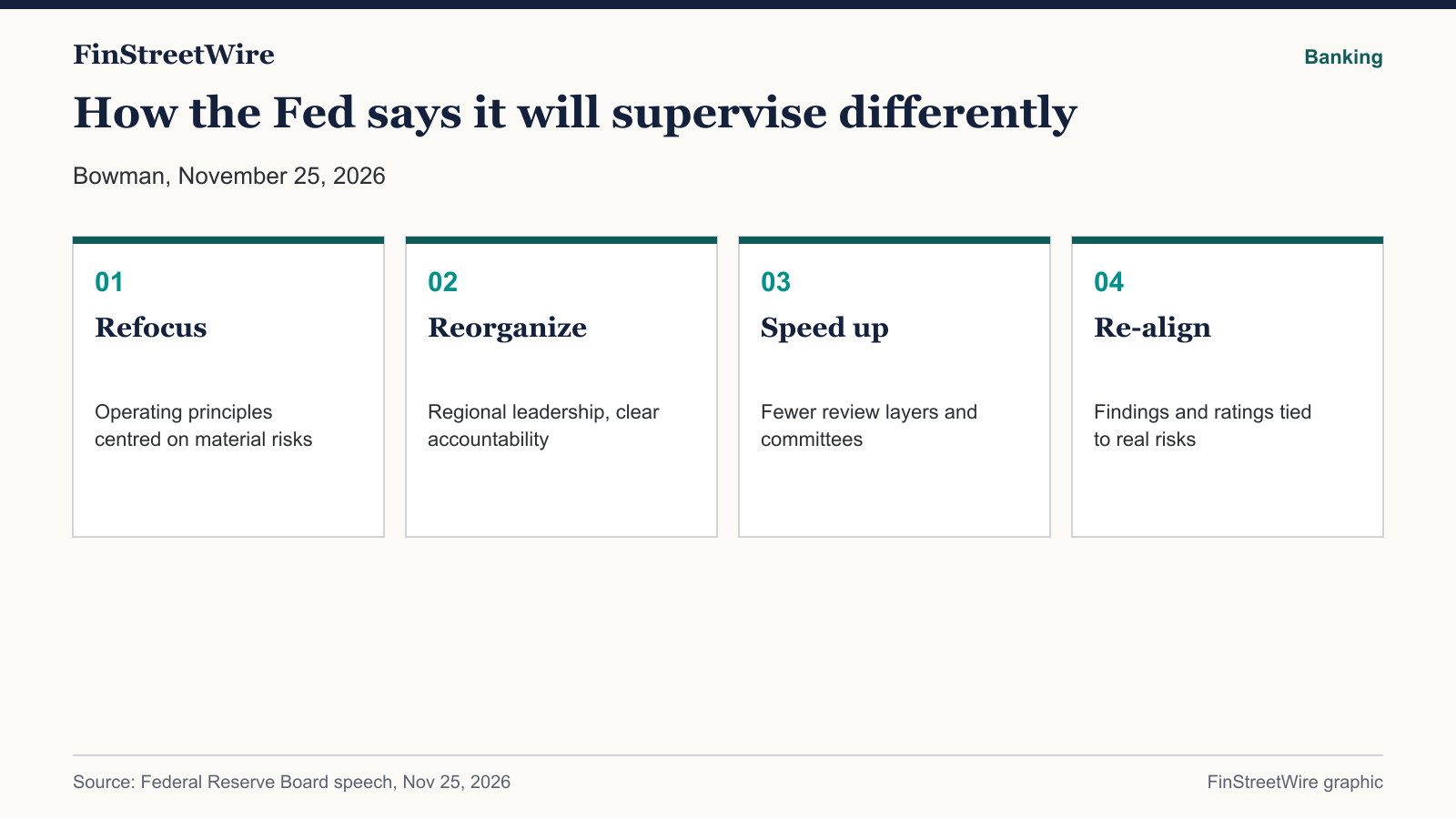
| Change | Stated aim |
|---|---|
| Statement of Supervisory Operating Principles | Focus on material risks and prompt, proportionate action |
| Reorganized supervisory function | Regional leadership; clearer authority and accountability |
| Fewer layers of review | Faster escalation and decisions |
| Review of committees | Remove processes that blur responsibility |
| Ratings and findings | Align more closely with material financial risks |
Source: Federal Reserve Board, speech by Vice Chair for Supervision Bowman, November 25, 2026.
What it means for banks
For banks, the practical message is fewer findings about paperwork and more pressure on balance-sheet risks. Bowman said supervision should rely on professional judgment rather than checklists and documentation, tailor work to each bank's size and risk, and streamline how concerns are resolved. Success, she said, should be measured by whether material risks are mitigated, not by the number of exams conducted or reports produced.[1]
By our reading, that could cut compliance work for many lenders, particularly smaller ones, while making supervisory action more pointed when examiners see a real threat to capital or liquidity. The speech does not say when the reorganization will be complete, how many regions there will be, or whether staffing will change; those details would determine how much changes in practice.[1]
The international angle
Bowman chairs the Financial Stability Board's Standing Committee on Supervisory and Regulatory Cooperation. She noted that the FSB published a consultation in October proposing eight high-level principles for more effective and adaptable regulation. She also cautioned that conclusions from post-failure reviews can embed untested assumptions and should be checked against evidence across jurisdictions before they inform global standards, a point that bears on any future Basel Committee work prompted by the 2023 failures.[1]
Questions readers ask
- How is the Fed changing bank supervision?
- Bowman says the Fed has begun reorganizing supervision under regional leadership with clearer accountability, fewer review layers and a focus on material risks rather than process.[1]
- What did the review of Silicon Valley Bank find?
- According to Bowman, supervisors identified SVB's key risks early and issued 54 findings from 2019 to March 2023, but none required it to reduce the securities and interest rate risks that led to its failure.[1]
Sources
- Modernizing Banking Supervision: A Shared Agenda for the Americas (speech by Vice Chair for Supervision Michelle W. Bowman). Board of Governors of the Federal Reserve System, Full speech and footnotes. Accessed .