Macquarie picks its risk chief Amy Mahony to run Macquarie Bank as Stuart Green and COO Nicole Sorbara retire
Group CEO Greg Ward tied the changes to faster digital transformation and delivering on regulatory commitments; both new executives start on April 1, 2027.
2 min read
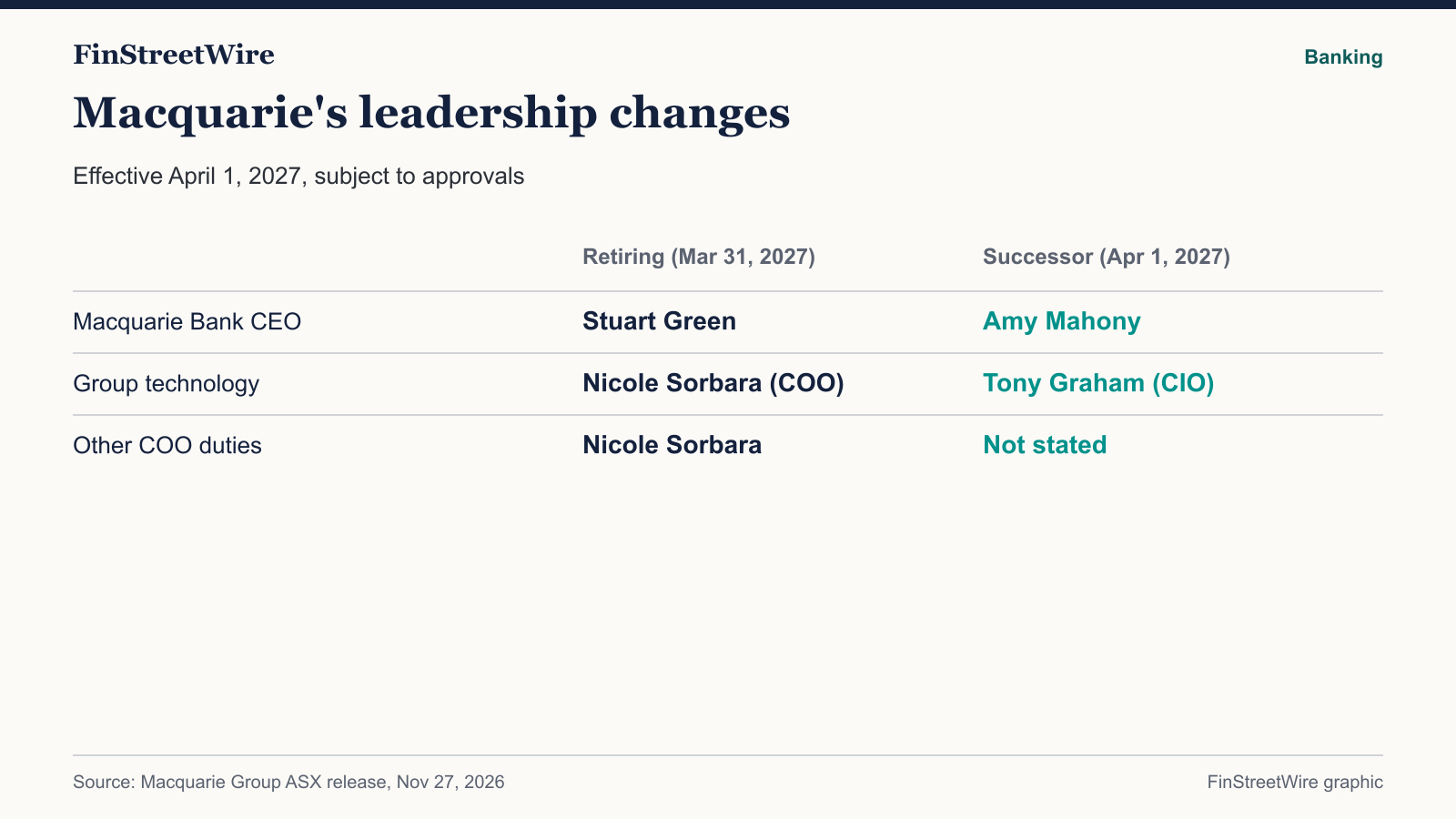
Macquarie Group is changing two of its most senior executives. Stuart Green, managing director and chief executive of Macquarie Bank, and Nicole Sorbara, the group's chief operating officer, will retire and step down from the Executive Committee on March 31, 2027, the company said on Friday in Sydney.[1]
Their replacements come from inside. Subject to necessary approvals, Amy Mahony will become Macquarie Bank CEO, and Tony Graham will take over Sorbara's technology responsibilities as chief information officer. Both join the Executive Committee on April 1, 2027.[1]
Who is taking over
Mahony has been at Macquarie for 15 years and is chief risk officer of Macquarie Asset Management. She was previously the group's global head of compliance and has held senior risk, compliance and regulatory engagement roles at Macquarie and elsewhere, according to the announcement.[1]
Graham has been with Macquarie for 28 years. He was most recently head of technology for Banking and Financial Services, the division that runs Macquarie's Australian retail bank, where he built the technology behind what the company describes as a leading digital bank in Australia.[1]
Reading the choice
Group chief executive Greg Ward framed both moves around two priorities. In the announcement he said the group's growth strategy depends on accelerating its digital transformation and delivering on its regulatory commitments. Appointing a risk and compliance specialist to run the bank, and a banking technologist as CIO, lines up directly with those two aims.[1]
“Our growth strategy depends on us accelerating our digital transformation and delivering on our regulatory commitments”
The departures end long tenures. Green spent 25 years at Macquarie, including as head of investor relations and group treasurer, and has run Macquarie Bank for the past six years. Sorbara spent 30 years at the group, the last 14 as COO, after roles in finance, Macquarie Capital and as global head of human resources.[1]
What we don't know
The announcement names a successor only for Sorbara's technology responsibilities. It does not say who will take her other operations duties, or whether the COO role will continue. It does not specify which approvals Mahony's appointment needs, or say who will replace her as risk chief at Macquarie Asset Management. No financial or strategic changes were announced alongside the appointments.[1]
Questions readers ask
- When do the changes take effect?
- Green and Sorbara leave the Executive Committee on March 31, 2027; Mahony and Graham join it on April 1, 2027, after a handover period.[1]
- Is Greg Ward leaving?
- No. The announcement concerns the Macquarie Bank CEO and group COO roles; Ward remains group chief executive.[1]
Sources
- Macquarie announces retirement of Stuart Green and Nicole Sorbara and changes to Executive Committee. Macquarie Group Limited (ASX: MQG) via ASX, Full release. Accessed .