Port Authority's $3.45 billion of project cost increases: what they mean for its bondholders
The agency's documents show overruns are absorbed by the capital plan, not the bond pledge, but the plan leans on cash flow and future fee increases.
6 min read
The bistate Port Authority of New York and New Jersey has taken on roughly $3.45 billion of higher costs across three of its largest projects without changing what secures its bonds. Its Feb. 4, 2026 official statement shows the money comes from trimming or delaying other capital work.[1]
That matters now because the agency is returning to the market. Its proposed 2027 budget, released Nov. 12, assumes $1.1 billion of new debt next year to help fund $4.0 billion of capital spending, against $24.36 billion of consolidated bonds outstanding at Sept. 30.[2][3]
The question for a bondholder is narrower than the headline. Cost overruns change what gets built and when. They reach debt holders only if they push borrowing up, or net revenue down, faster than the security can absorb.[1]
Where the $3.45 billion comes from
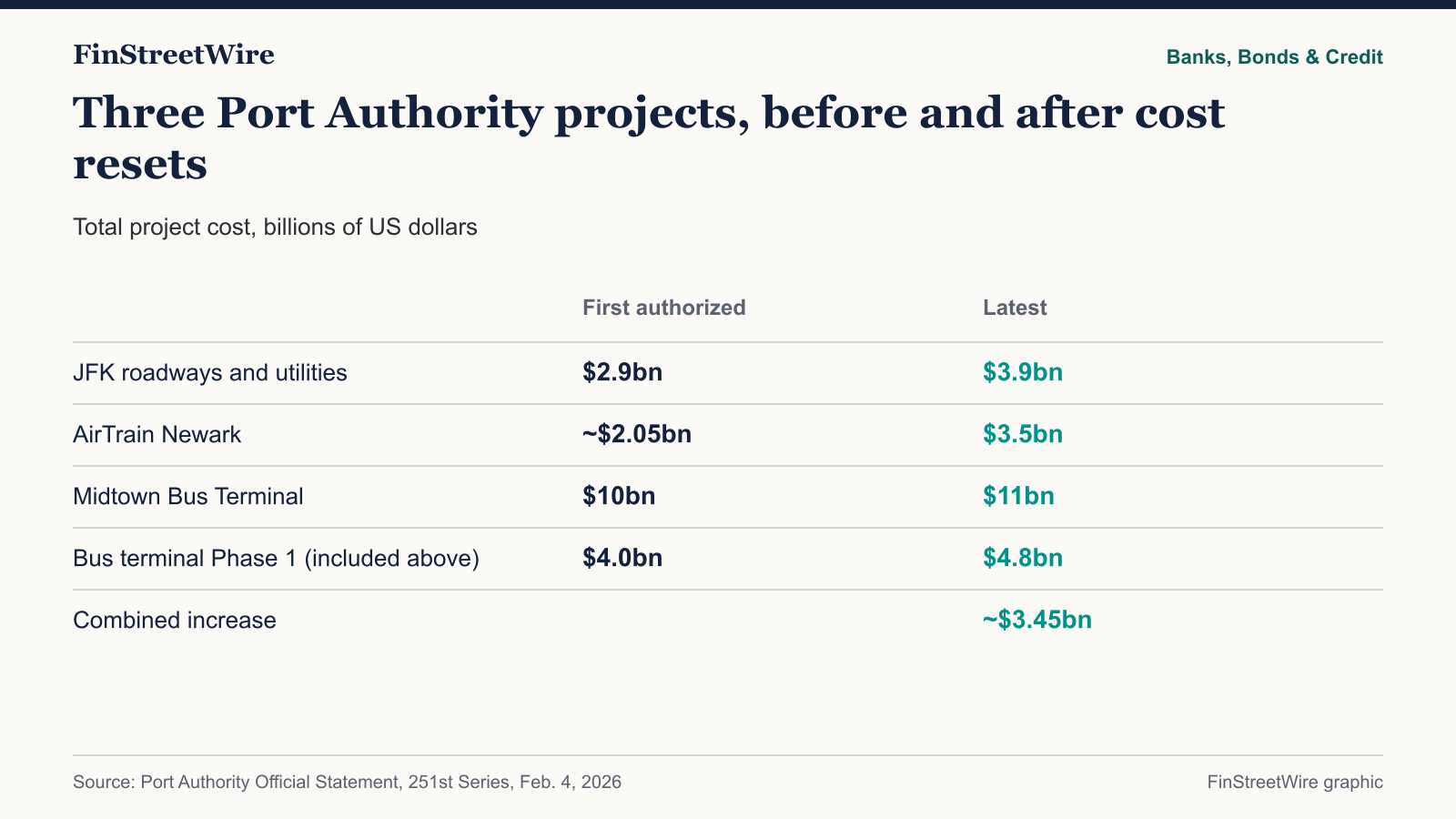
The figure is our sum of three board actions described in the official statement for the 251st series. None was announced as a single overrun, and each was disclosed when it happened.[1]
| Project | First authorization | Latest authorization | Increase |
|---|---|---|---|
| JFK roadways, utilities and ground transportation | $2.9bn (Dec. 2021) | $3.9bn (Mar. 2023) | $1.0bn |
| AirTrain Newark replacement | About $2.05bn (implied) | $3.5bn (Nov. 14, 2024) | About $1.45bn |
| Midtown Bus Terminal replacement (full program) | $10bn | $11bn (budget after June 2025 Phase 1 bids) | $1.0bn |
| of which Phase 1 | $4.0bn (Dec. 2024) | $4.8bn (June 2025) | $0.8bn |
| Total, three programs | About $3.45bn (our calculation) |
The AirTrain Newark first authorization is implied from the disclosed $3.5bn reauthorization and 'approximately $1.45 billion' increase. Phase 1 is included in the bus terminal total and is not added twice. Source: Port Authority Official Statement, Consolidated Bonds 251st Series, Feb. 4, 2026, Section II.
The agency's explanation is consistent across projects: inflation since late 2020, sharp rises in some materials prices, and contractors charging more to take on very large jobs. The 251st series document adds that tariffs on lumber, steel and aluminum keep costs volatile. It also states the agency's general response.[1]
“the Port Authority seeks to offset any increased costs in its construction activities through value engineering efforts, by reducing project scope or otherwise deferring or reducing spending on other capital projects.”
For the JFK work, the document says the increase was offset by deferring or reducing other projects. For the bus terminal, it says value engineering is under way to cut the $11 billion figure, with no assurance it will succeed.[1]
What the bond pledge covers
Consolidated bonds are general obligations of the Port Authority backed by its full faith and credit. They are secured equally by the net revenues of all existing facilities, the General Reserve Fund and the Consolidated Bond Reserve Fund. The bonds are not obligations of either state, and the agency has no taxing power.[1]
That structure is why a project overrun does not, on its own, impair the claim. Bondholders lend against the system's surplus, from airports, crossings, PATH, the port and real estate, rather than against a bus terminal. The protective covenant is the additional-bonds test: new consolidated bonds may be sold only when net revenues are at least 1.3 times the peak year of projected debt service including the new issue.[1]
How much room the numbers leave
The proposed 2027 budget gives the figures that matter. Net operating revenues are projected at $3.45 billion. Debt service charged to operations is $1.70 billion, or $1.95 billion including interest during construction. On those numbers coverage is about 2.0 times and 1.8 times respectively; measured with the wider $4.44 billion revenue line the budget sets aside for debt service and reserves, it is about 2.3 times total debt service (our calculations).[2]
For January through September 2026, the statements show $3.16 billion of net revenues for debt service against $1.23 billion of total debt service, about 2.6 times, helped by $112 million of retroactive World Trade Center rent (our calculation). Activity softened: aviation passengers fell 3.3% and bridge and tunnel vehicles 1.7% from a year earlier, while PATH riders rose 7.9%.[3]
Show the data as a table
| Item | $ billions |
|---|---|
| Pay-as-you-go cash | 19.6 |
| Consolidated bonds | 14.0 |
| Passenger facility charges | 3.4 |
| Gateway special obligations | 2.7 |
| Third-party funding | 2.0 |
| TIFIA loan | 1.9 |
| Federal grants and storm aid | 1.2 |
Federal grants and storm aid combine $840m of awarded grants and $380m of storm recovery funding. Source: Port Authority 2026-2035 Capital Plan, Supporting Information.
Our read: the pressure point is the cash line, not the bond line. Pay-as-you-go cash is about 44% of the plan's sources, and consolidated bonds about 31% (our calculation). When a project costs more, the agency can defer other work, borrow more within the 1.3-times test, or draw on cash. The budget shows the third option in use: reserves fall by about $0.6 billion over two years.[2][4]
The capital plan is explicit about what holds the cash line together.[4]
“This amount assumes that the Board of Commissioners will take certain actions in the future to create or raise certain fees and charges at its facilities in order to maintain a balanced plan.”
Increases approved in earlier years already feed the 2027 budget: an inflation-linked toll step, the third of four $0.25 toll increases and a 22% rise in PATH fare revenue. The proposed budget itself adds no new toll, fare or fee changes. Fitch, in its January 2026 action, cited the agency's broad control over prices as a credit strength and the larger capital program as an execution risk.[2][5]
What it means for the next deal
The February sale gives a benchmark. The $350 million 251st series priced its 5.25% bonds due 2056 to yield 4.48% to a Feb. 15, 2036 par call. Buyers of callable premium bonds earn the yield to the call date, not the coupon, if the agency refinances at par in 2036.[1]
| Item | Figure | Date / period | Source |
|---|---|---|---|
| Consolidated bonds outstanding | $24.36bn | Sept. 30, 2026 | Q3 2026 condensed statements |
| New debt assumed in 2027 budget | $1.1bn | Budget proposed Nov. 12, 2026 | Proposed 2027 budget |
| Net operating revenues | $3.45bn | 2027 budget | Proposed 2027 budget |
| Debt service to operations | $1.70bn ($1.95bn incl. construction interest) | 2027 budget | Proposed 2027 budget |
| Coverage, operations basis | About 2.0x | 2027 budget | Our calculation |
| Additional-bonds test | 1.3x prospective maximum debt service | Bond resolution | 251st series official statement |
| Reserve balances | $4.95bn -> $4.62bn -> $4.35bn | Jan. 1, 2026; end-2026 est.; end-2027 budget | Proposed 2027 budget |
| Ratings | Aa3 / AA- / AA- (Fitch outlook positive) | Feb. 4, 2026; Fitch Jan. 29, 2026 | Official statement; Fitch |
Coverage = net operating revenues / debt service to operations. Sources: Port Authority Official Statement (251st Series), Proposed 2027 Budget, Condensed Financial Statements for the nine months ended Sept. 30, 2026; Fitch Ratings action as republished.
Next dated marker: the Board of Commissioners is scheduled to vote on the 2027 budget on Dec. 17, 2026, after public comments close Dec. 15.[6]
Sources
- Official Statement, $350,000,000 Consolidated Bonds, Two Hundred Fifty-First Series. The Port Authority of New York and New Jersey, Cover; Section I risk discussion; Section II (JFK, EWR, MBTR); Section III (Consolidated Bond Resolution, additional-bonds test). Accessed .
- Proposed 2027 Budget. The Port Authority of New York and New Jersey, pp. 9-12 (Sources and Uses; Revenues & Reserves); Gross Operating Revenues; 2027 Debt Service. Accessed .
- Condensed Enterprise Fund Financial Statements, nine months ended Sept. 30, 2026 (unaudited). The Port Authority of New York and New Jersey, MD&A; bonds outstanding table; Revenue and Reserves; Facility Traffic (posting date not shown). Accessed .
- 2026-2035 Capital Plan: A Decade of Big Ambition. The Port Authority of New York and New Jersey, Supporting Information, Determination of Capital Capacity, p. 54 (document undated; exact publication date not verified). Accessed .
- Fitch Revises Port Authority of NY & NJ Outlook to Positive; Rates Senior Debt at 'AA-' (republication of Fitch rating action). Hellenic Shipping News (republishing Fitch Ratings), Key rating drivers. Accessed .
- Port Authority proposes $10.3B budget for NYC-area projects. Construction Dive, Board vote and comment dates. Accessed .