Bank of England cuts big-bank capital requirements by 30-60 basis points while warning on AI-linked debt
The Financial Policy Committee finished its capital review, lowering Tier 1 requirements toward a 13% benchmark while flagging fast-growing AI financing.
3 min read

The Bank of England has finished its review of how much capital UK banks must hold, and the answer is less.[1]
Its Financial Policy Committee (FPC) said on November 26 that requirements tied to domestic lending will be lowered, bringing the system into line with a benchmark of around 13% of risk-weighted assets.[1]
Risk-weighted assets are a bank's loans and investments adjusted for how risky each is judged to be; capital requirements are set as a share of them. The Prudential Regulation Authority (PRA), the Bank's supervisory arm, will now consult on the changes.[1]
How much capital banks will need
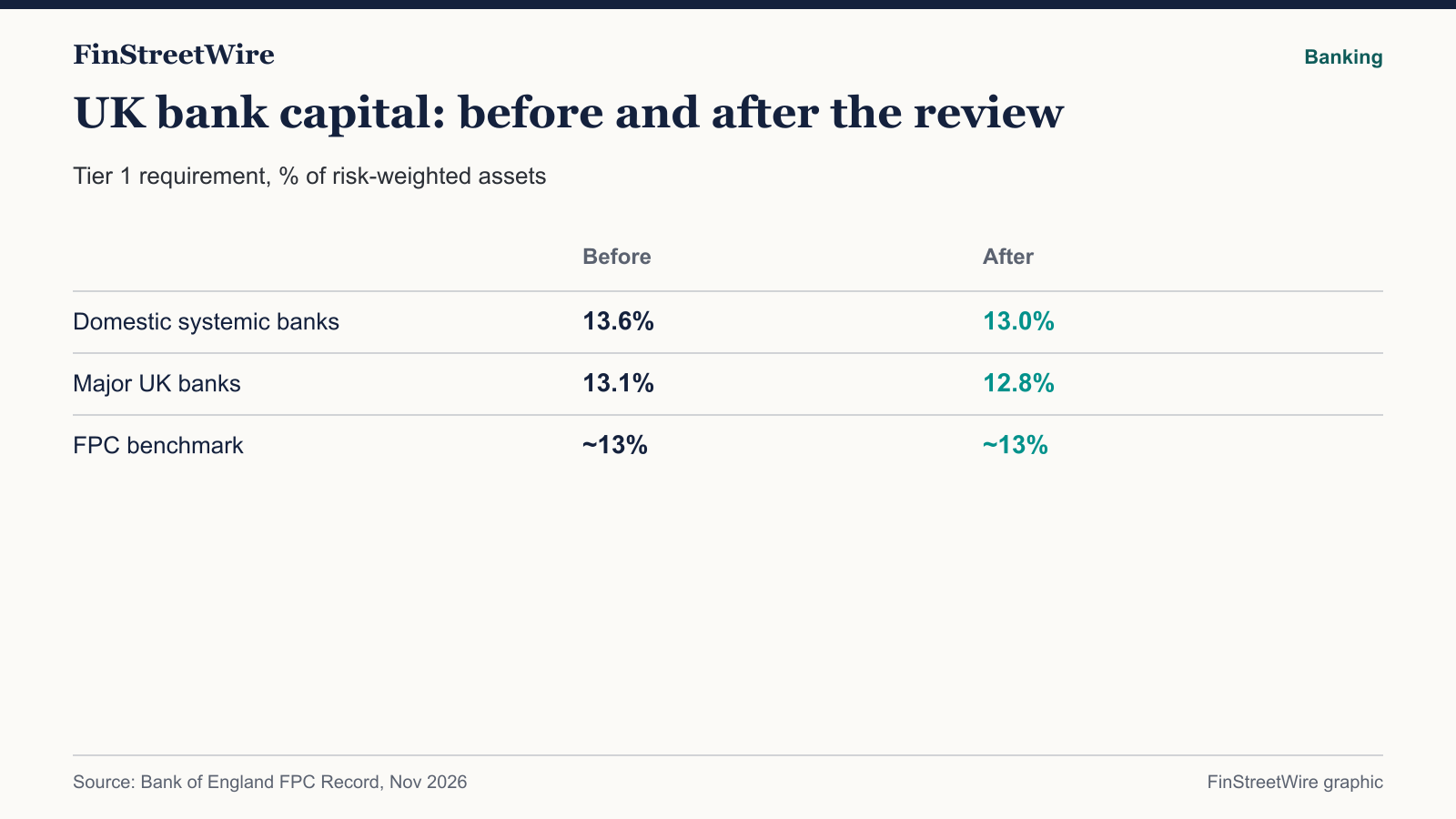
| Bank group | Before | After | Change |
|---|---|---|---|
| Domestically focused systemic banks | 13.6% | 13.0% | -60 bp |
| Major UK banks (aggregate) | 13.1% | 12.8% | -30 bp |
| Major UK banks incl. firm-specific and overseas buffers | n/a | 13.2% | n/a |
System-wide averages. bp = basis points (hundredths of a percentage point). Source: Bank of England, Financial Policy Committee Record, November 2026.
The biggest cut goes to the lenders most focused on the UK. For domestically focused systemically important banks, average Tier 1 requirements fall by 60 basis points, from 13.6% to 13.0%. For the major UK banks as a group the fall is 30 basis points, to 12.8%, or 13.2% once firm-specific buffers and overseas countercyclical buffers are included.[1]
Combined with changes to the leverage framework announced earlier in the review, the FPC says Tier 1 requirements for major UK banks fall by roughly half a percentage point of risk-weighted assets outside stress periods, with further reductions in what banks must hold through stress scenarios. The effect varies by bank and is larger for ring-fenced and domestically focused lenders.[1]
Why the Bank says this is safe
The FPC's reasoning is that its 2% neutral countercyclical capital buffer, a cushion banks build in normal times and can use in a downturn, already provides resilience, so overlapping domestic requirements can come down. It kept that buffer at 2%. The committee said requirements remain consistent with its benchmark of around 13%, which it describes as towards the lower end of the range likely to maximise sustainable growth.[1]
It also restated its aim of a single releasable buffer that banks could draw on without automatic restrictions on dividends, which would need changes beyond this review.[1]
The AI warning alongside it
The same record carries a sharper warning about AI. The FPC said AI-related financing has grown rapidly and now spans equity, public bonds, private credit and more complex structures, increasing links across the financial system and making it more likely that stress spreads. It noted hyperscaler bond issuance is set to exceed $305 billion in 2026, about 8% of global investment-grade issuance, and that some AI companies are financing others against future revenue commitments.[1]
The committee also flagged risks from autonomous AI agents and more capable open-weight models in firms' operations, and from reliance on a small number of cloud providers, citing recent Google Cloud and Microsoft outages.[1]
What we don't know
The record does not estimate how much extra lending the cut will produce or how much capital banks will instead return to shareholders; that depends on each bank's choices. The exact requirements for individual banks will only be clear after the PRA consultation, and the timing of implementation is described only as as soon as possible.[1]
Questions readers ask
- Are UK banks being allowed to hold less capital?
- Yes. Tier 1 requirements fall by 30 basis points for major banks in aggregate and 60 for domestically focused systemic banks, subject to a PRA consultation.[1]
- Did the Bank of England change the countercyclical buffer?
- No. It kept the UK countercyclical capital buffer at its neutral 2% setting.[1]
Sources
- Financial Policy Committee Record - November 2026. Bank of England, Paragraphs on the capital review (14-36), AI-related financing and operational risk. Accessed .